Vision

Untangling the DMA in seven questions and answers: a new phase in Big Tech regulation

On 6 September 2023, the European Commission (“Commission”) designated Alphabet, Amazon, Apple, Meta, Microsoft, and ByteDance (the parent company of TikTok) as gatekeepers under the Digital Markets Act (“DMA”). The DMA imposes additional obligations on online platforms that enjoy significant economic power and act as an important gateway for business users to reach end users (see also our earlier blog on the DMA). The substantive obligations of the DMA will enter into force in March 2024, subjecting the undertakings designated as ‘gatekeepers’ to a stricter regulatory regime.

In the meantime, Apple, Meta, and ByteDance have already appealed their designation decisions to the General Court of the European Union (“General Court”), and the Commission is conducting market investigations into possible additional designations. ByteDance has also filed an application for the suspension of its designation with the President of the General Court. In this blog, we discuss the scope and obligations of the DMA through seven questions and answers. We also cover recent developments regarding the designations, enforcement issues, and the role of third parties.

  1. What is the DMA?
  2. To whom does the DMA apply?
  3. Which undertakings have been designated as gatekeepers so far?
  4. What obligations does the DMA impose on gatekeepers?
  5. When does the obligation to inform the Commission about concentrations apply?
  6. How is the DMA enforced?
  7. Does the DMA facilitate private damages claims?

1. What is the DMA?

The DMA is an EU regulation that seeks to safeguard competition on digital markets by ensuring that digital markets remain ‘fair’ and ‘contestable’. The previous years, several online platforms have become so sizeable and powerful that new entrants face significant challenges when competing with these incumbents. Moreover, large online platforms typically possess such a vast and all-encompassing ecosystem that provides them with a significant advantage in reaching end users and enables them to effectively exclude other market participants. Furthermore, the vast amounts of data the gatekeepers generate further reinforce the competitive advantage gatekeepers typically enjoy over their competitors. As a result of the foregoing, innovation and quality in digital markets are diminished as existing competitors are unable to keep up, and new entrants are discouraged from entering the market.

The use of Articles 101 and/or 102 TFEU has not always proven to be effective in tackling these structural issues. Although both the Commission and national competition authorities (“NCAs”) have pursued several investigations in digital markets in recent years (for the Commission, think about the Amazon Buy Box and three investigations into Google), these investigations are often complex and time-consuming. The Commission’s investigations into Apple Pay and Apple’s App Store (music services), launched in 2020, are for example still ongoing. Ex post enforcement action based on Articles 101 and/or 102 TFEU may thus – in the view of the European legislator – in some cases come too late to repair the harm to the competitive playfield. The DMA seeks to close this enforcement gap by providing an ex ante regulatory framework for large online platforms (see also our earlier blog on this subject).


2. To whom does the DMA apply?

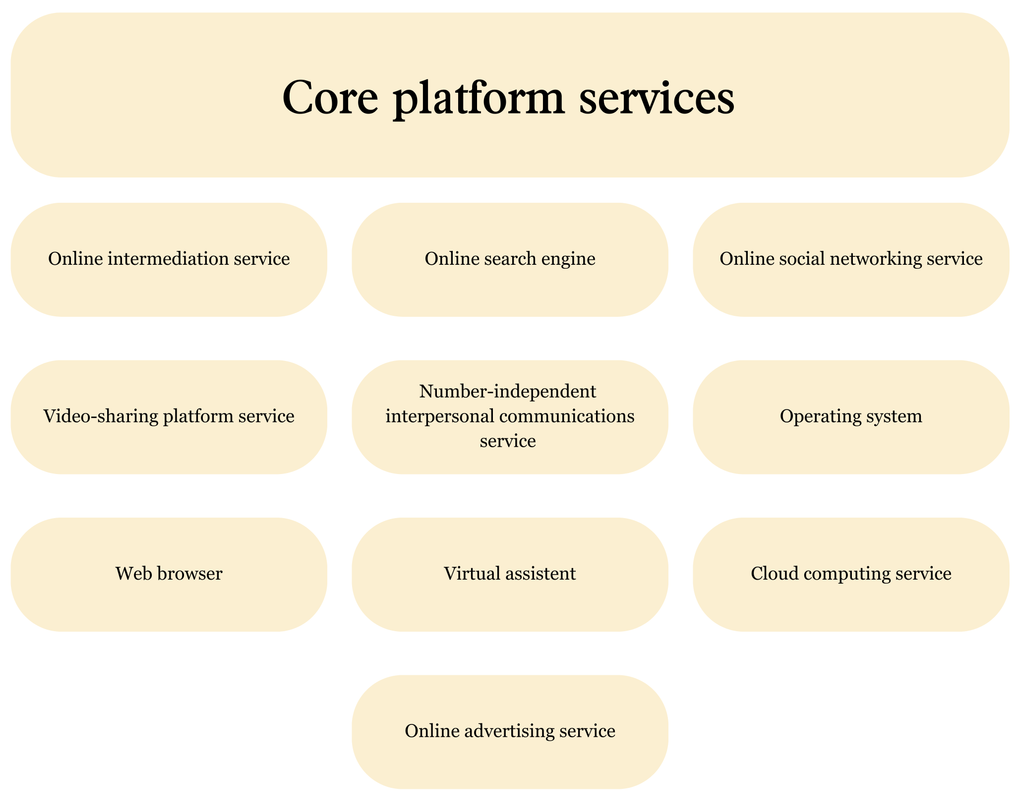
The DMA applies to gatekeepers. A gatekeeper provides one or more so-called core platform services (“CPSs”) The DMA distinguishes the following CPSs:

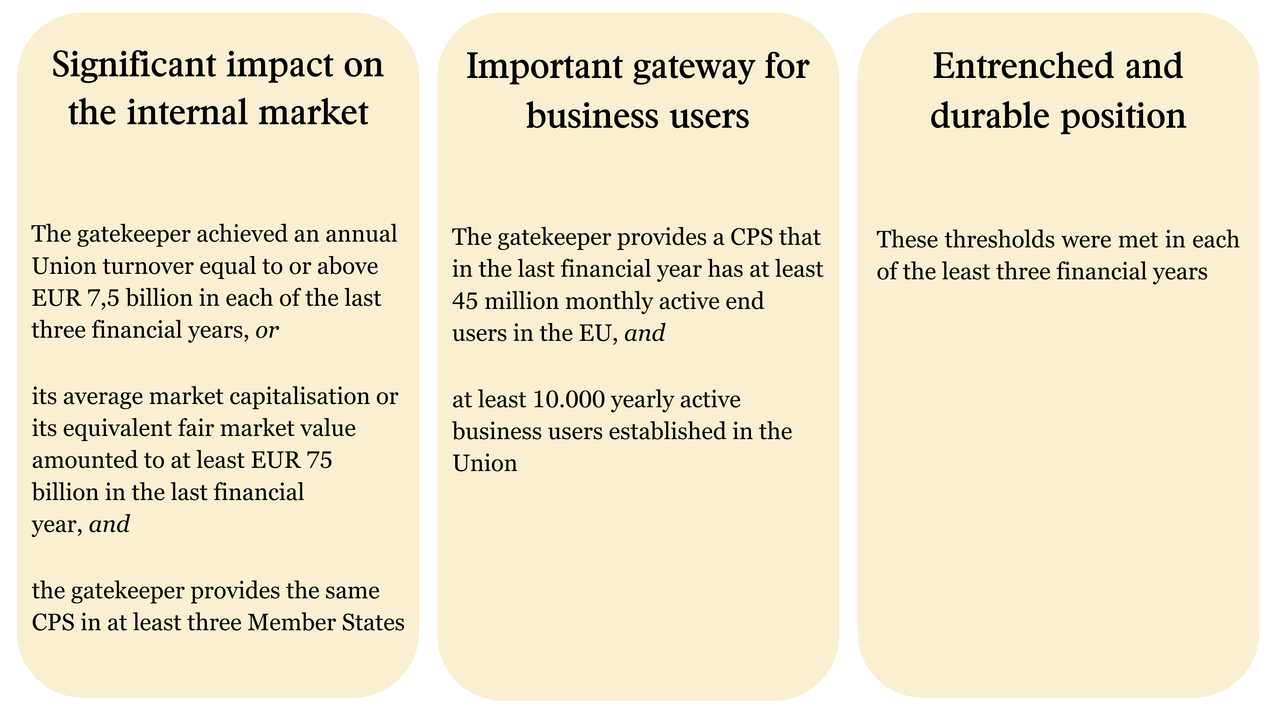
A CPS provider qualifies as a gatekeeper if a number of qualitative requirements are met. A gatekeeper is not necessarily dominant within the meaning of EU competition law. Instead, an undertaking is qualified as a gatekeeper if it (i) has a significant impact on the internal market, (ii) it provides a CPS which is an important gateway for business users to reach end users, and (iii) has or is expected to have an entrenched and durable position. An undertaking is subsequently presumed to satisfy the abovementioned requirements if it meets the following quantitative criteria:

If an undertaking meets the quantitative criteria, it is obliged to notify the Commission within two months after those thresholds are met. Upon notification, undertakings that qualify as gatekeepers can try to rebut this presumption. So far, Alphabet, Microsoft, and Samsung have successfully argued that they should not be designated as gatekeepers as regards their Gmail, Outlook, and Samsung Internet Browser, despite meeting the DMA’s quantitative thresholds. The Commission conceded to the objections and refrained from designating Alphabet, Microsoft and Samsung as gatekeepers with respect to these services.

Where the arguments challenging a designation fall short of outright refuting the designation, but do cast sufficient doubt, the Commission may conduct a market investigation. The Commission is currently conducting investigations in order to establish whether Microsoft Bing, Microsoft Edge, Microsoft Advertising, and Apple’s iMessage ought to be designated under the DMA. In the reverse, the Commission can also designate an undertaking as a gatekeeper on the basis of a market investigation if the undertaking does not meet the DMA’s quantitative thresholds.

A designation by the Commission is not temporally limited. The Commission can, upon request or on its own initiative, reconsider, amend, or repeal a designation if there has been a substantial change in any of the facts underlying the designation, or where it is found that the designation was founded on incomplete, incorrect, or misleading information. The Commission may later also designate new gatekeepers. There is for example already some talk about the potential designation of Booking.com in the near future. So far, Booking eluded the DMA’s quantitative thresholds – in large part due to the COVID-19 pandemic – but is already considered to be a prime candidate for a gatekeeper designation in the media.


3. Which undertakings have been designated as gatekeepers so far?

On 6 September 2023, the Commission designated six undertakings as gatekeepers in respect of twenty-two CPSs. The image below provides an overview.

Source: https://ec.europa.eu/commission/presscorner/detail/nl/qanda_20_2349

The Commission’s gatekeeper designations could be appealed until 16 November 2023. Microsoft, Amazon, and Alphabet (Google) expressed that they will not appeal their designations. Apple, ByteDance, and Meta did appeal their designation decisions. In its appeal, ByteDance essentially argues that TikTok does not enjoy an entrenched and durable position and that it does not meet both the DMA’s turnover and capitalisation thresholds (unlike all other gatekeepers so far designated). Meta specifically appealed the designation of ‘Facebook Marketplace’ and ‘Facebook Messenger’. Apple, in its turn, appealed all gatekeeper designations and also filed a complaint against the Commission’s decision to initiate a market investigation into whether Apple’s iMessage should be included in the designation decision. These appeals will probably be decided on next year.

Third parties may join the appeal proceedings before the General Court if they can establish an interest in the General Court’s decision. The ongoing proceedings will reveal whether competitors, customers or other third parties have a sufficient interest already in the stage of the gatekeeper’s designation, or whether this interest only arises in the event of a gatekeeper’s non-compliance with the DMA.


4. What obligations does the DMA impose on gatekeepers?

Articles 5, 6 and 7 of the DMA introduce a wide range of obligations for gatekeepers. Many of the obligations relate to the collection, processing, and combining of (personal) data. Without the express consent of the end user, a gatekeeper is for example prohibited to collect the personal data of end-users using services of third parties for advertising purposes. Additionally, a gatekeeper is prohibited from cross-using personal data generated by a CPS in other services provided separately by the gatekeeper and vice versa. The gatekeeper is furthermore precluded from (re)directing end-users that access a specific service of the gatekeeper into signing on to other services of the gatekeeper with the aim of combining the user’s personal data. Gatekeepers must furthermore provide end users with effective data portability.

The DMA also contains obligations to provide business users, advertisers and publishers insight into the data generated by and/or for them. The gatekeeper may not use the non-public data generated by business users in competition with these users, for example on a downstream market. With regard to advertisers and publishers, there is also an obligation to provide daily information on the ads placed upon their request, free of charge. For online search engines (i.e. for the time being only Google Search), there is an additional obligation to grant third-party search engines, upon their request, access to anonymised ranking, query, click and view data under fair, reasonable and non-discriminatory conditions (also: “FRAND”-conditions).

In addition to these rules on the processing and accessing of data, gatekeepers must abide by many different obligations that, at their core, concern the interaction between different services and the application of fair trading conditions. To this end, the DMA contains both certain do’s – for example, in the context of interoperability of certain hardware and communication services – and don’ts (think of the express prohibition of self-preferencing and the mandatory use of certain identification or (in-app) payment systems). Gatekeepers are also barred from engaging in tying and bundling practices, for example by making the use of one CPS contingent upon the registration or subscription to another. A gatekeeper should enable end users to easily install and uninstall software applications (including third-party app stores) and allow end-users to easily change the default settings. End users should not be (technically) prevented from switching to or additionally using other software applications or services, and should be able to terminate their service with the gatekeeper without undue difficulty.

Furthermore, the gatekeeper should not prevent business users from offering the same products or services to end users through their own direct sales channel and/or third-party services at prices or conditions that are different from those offered through the online intermediation services of the gatekeeper. More generally, the gatekeeper should not prevent business users and end users from going around the gatekeeper and contracting with other parties (e.g. also indirectly by denying access to certain content or features upon doing so). Specifically with regard to app stores, online search engines and online social networking services, the DMA includes the obligation to apply general FRAND access conditions for business users, which should also contain an alternative dispute settlement mechanism.

Finally, to encourage effective enforcement, the DMA explicitly prescribes that the gatekeeper may not restrict or prevent business users and end users from reporting breaches of the DMA or other EU law rules to a competent authority. A full overview of the obligations the DMA imposes can be found in Articles 5 – 7 of the DMA. The designated gatekeepers must bring their operations into compliance with the DMA by March 2024. Gatekeepers must also submit a compliance report to the Commission and establish an independent compliance function.


5. When does the obligation to inform the Commission about concentrations apply?

Another unique feature of the DMA that has so far received rather little attention is the obligation for gatekeepers to inform the Commission of any proposed concentration in the digital sector, regardless of whether the proposed concentration must be notified to the Commission under the EU Merger Regulation (“EUMR”) or to a national competition authority. This duty to inform reflects the increasing emphasis of the Commission on preventing so-called killer acquisitions. It complements the Commission’s use of Article 22 EUMR to examine mergers that do not meet EU and/or national merger thresholds (read more here), and the CJEU’s recent Towercast-judgment, where the CJEU ruled that certain non-notifiable mergers may qualify as an abuse of dominance under Article 102 TFEU.

As the DMA merely introduces a duty to inform the Commission, it does not provide the Commission with additional powers to investigate these concentrations, and hence, to potentially veto them. Upon ‘notification’, the gatekeeper is required to provide a description of the concentration and the activities of the undertakings involved, as well as the annual EU turnover, the value and rationale of the transaction, the number of annual active users and the number of monthly end users. This will allow the Commission to monitor whether new CPSs need to be designated. The DMA also explicitly states that this information could potentially be used for a subsequent Article 22-referral.


6. How is the DMA enforced?

The primary responsibility for enforcement of the DMA lies with the Commission. In addition to the market investigation mentioned above, the DMA provides the Commission with various investigative powers, such as the possibility to request information and conduct inspections (similar to those under Regulation 1/2003). In doing so, the Commission can also impose interim measures. In case of an infringement of the DMA, the Commission, after issuing its preliminary findings, can impose substantial fines and periodic penalty payments, as well as behavioural remedies. These fines can amount to 10% of an undertaking’s annual turnover and may be doubled to up to 20% for repeat offenders. In case of systemic non-compliance (more than three infringement decisions in eight years), the Commission may also impose structural measures (including, for example, a temporary ban on new acquisitions), following a market investigation.

NCAs only play a supporting role in the enforcement of the DMA by monitoring compliance. In the Netherlands, the Digital Markets Regulation Implementation Act (“Implementation Act”) designates the Dutch Competition Authority (Autoriteit Consument en Markt, “ACM”) as the competent national authority responsible for overseeing compliance with the DMA. The ACM possesses various supervisory powers and may initiate investigations into possible breaches of the DMA on its own initiative. Yet ultimately, the ACM reports back to the Commission, and only the Commission can initiate enforcement proceedings under the DMA.

The ACM’s supervisory powers end where the Commission’s investigation begins. It might nevertheless be difficult to establish clear boundaries as these supervisory and investigative powers could overlap. In its recent advice on the Implementation Act, the Dutch Council of State already indicated that the powers of the Commission, the ACM, and the Dutch Data Protection Authority’s (Autoriteit Persoonsgegevens, “AP”) potentially overlap with one another (for example regarding the enforcement of the Platform-to-Business Regulation and the Data Protection Regulation). Also, many obligations from the DMA bear close similarities to (or even: mirror) previous cases that were addressed under ‘regular’ competition law (think of the specific ban on self-preferencing in the DMA following the Google Shopping case). At the same time, the DMA prevents national authorities from taking decisions contrary to a decision adopted by the Commission on the basis of the DMA. In light of these ambiguities, the Dutch Council of State has advised the (Dutch) legislator to complement the explanatory memorandum of the Implementation Act on these points.

Public enforcement of the DMA may also be initiated on the basis of complaints and signals from third parties, including competitors, business users, and end users. Under Article 27 of the DMA, third parties may directly report possible breaches of the DMA to both the competent national authorities and the Commission. The DMA also encourages whistleblowers to report infringements by gatekeepers to the competent authorities. The Commission stresses that whistleblowers can play a crucial role in the enforcement of the DMA as they alert the competent authorities of potential infringements. To encourage employees to ‘blow the whistle’, the Commission has asserted that whistleblowers need to be protected from retaliation. Consequently, the EU Whistleblower Directive is also applicable to the DMA.


7. Does the DMA facilitate private damages claims?

As of now, still little is known about private enforcement of the DMA. On the basis of Article 288 TFEU, all EU Regulations, hence including the DMA, enjoy direct effect throughout the Member States. Individuals can invoke the rights enshrined in an regulation in civil proceedings where the rights granted to the individual are sufficiently clear, precise, and relevant to the individual’s situation. Given that most obligations in the DMA are formulated in a rather specific and precise fashion, it can be assumed that such is the case (also confirmed by the Commission), although Article 6 of the DMA contains obligations that may “be further specified”.

If a third party suffers damages as a result of a gatekeeper’s infringement of the DMA, it may initiate civil proceedings before a national court. Article 39 of the DMA provides for cooperation between the national competition authorities and the Commission in the national application of the DMA. A national court may request the Commission to provide information and issue guidance when applying the DMA in national proceedings. The Commission can also intervene on its own initiative if the coherent application of the DMA so requires. Additionally, Member States must forward to the Commission a copy of any written judgment of national courts deciding on the application of the DMA.

Throughout the legislative process, it has been stressed that the DMA is not a competition law instrument. Also considering the legal basis of the DMA, the procedural guarantees and (material) presumptions that Regulation 1/2003 and the Cartel Damages Directive provide, are inapplicable. The DMA therefore explicitly stipulates that national courts shall not give a decision which runs counter to a decision adopted by the Commission under the DMA. It can thus be inferred that the unlawful conduct (as one of the elements for establishing a tort action under the Dutch Civil Code) is irrefutably established before a national court after a DMA- infringement decision by the Commission (just as it is on the basis of Article 16 of Regulation 1/2003). This will facilitate a follow-on damages claim following a non-compliance decision based on the DMA.


Conclusion

After many years of negotiations, the practical entry into force of the DMA is nearly in sight. Six undertakings have so far been designated as gatekeepers and the first legal proceedings challenging these designations are already pending before the General Court. In the meantime, the Commission is conducting market investigations to determine whether other services provided by these gatekeepers should be designated under the DMA. Given the thin dividing line between the DMA on the one hand and European and national competition rules on the other, national authorities will need to consider how to most effectively shape cooperation among themselves and with the Commission. Third parties such as the gatekeepers’ competitors and customers may also want to prepare for the new rules that are set to apply to their competitors/business partners in March 2024. During the legislative process of the DMA, the legislator strengthened their role in the enforcement of the DMA by providing for an explicit complaint option as well as by implementing several additional rules on how the DMA is to be applied in national civil proceedings. Third parties are therefore expected to play a crucial role in overseeing the enforcement of the DMA.


More questions about the DMA? Please contact one of our competition law specialists.

Vision

New notification obligation under the Foreign Subsidies Regulation

This is the Competition Newsflash by bureau Brandeis (see the original version here).

Would you like to receive Competition Flashback by e-mail in the future? You can subscribe to our mailing list here.

New notification obligation onder de Foreign Subsidies Regulation

From 12 October 2023, companies are required to report large concentrations or participations in public procurement procedures involving funding from non-European public authorities (“third countries”) to the European Commission (Commission”). This notification obligation is set out in the Foreign Subsidies Regulation (FSR”), and applies if certain financial thresholds are met. The FSR has been in force since 12 July 2023, but the notification obligation only applies since 12 October 2023.

The FSR marks another significant step by the European Union in strengthening its merger control regime (detailed in our blog). In recent years, the Commission has introduced the Foreign Direct Investments Regulation (“FDI”, detailed in our blog), and has eased its policy regarding the referral of non-notifiable mergers by national authorities under Article 22 of the European Merger Regulation (detailed in our blog). In addition, the European Court of Justice’s recent judgement in Towercast clarified that a non-notifiable concentration can constitute an abuse of a dominant position. All of the above shows that competition authorities have rapidly acquired an expanding toolkit to evaluate the effects of concentrations on the competitive landscape.

By answering ten questions, we offer a concise overview of the primary changes introduced by the new rules of the FSR.

Ten questions and answers 

  1. What is the purpose of the FSR?
  2. When are companies obliged to notify under the FSR?
  3. What financial contributions qualify as foreign (non-European) subsidies?
  4. Can the Commission also launch ex officio investigations?
  5. What is the assessment procedure of the Commission, and what are its powers?
  6. Does the FSR include a standstill obligation?
  7. What is the Commission’s time limit when investigating?
  8. What happens if a company does not fulfil its notifying obligation?
  9. Does the FSR apply to concentrations or public procurement procedures that took place before 12 October 2023?
  10. What can companies do to make the M&A or public procurement process as smooth as possible?

1. What is the purpose of the FSR?

According to the European Commission, subsidies from non-European public authorities (“foreign subsidies“), such as interest-free loans or tax breaks, have regularly distorted competition in the European market in recent years. Such foreign subsidies were able to be provided unlimitedly to companies in the European Union, while subsidies from European governments (“European subsidies“) are subject to the stringent rules on state aid (see our blog).

Recent examples have occurred in the soccer industry. In August 2023, Spain’s La Liga has filed a complaint with the Commission, alleging that Paris Saint-Germain (“PSG”) has been benefiting from foreign subsidies provided by the Qatar government. These subsidies allegedly enabled PSG to “sign top players and coaches well above its potential in a normal market situation.”

In the past foreign subsidies have created an uneven playing field between those who receive foreign subsidies, and those who do not (as outlined in the Commission’s White Paper). The FSR aims to address this imbalance by regulating the beneficiaries of foreign subsidies, thereby fostering a level playing field for all companies operating in the European Union.

back to top


2. When are companies obliged to notify under the FSR?

The FSR contains a notification obligation for certain concentrations or participations in public procurement procedures.

Notification threshold for concentrations

Companies acquiring, merging or setting up a joint venture with another company must notify the Commission if they meet the following two conditions:

  1. at least one of the merging undertakings (in the case of mergers), the acquired undertaking (in the case of acquisitions), or the joint venture is established in the European Union and generates an aggregated turnover in the Union of at least € 500 million; and
  2. the relevant undertakings were granted combined aggregated financial contributions of more that € 50 million from third countries in the three years preceding the conclusion of the agreement, the announcement of the public bid, or the acquisition of a controlling interest. For mergers, relevant undertakings include the merging parties; for acquisitions, both the buyer(s) and the target; and for joint ventures, the joint venture partners and the joint venture itself.

The notification obligation must be satisfied prior to the completion of a concentration.

Notification threshold for public procurement procedures

Companies participating in public procurement procedures are required to notify the Commission of foreign financial contributions if the following thresholds are met:

  1. the estimated value of the public procurement is at least € 250 million; and
  2. the bidder, including its subsidiaries, holding companies, and main subcontractors and suppliers involved in the bid, was granted aggregate financial contributions of at least € 4 million per third country. These contribution(s) have been granted in the three years prior to participation.

In public procurement procedures, companies subject to the notification obligation must submit the notification to the contracting authority together with its bid. The contracting authority will then transfer the notification to the Commission without delay.

back to top


3. What financial contributions qualify as foreign (non-European) subsidies?

Under the FSR, a foreign subsidy is a financial contribution that is provided directly or indirectly by a third country, conferring an indirect or direct benefit to the receiving company which is limited in law or in fact to one or more companies or industries.

A foreign financial contribution is a broad concept, including capital injections, interest-free loans, unlimited guarantees, preferential tax treatment, grants or tax credits. Furthermore, if an undertaking sells its products or services to a third country, the sales income is considered to be a foreign financial contribution. These foreign financial contributions do not necessarily qualify as foreign subsidies under the FSR, but do count for the FSR’s notification threshold.

The concept of a “third country” includes the central government of a country, but also other non-European government entities whose actions can be attributed to the central government. These may include, for example, municipalities, or private entities acting on behalf of the government.

back to top


4. Can the Commission also launch ex officio investigations?

The Commission may on its own initiative examine information from any source, including Member States, a natural or legal person or association, regarding alleged foreign subsidies distorting the internal market. The Commission can still do so after a concentration is implemented. In regard to public procurement procedures, the Commission can only launch ex officio investigations if the public contract has already been awarded. These powers of the Commission are limited to ten years after the foreign subsidy has been awarded.

After an ex officio investigation, the Commission can prohibit a proposed concentration or require the undertakings to dissolve the completed concentration. The latter can be realised through the restoration of the situation prevailing prior to the concentration, or if not possible, by adopting measures appropriate to achieve such restoration as far as possible. In the context of ex officio investigations into public procurement procedures, the Commission cannot revoke the decision awarding a contract, nor can it terminate a contract. Timewise, the Commission must aim to adopt a decision within 18 months from the opening of the in-depth investigation. No standstill obligation applies during an ex officio investigation.

back to top


5. What is the assessment procedure of the Commission, and what are its powers?

Commission’s investigations involve a preliminary review and, if there is sufficient evidence of a distortive foreign subsidy, an in-depth investigation. In its investigations, the Commission will assess whether a financial contribution qualifies as a foreign subsidy within the meaning of the FSR and whether it (will) distort(s) the Single Market. To determine whether a distortion exists, the Commission can take various elements into account, such as the size of the foreign subsidy or the goal of the foreign subsidy. For example, if a foreign subsidy covers a substantial part of the purchase price in case of concentrations, it is considered to likely cause a distortion. A foreign subsidy granted for operating costs is more likely to cause a distortion than a subsidy that is granted for investment costs. The characteristics of the market, and in particular the competitive conditions on the market should be taken into account when investigating potential distortions.

If the Commission finds that a foreign subsidy (will) distort(s) the Single Market, it will balance the negative effects of the (potential) distortion against the positive effects of the foreign subsidy on the development of the relevant subsidised economic activity. Member States, as well as any natural or legal person can submit information on the positive effects, on which the Commission must base its considerations. Positive effects relate to the development of the subsidised economic activity and (the Union’s) relevant policy objectives, such as sustainability and R&D. The negative effects are the effects of the established (potential) distortion.

If the negative effects outweigh the positive effects, the Commission can accept commitments from the companies concerned to remedy the (potential) distortion. If no (adequate) commitments are offered, the Commission may impose redressive measures itself. Commitments as well as redressive measures must fully and effectively address the (potential) distortion and be proportionate. They can be structural, such as divestiture of certain assets, or behavioural, such as reduction of market capacity, sharing of critical infrastructure or business information, or licensing.

The most far-reaching power of the Commission is to prohibit the concentration or award of a public contract before it takes place. If a concentration has already been implemented and remedial measures cannot remedy the disruption, the Commission can order to dissolve the concentration. During the investigations, the Commission has the power to impose interim measures if that is necessary to prevent irreparable harm to the internal market.

back to top


6. Does the FSR include a standstill obligation?

Yes, the FSR contains a standstill obligation during the Commission’s investigations, if not initiated ex officio. A concentration cannot be completed until it has been authorised by the Commission. A public contract cannot be awarded to the notifying company until the Commission has approved its participation.

back to top


7. What is the Commission’s time limit when investigating?

In regard to concentrations, the Commission has 25 working days after the notification to decide whether to open an in-depth investigation. This in-depth investigation can take up to 90 working days. This period can be extended by 15 working days. M&A processes could thus be delayed by 130 working days.

In regard to public procurement procedures, the Commission has 20 working days after the notification to decide whether to launch an in-depth investigation. This period can be extended by 10 working days. The in-depth investigation can take 110 working days, and can be extended by 20 working days. Public procurement procedures could thus be delayed by 160 working days.

back to top


8. What happens if a company does not fulfill its notifying obligation?

If the notifying obligation is not fulfilled, the Commission may impose a fine of 10% of the total turnover or 5% of the average daily turnover. If incorrect information is provided, the Commission may impose a fine of 1% of the total turnover or 5% of the average daily turnover. In imposing fines, the Commission shall take due account of the principles of proportionality and appropriateness.

back to top


9. Does the FSR apply to concentrations or public procurement procedures that took place before 12 Octrober 2023?

The notification obligation also applies to concentrations that were concluded on or after 12 July 2023, but had not yet been implemented before 12 October 2023. For participations in public procurement procedures, the notification obligation only applies from 12 October 2023.

back to top


10. What can companies do to make the M&A process or public procurement procedure as smooth as possible?

Companies that regularly receive financial contributions from non-European governments should be aware of potential delays in M&A processes or public procurement procedures due to the Commission’s extensive decision deadlines and the substantial efforts required for fulfilling a notification obligation.

To minimise delays, thorough preparation is essential. The gathering of the information required for FSR notifications is not part of standard business operations. It is therefore advisable for companies to organise their records related to foreign financial contributions in order. This proactive approach facilitates the quick gathering of the required information for notifications.

When a concentration needs to be notified to the Commission under regular merger control, it is prudent to do this concurrently with the FSR notification. The FSR decision deadlines are roughly the same as those applicable in merger control, enabling them to run in parallel. This approach helps minimise potential delays in the M&A process.

Last, companies are able to consult with the Commission prior to the submission of an actual notification. Such pre-notifications serve as informal preparation for FSR notifications and speed up the notification process. Currently, the Commission has already conducted 17 pre-notification meetings with companies concerning an FSR notification related to concentrations.

back to top


Vision

Competition Flashback Q3 2023: EU and Dutch competition law developments

This is the Competition Flashback Q3 2023 by bureau Brandeis, featuring a selection of the key EU and Dutch competition law developments of the past quarter (see the original version here).

Would you like to receive Competition Flashback by e-mail in the future? You can subscribe to our mailing list here.


Overview Q3 2023


Merger control

Cartels and vertical restraints

Abuse of a dominant position

Damage claims for competition law infringements

Regulated markets and consumer law 


Commission fines seller (Grail) for the first time for gun-jumping, buyer (Illumina) receives record fine of € 432 million

European Commission, press release of 12 July 2023

On 12 July 2023, the European Commission (“Commission”) imposed a record fine of € 432 million on biotech company Illumina for prematurely implementing the acquisition of Grail.

The Commission launched an in-depth investigation into this transaction in 2021 based on a referral from several European Member States under Article 22 of the EU Merger Regulation (“EUMR”) (see our blog on Article 22 here). The General Court of the European Union (“General Court”) had already confirmed, in its judgment of 13 July 2022, that the Commission was entitled to exercise this power under Article 22 EUMR. Subsequently, the Commission decided to prohibit the transaction in its entirety (for more on this, see Competition Flashback (“CF”) Q3 2022).

In parallel with the substantive assessment of the transaction, the Commission opened an investigation into a possible violation of the standstill obligation by Illumina in 2021 and already imposed interim measures at that time. During the Commission’s investigation, Illumina publicly announced that it had completed its acquisition of Grail. In its decision of 12 July 2023, the Commission confirmed its preliminary view that Illumina and Grail knowingly breached the standstill obligation.

According to the Commission, there was a deliberate strategy on Illumina’s part, as it strategically weighed the risk of a gun-jumping fine against the risk of paying a considerable breakup fee if it did not acquire Grail. The Commission considered this to be an unprecedented and very serious infringement that undermines the effective functioning of the European merger control system. Therefore, a high and deterrent fine is justified. Additionally, the Commission decided to impose a symbolic fine of € 1,000 on target Grail for its active role in the infringement. This marks the first time that a target in a transaction has been fined by the Commission for violating the standstill obligation (read more here).


Back to top


Rotterdam court confirms ACM’s ban on PostNL takeover of Sandd

Rotterdam District Court, judgment of 29 September 2023

On 29 September 2023, the Rotterdam District Court ruled that the Dutch Authority for Consumers and Markets (Autoriteit Consument en Markt, “ACM”) rightly decided not to grant postal operator PostNL a licence to acquire rival postal operator Sandd in 2019. At the time, the ACM refused to grant a licence because PostNL’s takeover of Sandd would strengthen PostNL’s dominant position. The ACM also expected a price increase for business mail of 30% to 40% after the transaction. The ACM’s market investigation also showed that, although the volume of physical mail will decrease, there will still be a substantial demand for physical mail in the long term.

PostNL requested the Minister of Economic Affairs and Climate Policy (“Minister”) to still grant a licence under Section 47(1) and (2) of the Dutch Competition Act and also appealed the ACM’s decision. The hearing of that appeal was suspended until the licence application was irrevocably decided by the Minister. On 27 September 2019, the Minister granted a licence, which was subsequently reversed by the court of first instance and on appeal (see also CF Q2 2022). With that, PostNL’s appeal against the ACM’s decision revived, which has now been decided by the court.

The court declared PostNL’s appeal unfounded. The court ruled that the ACM had correctly defined two national markets for consumer mail and business mail. Contrary to PostNL’s argument, the ACM was indeed allowed to use data from its quantitative and qualitative research as well as internal PostNL documents, as PostNL also used these itself in its strategic documents and forecasts. In addition, the court held that the ACM correctly assumed the counterfactual that PostNL would remain profitable in the short and long term, whilst Sandd would continue to exert competitive pressure if the acquisition did not take place.

The possible horizontal effects of the merger on the markets for business mail and consumer mail – such as the elimination of the only competitor with a national network and an increase in the price for bulk mail – have also been made sufficiently plausible by the ACM. The same applies to the vertical effects for business mail, namely the ability and incentive for PostNL to foreclose competitors from its delivery network. According to the court, the efficiency defence raised by PostNL was also thoroughly examined and rightly rejected by the ACM. Finally, the court agreed that PostNL had not convincingly demonstrated that it could not perform the universal postal service (profitably) absent the merger. The court thus fully upheld the ACM’s decision not to grant a licence.

Back to top


CJEU nuances SIEC-test in appeal CK Telecoms/Hutchison and refers back to General Court

Court of Justice, judgment of 13 July 2023

This summer, the Court of Justice of the European Union (“CJEU”) overturned the General Court’s controversial judgment in CK Telecoms v Hutchison, which set a high standard of proof and strict requirements for prohibiting mergers in oligopolistic markets. In 2020, the General Court annulled the Commission’s decision to prohibit the merger between the two mobile network operators in the United Kingdom. In 2016, the Commission found that the 4-to-3 merger would lead to a significant impediment to effective competition (“SIEC”) in three different markets. Upon appeal, the General Court held that the Commission had not applied the SIEC-test correctly and that its analysis could not support the conclusions in the prohibition decision.

The CJEU overturns the General Court’s judgment. It ruled that the same standard of proof applies to both the prohibition and the approval of a merger. Given the inherent uncertainty of prospective analyses, it is sufficient for the Commission to demonstrate that it is more likely than not that a merger will lead to a restriction of competition. The SIEC-test has no specific, cumulative requirements. With regard to the concepts of ‘important competitive force’ and ‘close competitors’ as included in the Horizontal Merger Guidelines, the CJEU agrees with the Commission that the General Court applied too strict a standard. The General Court ruled that (one of) the merging parties must hold a special position, for example by a particularly aggressive pricing policy, and that the parties should be ‘particularly close competitors’. However, within an oligopolistic market, several companies can actually exert significant competitive pressure, and not only with regard to prices, the CJEU states. Furthermore, the General Court disregarded the function of efficiency benefits in merger control when it ruled that the Commission should automatically take them into account in its assessment. The CJEU emphasises that concentrations do not automatically lead to efficiency benefits and it is up to the merging parties to substantiate these. Assuming that efficiency benefits (can) occur would wrongly lead to a reversal of the burden of proof.

Lastly, the CJEU finds that the General Court failed to fully weigh all the Commission’s evidence before annulling the prohibition decision. Due to the gross disregard of the law and the failure to discuss various grounds at first instance, the CJEU refers the case back to the General Court.


Back to top


CJEU clarifies scope of FDI Screening Regulation and possible restrictions of freedom of establishment

Court of Justice, judgment of 13 July 2023

In response to a preliminary reference from a Hungarian court, the CJEU clarifies that Regulation 2019/452 (“FDI Screening Regulation”) applies only to direct investments by foreign companies, and determines that a prohibition decision based on a broad screening mechanism may violate the freedom of establishment. In 2020, the Hungarian Minister of Innovation and Technology prohibited the acquisition of the raw materials extraction company Janes es Tarsa (“JeT”) by construction materials company Xella Magyarország (“Xella”). Since Xella is indirectly owned by a top holding company registered in Bermuda, the acquisition was seen as a risk to the security of supply of these strategic raw materials, as stated by the minister. Xella challenged this prohibition decision before the national court, which had to assess whether there this infringes the FDI Screening Regulation and/or the provisions on free movement.

First, the CJEU determines that the FDI Screening Regulation does not apply in this case, as it only covers foreign direct investments and Xella is a Hungarian undertaking. Although the regulation provides that the ownership structures of the acquiring party can be taken into account, the CJEU clarifies that this pertains to whether the investor is (in)directly controlled by the government of a third country.

Since Xella, as a Hungarian undertaking, is prohibited from acquiring a shareholding in another EU company, the CJEU concludes that there is a restriction on the free movement of establishment. Such a restriction is only permissible if justified. According to the CJEU, the protection of public order and/or public security can serve as justification only in the case of a genuine and sufficiently serious threat to a fundamental interest of society. The CJEU has previously found justifications in cases involving companies providing public services in the petroleum, telecommunications, and energy sectors. In the case at hand, the CJEU finds that the objective of ensuring the security and continuity of supply to the construction sector does not constitute a public security reason. Moreover, the CJEU does not consider the risks outlined by the minister to be plausible, as Xella already purchases 90% of JeT, and the market value of these raw materials is relatively low compared to the transport costs, so that it is unlikely they would be withdrawn from the Hungarian market.


Back to top


Overview highlights merger cases

By its decision of 25 September 2023, the Commission prohibited Booking Holdings’ (“Booking”) acquisition of online travel agent (“OTA”) Flugo Group Holdings AB (“eTraveli”). The Commission finds that this acquisition of the ‘best-in-class’ flight OTA enables Booking to strengthen its dominant economic position on the hotel OTA market and further expand its ecosystem of travel services. It considers that, as the first step in planning a trip, a flight OTA acts as an important customer acquisition channel and generates significant traffic for Booking’s website(s). Additionally, Booking is already active in the market for metasearch services, primarily through its price comparison platform KAYAK. The Commission considers that the acquisition would thus enhance network effects and raise barriers to entry and expansion in the hotel OTA market, potentially resulting in higher prices for hotels and consumers.

During the second-phase investigation, Booking proposed to display a ‘carousel’ of offers from various competing hotel OTAs (“Carousel”) on the confirmation page after booking a flight. Given that the Carousel would only be displayed on the flight confirmation page (and therefore does not exclude other cross-sell opportunities), and would be driven by Booking’s own, non-transparent KAYAK algorithm, the Commission found that the Carousel did not fully address its concerns and subsequently decided to prohibit the acquisition altogether. Booking has already announced that it will appeal the prohibition decision.

* Bas Braeken, Demi van den Berg and Jade Versteeg represented an OTA in formulating its objections to this transaction.


Following an extensive Phase II-investigation (see also CF Q4 2022), Broadcom was given green light to acquire VMware, yet subject to conditions. Broadcom is mainly active in hardware (such as Fibre Channel Host-Bus Adapters (“FC HBAs”), Network Interface Cards and storage adapters). VMware is a provider of virtualisation software that can be used with a wide range of hardware, including Broadcom’s hardware.

In the second-phase investigation, the Commission found that the transaction would restrict competition in the global market for the supply of FC HBAs. To address the Commission’s concerns, Broadcom committed that competitor Marvell Technology and other potential future competitors would have access to the source code of FC HBAs for ten years. In doing so, Broadcom committed that the FC HBAs it now offers will remain interoperable with VMware virtualisation software. In view of the Commission, this sufficiently addresses its competition concerns.


Amazon/iRobot

On 6 July 2023, the Commission announced the launch of a second-phase investigation into Amazon’s acquisition of robot vacuum cleaner manufacturer iRobot. The Commission has expressed concerns that this acquisition would allow Amazon to restrict competition within the robot vacuum cleaner market and to strengthen its position as provider of an online marketplace.
During the initial investigation, the Commission found that Amazon is an important sales channel for robot vacuum cleaners in several Member States. With the acquisition of iRobot, Amazon would gain access to iRobot’s users’ data, thereby obtaining a significant competitive advantage over other providers of robot vacuum cleaners that also sell their products on Amazon’s platform. According to the Commission, this could give Amazon both the ability and incentive to exclude iRobot’s competitors in various ways. In the second-phase investigation, the Commission will further investigate the effects of the proposed transaction.


Qualcomm/Autotalks

The Commission recently announced its investigation in Qualcomm’s proposed acquisition of Autotalks. This investigation was initiated following a referral from 15 national competition authorities, including the ACM, pursuant to Article 22 of the EUMR. Qualcomm is a global manufacturer known for producing chips used in various applications, including driver assistance systems. Two different technical standards apply to these specific chips. Israel’s (innovative) Autotalks is currently the only company in the world producing chips that comply with both standards. The Commission emphasises the critical role played by both parties’ chips for the development of driver assistance systems. These systems have far-reaching implications, including the reduction of CO2-emissions and the advancement of autonomous vehicles. It is important that the chips of both Qualcomm and Autotalks remain available at competitive prices and terms to support continued innovation in this sector, according to the Commission.


EEX/Nasdaq

Following yet another Article 22 referral, this time from Denmark, Finland, Sweden and Norway, the Commission has announced its investigation into the acquisition of Nasdaq Power by European Energy Exchange’s (“EEX”). Both companies are active in the Norwegian energy market. The Commission notes that EEX and Nasdaq Power are key to creating stable and predictable energy prices, and that the acquisition appears to combine the only two providers that can realise the conclusion of long-term energy contracts with fixed prices. Given the ongoing energy crisis, the Commission underscores the importance of ensuring the efficient operation of energy markets. EEX/Nasdaq marks the third transaction in which the Commission has accepted an Article 22 referral, in line with its Article 22 guidelines.

Back to top


Rotterdam court upholds € 82 million cartel fine for cigarette manufacturers

Rotterdam District Court, ruling of 18 July 2023

On 18 July 2023, the Rotterdam District Court declared the appeals of Philip Morris, JT International, British American Tobacco and Van Nelle Tabak against the tobacco cartel decision of the ACM, unfounded. In 2020, the ACM imposed fines on the four cigarette manufacturers for exchanging information on future prices of cigarette packs through wholesalers. By asking wholesalers for future price information from competing manufacturers and/or not objecting to receiving this information, the ACM found there was a concerted practice aimed at restricting competition in the Dutch cigarette market.

In their appeals, the manufacturers challenge, inter alia, the existence of a concerted practice, a single and continuous infringement, and a restriction of competition by object. According to the manufacturers, the excise tax system makes the market highly regulated and transparent, and there was a legitimate reason to provide the future price lists to wholesalers. The court rejects all of these arguments and endorses the ACM’s view that this does not prevent the qualification of a restriction of competition by object and the seriousness of the violation. According to the ACM and the court, the core of the infringement consists of maintaining a practice of indirect information exchange, thereby removing uncertainty in the market.

The manufacturers also objected against the amount of the fine imposed by the ACM and the way the ACM conducted its investigation. The court does not follow these arguments either. However, the manufacturers’ argument that the ACM wrongly applied the 2009 Fining Guidelines when the 2007 Penalty Code was in force for part of the infringement period does succeed. Since the application of the old policy rules would nevertheless not have led to a more favourable result for the manufacturers, the court still declared the manufacturers’ appeal unfounded in its entirety.


Back to top


Television manufacturer LG receives a fine of nearly € 8 million for resale price maintenance

ACM, decision of 11 July 2023

After Samsung, the ACM has now also decided to impose a fine of nearly € 8 million on television manufacturer LG  for influencing resale prices of seven large retailers of LG televisions. LG provided retailers with a recommended price and monitored whether retailers adhered to the recommendation. It did this partly by monitoring retailers’ price comparison websites and web shops. LG was also tipped off by competing retailers. When a retailer maintained a lower price than the recommended price, LG contacted the relevant retailer via email or Whatsapp and urged him to adjust the different price to LG’s desired level. According to the ACM, LG hereby coordinated the consumer price level for LG televisions in the Netherlands and tried to prevent price drops.

According to LG, the price recommendations were in fact, only recommendations. LG also argued that it did not exercise coercion and did not offer incentives to actually adjust the price to the recommended price. The ACM nevertheless held that exercising coercion and giving incentives are not imperative in order to induce retailers to adhere to the ‘recommended price’, as they trusted other retailers to do the same. This secured their margins.

When calculating the fine, the ACM took into account as an aggravatig circumstance that LG systematically and frequently intervened in the pricing of televisions over a long period of time; almost three years. As a mitigating circumstance, the ACM does consider the lack of coercion and/or incentives and that it has not previously imposed a fine for resale price maintenance during the infringement period. While Samsung was fined for a similar infringement in 2021, LG’s infringement period had already ended by then. Finally, the ACM sees reason to further mitigate the fine due to the particularly long period (almost two years) between the investigation report and the fining decision. This eventually resulted in a fine of € 7.9 million.

Back to top


Court confirms multi-million fine for Valve over geo-blocking

General Court, judgment of 27 September 2023

The General Court recently confirmed the fine imposed by the Commission in 2021 on Valve – the company behind the video game platform Steam – for engaging in geo-blocking practices with five game publishers: Bandai Namco, Capcom, Focus Home, Koch Media (now Plaion) and ZeniMax. The fines in total amount to almost € 8 million. The game publishers decided not to challenge their fines.

According to the Commission’s decision, these game developers restricted cross-border sales of PC video games by placing territorial restrictions on certain PC games. By doing so, they tried to prevent PC games from being bought in countries where prices were lower, notably the Baltic States and some countries in central and eastern Europe, while subsequently being played elsewhere.

According to the General Court, the Commission correctly concluded that there was an agreement or concerted practice having the object of restricting trade between Member States. The geo-blocking therefore did not pursue an objective of protecting the copyright of the game publishers, as Valve argued. The General Court stressed that although copyright intends to ensure that the holders thereof can commercially exploit their protected material – for example, by licensing it – it does not guarantee them the opportunity to claim the highest possible remuneration or to artificially create price differences by partitioning national markets. That is irreconcilable with the internal market. The General Court dismisses the action brought by Valve.

Back to top


ACM fines traffic sign cartel

ACM, decision of 12 July 2023

On 20 July 2023, the ACM fined traffic sign manufacturers Brimos and Agmi for fixing prices in four different tenders for the production of traffic signs. The National Guide Signing Service (an alliance of the different government bodies in the Netherlands, in Dutch: Nationale Bewegwijzeringsdienst) regularly calls for tenders from a number of companies to produce traffic signs. In 2020, Brimos and Agmi agreed on the prices they would charge in their tenders prior to submitting them. They also discussed who should win which tender.

Brimos reported the agreements to the ACM through a leniency application and was therefore granted a complete exemption from a fine of € 135,000. Following dawn raids by the ACM, Agmi also submitted a leniency application and cooperated in a simplified settlement procedure. Agmi was therefore granted a 60% reduction of the fine and ended up paying € 56,000.

Back to top


Commission imposes € 1.2 million fine on Diehl for participating in hand grenade cartel

European Commission, decision of 21 September 2023 (press release available)

The Commission has imposed a € 1.2 million fine on defence company Diehl for participating in a cartel in military hand grenades. Diehl and competitor RUAG entered into market-sharing agreements for 14 years, and sought mutual consent to conduct business within each other’s territories. This fine is the first in the defence sector, serving as a clear signal that cartelisation will not go unpunished, even within strategic sectors amidst shifting geopolitical dynamics. Notably, the Commission has deviated from the standard method of calculation in its Guidelines, and has imposed a higher fine to create a stronger deterrent effect.

The investigation into this cartel began after RUAG applied for leniency with the Commission in mid-April 2021. After the Commission conducted a dawn raid on Diehl on November 13, 2021, Diehl also applied for leniency. As RUAG was the first to file a leniency application, it escaped a fine of approximately € 2.5 million. Diehl received a 50% reduction. This is a significant reduction, but justified by the timing of Diehl’s cooperation and the extent to which it provided essential evidence, according to the Commission. Moreover, the Commission reduced the fine by 10% due to the acknowledgement of involvement and liability by both cartel participants in this regard. This is in line with its Notice on Settlement Proceedings in Cartel Cases.


Back to top


Jan Linders becomes franchisee of Albert Heijn subject to commitments

ACM, decision of 31 August 2023

In its decision of 31 August 2023, the ACM declared the commitments of Albert Heijn and Jan Linders, relating to a proposed cooperation, binding. The two supermarket chains entered into a cooperation agreement on 13 December 2022 as a result of which Jan Linders will operate its stores as a franchisee of Albert Heijn. Additionally, Jan Linders will sell its distribution centre to Albert Heijn. Furthermore, as part of the franchise agreement, Albert Heijn is selling ten shops to Jan Linders to be operated as Albert Heijn franchises; this acquisition has already been approved by the ACM.

During the informal investigation into the cooperation agreement, the ACM raised potential competition risks in several local markets within the catchment areas surrounding five Jan Linders supermarkets. For the purpose of a quick resolution and to avoid further investigation, Jan Linders agreed to sell the five supermarkets in question to competitors. Moreover, Jan Linders and Albert Heijn will not operate these divested supermarkets for a period of ten years. One of these shops will continue as a Spar franchise, the sale of the remaining four shops to Jumbo has already been approved by the ACM.

Back to top


ACM reduces fine Leadiant for excessive pricing of CTX-drug by over € 2.5 million

ACM, decision of 22 June 2023 (summary)

In its decision on objection of 22 June 2023, the ACM reduced the fine imposed on pharmaceutical company Leadiant by over € 2.5 million. In 2021, the ACM fined Leadiant over € 19.5 million for charging excessive prices for its drug ‘CDCA-Leadiant,’ which is a life-saving drug for patients suffering from the rare metabolic disease cerebrotendinous xanthomatosis (“CTX”). Where the first CDCA-based drug (Chenofalk) was sold by Leadiant for € 46 per package in 2008, the price for the CDCA-Leadiant launched in 2017 amounted to € 14,000 per package (representing € 153,300 per patient per year). As Leadiant was granted the exclusive right to supply a CDCA-based drug in the European market from June 2017 to December 2019, and no alternative medicines were available during that period, the ACM concluded that Leadiant held a dominant position, and had abused this position by the excessive and unfair price of € 14,000 per package.

In its objection, Leadiant argues, inter alia, that there was a collective boycott on the part of health insurers, that the ACM used incorrect calculation methods, and that the ACM wrongly included the prices of the earlier versions of the CTX-drug in its assessment. The ACM did not accept these arguments. Although the ACM took into account the required investments and financial risks involved with Leadiant’s exclusive right, it concludes that any calculation method would result in an excessive and unfair price. The ACM does, however, accept the argument that between 1 April 2018 and 26 July 2018, a magistral (pharmacy-prepared) version of the CDCA-drug was also available in the Netherlands, which means that Leadiant was not dominant during that period. This leads to an adjustment of the established infringement period, and thus, the total amount of the fine.


Back to top


European Commission re-imposes fine on Intel after annulment by General Court

European Commission, press release dated 22 September 2023

The Commission has re-imposed a fine on Intel for the company’s abuse of its dominant position in the market for computer chips. Intel, one of the largest producers of computer chips, gave rebates to computer manufacturers on the condition that they would buy (almost) all of Intel’s chips. In addition, Intel paid them to halt or delay the launch of specific products containing chips of competitors, so-called ‘naked restrictions’.

The abuse was previously identified and fined by the Commission: it already fined Intel for € 1.09 billion in 2009. However, this decision was overturned by the General Court in January 2022. The General Court held that the Commission had made an incomplete analysis regarding the conditional rebates so that it could conclude that this practice brought about (potential) anticompetitive effects. The General Court subsequently held that, because of the partial annulment of the decision in so far it relates to the conditional rebates, it was not in a position to establish the amount of the fine relating to the ‘naked restrictions’. The General Court therefore annulled the fine in its entirety.

The Commission has now imposed a new fine on Intel of € 376 million which only relates to the ‘naked restrictions’. The appeal against the General Court’s judgment annulling the decision on the conditional rebates is still pending before the CJEU.

Back to top


Breach of data protection rules can be taken into account when assessing competition law infringements

Court of Justice, judgment of 4 July 2023

In response to preliminary questions referred by a German court, the CJEU rules that a (national) competition authority must take into account any decision or investigation by the competent data protection authority. In 2019, the German competition authority, the Bundeskartellamt (“Bka”), decided that Meta Platforms Ireland (“Meta”) abused its dominant position on the market for social networks by collecting and combining data about Facebook users’ activities inside and outside its social network. Users had to accept these terms and conditions in order to use Facebook. By collecting, using and merging this data, Meta violated the General Data Protection Regulation (“GDPR”) and also abused its dominant position, according to the Bka. Meta contested this decision before the German court, who questioned whether the Bka – as part of its investigation into the abuse of dominance – was entitled to test whether the data processing violated the GDPR.

The CJEU ruled that a competition authority, in this case the Bka, may be required to check whether certain conduct complies with legal standards other than those concerning competition law, including the GDPR. In doing so, the Bka does not take the place of the authority supervising the GDPR, as it only assesses the compliance with the GDPR to determine whether there is an abuse of dominance. However, the CJEU stresses that consultation and sincere cooperation between competition and data protection authorities is crucial. If the data protection authority has already taken a decision on the conduct in question, the competition authority should not deviate from it.


Back to top


Court assumes international jurisdiction against Apple and declares a foundation inadmissible

Amsterdam District Court, judgment of 16 August 2023

The District Court of Amsterdam intends to refer preliminary questions to the CJEU on the relative jurisdiction of national courts in situations where different national courts have relative jurisdiction at the same time. In this case, foundations RCJ, ASC and CCC brought collective actions, so-called WAMCA claims, against Apple for charging (too) high commission rates in the Apple App Store and the fact that in-app payments could only be made through Apple’s own payment system. According to the foundations, these practices violate Articles 101 and 102 TFEU.

RCJ, ASC and CCC represent the interests of consumers and/or app developers. RCJ was the first to issue its writ of summons on 4 October 2021, which initiated the three-month period for filing a competing class action. The second foundation, ASC, and third foundation, CCC, issued their writs of summons later, after those three months. Only ASC, however, had requested an extension of the three-month period. The court held that this extension did not have general effect, so that it could therefore not be invoked by CCC. The court consequently held that CCC had no cause of action.

The court further assumed international jurisdiction based on the Handlungsort and the Erfolgsort, because the place of the harmful event could be located in the Netherlands. Although commission fees are charged in the App Store worldwide, the existence of a Dutch App Store demonstrates that there is a Dutch market. Even if the geographical market in which the abuse of dominance is implemented is broader than (just) the Netherlands, the Dutch court has jurisdiction as part of that market, the court said. Moreover, Apple deliberately targeted the Dutch market by setting up several storefronts, including the one in the Netherlands (Handlungsort). The place where the damage occurred is also in the Netherlands for Dutch consumers (Erfolgsort).

The court is, however, less certain about its relative jurisdiction. The underlying consumers represented by the foundations are spread all over the Netherlands and there is no concrete indication pointing to a single district court. Since Article 7(2) of the Brussels I bis Regulation simultaneously designates the absolute and relative competent court, this would mean that possibly every district court in the Netherlands would have relative jurisdiction, which would not benefit procedural economy and efficiency. The court is therefore considering asking the CJEU for some guidance on this issue.


Back to top


European Commission designates six gatekeepers under the DMA

European Commission, press release dated 6 September 2023

On 6 September, 2023, the Commission officially designated six gatekeepers under the Digital Markets Act (“DMA”). Under the DMA, gatekeepers are companies that have consistently provided a core platform service over at least the past three years, that serves as an important gateway for business users to reach end users. This is presumed to be the case if the undertaking has at least 45 million monthly active end users and 10,000 yearly active business users within the EU. Additionally, a gatekeeper must have a size that impacts the internal market, which is presumed at an annual turnover in the EU of € 7.5 billion, or a market value of € 75 billion, while also providing a core platform service in at least three Member States. Core platform services include, for example search engines, online social networking services, web browsers, operating systems and online intermediation services such as app stores.

Alphabet, Amazon, Apple, ByteDance (TikTok), Meta and Microsoft have all been designated as gatekeepers for various core platform services. Collectively, they offer a total of 20 core platform services that must comply with the DMA’s rules of conduct and obligations. The primary goal of these rules is to foster an open and fair European digital market (outlined in our blog of 22 December 2022). The DMA imposes both positive obligations, for example in the context of interoperability and data portability, as well as negative obligations, including bans on self-preferencing and the combining of personal data. Also, gatekeepers must inform the Commission of any proposed concentration in the digital sector. These designated gatekeepers have until 6 March 2024 to align their services and behaviour with the provisions of the DMA.

It’s worth noting that the Commission decided not to classify Apple and Microsoft as gatekeepers in relation to Apple’s messaging service (iMessage) and Microsoft’s web browser (Bing), following protests by the two tech giants. The Commission initiated market surveys to further assess the arguments presented by Apple and Microsoft in that regard. Furthermore, the Commission is investigating whether Apple should be designated as a gatekeeper for its iPadOS, despite that this service does not meet the quantitative criteria from the DMA mentioned above.


Back to top


American Express and Visa appeal over interchange fees inadmissible

Trade and Industry Appeals Tribunal, ruling of 13 September 2022 (publication date: 29 August 2023)

The Trade and Industry Appeals Tribunal (“CBb”) recently declared American Express’ and Visa’s appeal against the annulment of the order subject to penalty payments imposed on Mastercard and ICS inadmissible. By decision of 22 October 2020, the ACM imposed an order subject to penalty payments on Mastercard and ICS for charging excessive interchange fees for handling transactions within a four-party payment card scheme with co-branding partner Bijenkorf. In first instance, the court ruled that the interchange fees paid by ICS to Bijenkorf and Mastercard to ICS were not covered by the Regulation on interchange fees for card-based fees and therefore did not have to comply with the maximum fee of 0.3% of the transaction value per transaction set by that regulation. Since this case involved four parties as well as a co-branding partner, the Regulation was not applicable as such, and exceeding the 0.3% limit for payments to co-branding partners did in this case not lead to consumer harm, the court said.

American Express and Visa appealed the annulment of the order subject to penalty payments. In its recent ruling, the CBb declared the appeal inadmissible as the Bijenkorf Card had since then been cancelled and, thus, there was no longer a violation. Enforcement action is therefore no longer possible, according to the CBb.


Back to top


Outsourcing to call centres does not preclude liability for unfair trading practices during marketing calls

Rotterdam District Court, ruling of 23 August 2023

The Rotterdam District Court recently upheld the € 400,000 fine imposed by the ACM on energy supplier DGB for conducting unfair trading practices during phone calls made by call centres on behalf of DGB. In an attempt to recruit more consumers, DGB decided to actively target sales to consumers through telemarketing calls. The court agreed with the ACM that essential information was not provided during these call, or was provided too late. For example, the commercial purpose of the call was not always disclosed. Also, it was not always clear on whose behalf the call centre agent was calling and information regarding the product, any associated actions, and the right of withdrawal was not provided or was provided too late. All this information should be provided to the consumer right at the beginning of the marketing call, and telemarketers should not slowly entrap consumers by providing faulty information, the court said.

DGB argued that the ACM wrongly attributed the conduct of the commissioned call centres to DGB. The court disagreed and ruled that DGB was aware of the practice, or in any case, could have been aware. Moreover, as could reasonably be required of a legal person, DGB enjoys a duty of care to supervise the call centres and prevent the conduct in question. The fact that DGB had outsourced customer acquisition to a call centre does not affect DGB’s liability under the Dutch Drijfmest-criteria, the court said.


Back to top


For all your questions regarding (EU) competition law, bureau Brandeis would be happy to assist.


Bas Braeken – Jade Versteeg – Lara Elzas – Timo Hieselaar – Demi van den Berg – Coen Vermeij – Gayle Lutchman

Vision

Landmark case in the UK: standard third party funding agreements in collective actions appear to be unenforceable

On 26 July 2023, the UK Supreme Court rendered a landmark decision on third party funding agreements in collective actions proceedings. This case concerned follow-on damages proceedings in the renowned truck cartel case. In this decision, the Supreme Court qualified the (standard) funding agreements that the claimants use as “damages-based agreements” (“DBAs”), which is a type of ‘contingency fee’ arrangement in UK law for ‘representatives and those providing other services in relation to the making of the claim’.  The Supreme Court now decided that funders offer such services and therefore should follow DBA regulations.

Under UK law, DBAs are regulated, especially in cases before the Competition Appeal Tribunal (“CAT”). Claim vehicles are not allowed to use DBAs at all in opt-out proceedings (where a claim vehicle starts proceedings on behalf of a defined group, but group members may opt-out) and they can only use them when they comply with a specific regulatory regime in opt-in proceedings (proceedings that parties should actively join). By qualifying standard third party funding agreements as DBAs, the agreements cannot be used to fund opt-out proceedings and should be changed in order to comply with the regime for opt-in proceedings.

Effect on the current funding practice in the UK

This decision therefore has far-reaching effects for all current and future cartel damages proceedings in the UK. At this moment, 31 collective action cases are pending before the Competition Appeal Tribunal (“CAT”). Most, if not all, of these cases are funded by a third-party funder using such agreements. Claimants and funders of these cases should now reconsider their funding agreements. They might have to renegotiate the funding agreements or even find new ways to fund class action litigation.

The impact of this decision is therefore enormous, as funders face difficulties in recouping their investment after a settlement or an award. That might lead to difficulties for claimants to find funding for their cases. That is acknowledged by the Supreme Court, but it does not change the decision. Lord Sales notes that the Court has been informed that “the likely consequence in practice would be that most third party litigation funding agreements would (…) be unenforceable as the law currently stands”. However, the fact that claimants and funders were under the impression that such agreements did not fall within the definition of a DBA when they concluded these agreements “would not justify the court in changing or distorting the meaning of ‘claims management service’”.

As for the current collective action proceedings, it cannot be ruled out that some opportunistic claimants at the end of proceedings with enough many in the bank will try to conclude the case without paying their funders. UK class action proceedings can cost up to several million pounds, which is normally paid by these funders in advance, so that can save a lot of money.

On the other hand, we need to add some nuance. Since proceedings are so expensive, it is unlikely that the current practice of third party funding will stop at all. However, if the UK parliament will not change the law – and funders are probably lobbying for that already – it might be more difficult to invest in such cases and it is well possible that funders shift their focus to more funder-friendly countries, such as the Netherlands.

What are the Dutch rules?

Under Dutch law, there are only rules on financing opt-out cases, which aim to protect damaged parties (often consumers) that cannot instruct the claim vehicle representing them. These damaged parties are possibly not even aware of the case. These rules, however, do not apply to opt-in cases where claimants litigate on the basis of assignments. This was confirmed in one of the trucks cases in July 2022. The Dutch Court of Amsterdam ruled that the opt-out regulations are not applicable to opt-in proceedings started by claim vehicles, as they claim on behalf of professional parties that made a free choice to join the proceedings and who may instruct the claim vehicle. They don’t need the legal protection that is provided for the opt-out cases.

Vision

The EU-US Data Privacy Framework has been adopted, what now?

The obstacles surrounding transfers of personal data to the United States are well-known. With a recent decision from the European Commission, however, some needed legal certaintyis provided.

On 10 July 2023, the European Commission adopted its adequacy decision for the EU-US Data Privacy Framework. On the basis of this decision, personal data can flow freely from the EU to companies in the United States that participate in the Data Privacy Framework.

The consequences of this adequacy decision are summarized in blog post.

Background: Schrems II

In 2021, the Court of Justice of the European Union (“CJEU”) invalidated the adequacy decision for transfers to the US at that time, the Privacy Shield. According to the CJEU, US law provided insufficient safeguards against surveillance by US intelligence agencies. Since this judgment in Schrems II­, transfers of personal data to the US were only allowed with the use of trasnfer mechanisms, such as Standard Contractual Clauses (“SCCs”). Moreover, additional safeguards were deemed necessary on top of these SCCs, as the CJEU decided that those alone would provide inadequte protection. As a result of this judgment, it was practically impossible to transfer personal data to the US in full compliance with the General Data Protection Regulation (“GDPR”).

What does the Data Privacy Framework entail?

The European Commission has welcomed the successor to the 2020 Privacy Shield. This decision follows an Executive Order of President Biden, which includes additional safeguards for the protection of European personal data. The most important changes are as follows:

  1. US legislation now includes binding safeguards that limit access to data by US intelligence authorities to what is necessary and proportionate to protect national security;
  2. There now is enhanced oversight of activities by US intelligence services to ensure compliance with limitations on surveillance activities; and
  3. An idependent and impartial redress mechanism has been established, which includes a new Data Protection Review Court to investigate and resolve complaints regarding access to their data by US national security authorities.

US companies can certify their participation in the Data Privacy Framework by committing to comply with a detailed set of privacy obligations. This includes principles of purporse limitation, data minimisation, and data security. The US Department of Commerce will process applications for certification and monitor whether participating companies continue to meet the certification requirements. Registration will be possible via the website of the US Department of Commerce. The US Federal Trade Commision will enforce compliance by US companies with their obligations under the Framework.

What are the consequences?

Current transfer mechanisms stay valid: as far as SCCs or similar transfer mechanisms for transfers to the US are used, these remain valid. Namely, the safeguards adopted by the US government also apply to these mechanisms. In this case, we advise evaluating whether additional safeguards are also necessary, considering that data exporters should take into account the assessment conducted by the Commission in the Adequacy Decision.

Adequacy decision as an alternative mechanism: as far as a party has a relationship or enters into a new relationship with US companies for data processing, the transfer of data can be based on the Data Privacy Framework. Please note that thisis only possible in the case that these companies actually participate in the Framework.

A long-term solution?

According to the privacy activist, Max Schrems, who successfully fought the validity of the successors to this adequacy decision, the Data Privacy Framework should also be invalidated. He writes that the Framework is a factual copy of the Privacy Shield and does not include sufficient safeguards against US surveillance. His foundation, none of your business, has already announced to challenge the adequacy decision before the CJEU. The foundation expects that the CJEU will either invalidate the decision or provide more clarity about the enforcement thereof within about two years.

In short, for at least the coming two years you can rely upon the validity of the Data Privacy Framework.

What are the next steps?

The various transfer mechanisms can be combined. As such, we advise to keep using SCCs for existing relationships. On top of the SCCs, it cannot hurt that the US company also participates in the Data Privacy Framework.

For new relationships, it is sufficient if the US company is a participant to the Framework. You can view the list of participants on this website. However, considering the uncertainty about the adequacy decision as a long-term soluiton, we also advise to rely on SCCs. Until the certification process is up and running, we note that it is necessary to use SCCs or a similar mechanism.

The European Data Protection Board (“EDPB”) has recently published an information note on data transfers to the US following the adequacy decision. When the EDPB and/or the Dutch Data Protection Authority publish(es) any further guifance, we will post an update on our website.


Vision

Competition Newsflash: Dutch legislation on FDI-screening (Vifo Act) enters into force

On 1 June 2023, the Act on security screening of investments, mergers and acquisitions (in Dutch: Wet Veiligheidstoets investeringen, fusies en overnames, “Vifo Act”) entered into force. The Vifo Act aims to manage risks to national security arising from acquisitions and mergers (“investment activities”).

Under the Vifo Act, investment activities in companies providing certain designated critical activities (“vital providers”), managers of business campuses and in companies that provide sensitive technology must be notified to the Bureau for Verification of Investments (in Dutch: Bureau Toetsing Investeringen, “BTI”), part of the Ministry of Economic Affairs and Climate, for a safety check of risks to national security and related interests. This new obligation to notify certain investment activities exists in addition to the obligation to notify concentration to the European Commission, the Netherlands Authority for Consumers and Markets (“ACM”), or other national competition authorities.

The Ministry recently announced that the first (retroactive) investigation of the BTI will revolve around the previous acquisition of chip company Nowi by Nexperia (owned by the Chinese Wingtech Technology).

In this newsletter, we answer the twelve most important questions regarding the Vifo Act.

Overview

  1. When should a notification be made?
  2. What is meant by vital providers and managers of business campuses?
  3. What is meant by sensitive technologies?
  4. What does the BTI substantively test?
  5. What can the BTI decide?
  6. How does the Vifo Act relate to the (European) FDI screening regulation and to (national) sector-specific legal security tests?
  7. Who does the reporting obligation apply to?
  8. What are the deadlines for taking a decision?
  9. What does a notification cost?
  10. Does the Vifo Act contain a standstill obligation?
  11. What happens if no notification is filed or if incorrect or incomplete information is provided?
  12. Does the notification requirement and investment test also apply to acquisition activities that took place before the Vifo Act enters into force?

1. When should a notification be made?

There is an obligation to notify to the BTI in respect of investment activities in vital providers, managers of business campuses and in companies active in sensitive technologies.

Investment activities are defined as:

  • acquiring control (within the meaning of merger control) in a target company;
  • a merger between companies;
  • establishing a full function joint venture; or
  • acquiring essential assets (these are assets that are essential to the operations of the vital provider).

In addition, the Vifo Act applies when acquiring or increasing significant influence over companies operating in the field of highly sensitive technology. The Decree in the Scope of Application of Sensitive Technology determines which sensitive technologies are designated as ‘highly sensitive’. Significant influence already exists if the intervening party can cast 10% of the votes of the general meeting in a target company. Then another notification must be made if the voting rights of the interrelated parties increase to 20% and to 25% of the votes. Significant influence also exists if the target company is obliged to appoint or dismiss one or more directors on the recommendation of a third party.

The notification will be investigated by the BTI. In case of doubt about the applicability of the Vifo Act, parties may also informally consult with the BTI.

back to top


2. What is meant by vital providers and managers of business campuses?

Vital providers are:

  • Heat suppliers;
  • Nuclear power companies;
  • Certain companies engaged in exploration, transportation and/or storage of natural gas;
  • Ground handling service providers;
  • Schiphol Airport;
  • KLM;
  • The Port of Rotterdam
  • Banks with a registered office in the Netherlands; and
  • Certain financial market infrastructure providers such as trading platforms.

The minister can also designate other categories of vital providers by decree. The minister has not (yet) done so.

Managers of business campuses are enterprises that manage a site where a multiple companies operate that publicly-privately collaborate on technologies and applications that are of economic and strategic importance to the Netherlands. This includes, for example, the High Tech Campus Eindhoven and the TU Delft Campus.

back to top


3. What is meant by sensitive technologies?

Sensitive technologies are:

  • Dual-use items. These are items suitable for both civil and military use, such as certain software requiring an export authorisation under Regulation 2021/821 for the control of exports, transfer, brokering, technical assistance, transit and transfer of dual-use items; and/or
  • Military goods included in the EU Common Military List.

The minister can also designate other technologies as sensitive technology by order in council. The Decree in the Scope of Application of Sensitive Technology designates quantum technology, photonics technology, semiconductor technology and High Assurance information security products also as sensitive technology.

back to top


4. What does the BTI substantively test?

The BTI assesses whether the investment activity poses a risk to national security in that:

  • it disrupts the continuity of vital processes;
  • it affects the integrity and exclusivity of knowledge and information containing critical or strategic information for the Netherlands; or
  • it creates an unwanted strategic dependence of the Netherlands on other countries.

The Vifo Act aims, among other things, to prevent that, by acquiring (indirect) control/influence through business operations, the vital process is compromised, state-sensitive information gets into the hands of foreign/private parties or that the Netherlands is put in a blackmailing position. In addition, the Vifo Act should ensure that other countries or players (for the benefit of their own military, economic or geopolitical position) do not acquire high-quality Dutch knowledge or sensitive technology, which are of strategic significance for the Netherlands. This includes looking at the motives of the intertwined party, the country of origin, financial stability, and any criminal past of the acquirer.

The BTI’s investigation focuses not only on the acquirer, but also on the ownership structure and relationships of other parties in the acquirer, such as large equity stakes, affiliated equity stakes of various friendly parties, special control rights, the composition of management and supervisory boards and related appointment rights. Importantly, relevant state or non-state actors who may exert undesirable influence on the acquirer are brought to the surface.

back to top


5. What can the BTI decide?

The BTI conducts a risk analysis and may conclude the following:

  • No risk to national security. If there is no risk to national security, the BTI decides that no review decision is required.
  • Risk to national security. If the analysis shows that an activity may lead to risks to national security, a review decision is required. For this purpose, an application should be submitted to the BTI. If the review decision shows that there are risks to national security, the BTI (on behalf of the Minister) is authorised to take “mitigating measures” or, in extreme cases, an acquisition activity may be banned. Thus, unlike remedies in merger control, mitigating measures are not offered by the undertakings concerned. The BTI can subsequently take the following decisions:
    • Mitigating measures. The Vifo Act contains an exhaustive list of requirements and regulations that can be attached to the transaction. For example, there may be requirements regarding sensitive information, the appointment of a security officer. The BTI may also stipulate that vital processes must be placed in a Dutch subsidiary. With regard to sensitive technologies, the limitative list of possible requirements and regulations consists, for example, of the requirement that certain technology or codes be deposited with the Dutch State or a third party in the Netherlands.
    • Total ban on acquisition activity. Banning an acquisition activity outright is a measure of last resort, according to the Explanatory Memorandum to the Vifo Act. Only if mitigating measures are not deemed sufficient, a ban is considered in the extreme.

Interested parties may object or appeal against the review decision to impose requirements or regulations on an acquisition activity or impose a ban. The review decision will not be made public.

back to top


6. How does the Vifo Act relate to the (European) FDI screening regulation and to (national) sector-specific legal security tests?

The Vifo Act stems from the European Regulation establishing a framework for the screening of foreign investments in the Union concerning foreign subsidies that distort the internal market (“FDI Screening Regulation”). The FDI Screening Regulation does not contain an EU-wide harmonised FDI screening mechanism. It only contains procedural rules included for screening of direct investment of companies from non-European countries in the European Union. Among other things, the FDI screening regulation sets obligations regarding information exchange between member states. For example, it requires member states screening a direct investment to actively share information with the European Commission and other member states. The European Commission and member states can then respond in turn. It also allows the European Commission to give member states non-binding opinions.

The FDI Screening Regulation is implemented in the Netherlands by the Foreign Direct Investment Screening Regulation Implementation Act (“Implementation Act”). In response to the FDI screening regulation, the State decided to legislate the protection of national security in the case of foreign investments with the Vifo Act. In addition to non-European investments, the Vifo Act also covers European investments made in the Netherlands. Under the FDI screening regulation, the BTI is obliged to inform the regulators of other EU member states if it has been notified of a non-European investment. This is subject to national regulations. So there is no one-stop shop arrangement as is the case with the Merger Control, for example.

The Vifo Act does not apply if the transaction falls under a national sector-specific security test such as the applicable obligations under the Telecommunications Undesirable Control Act, the Electricity Act, the Gas Act and the General Security Requirements Defence Contracts 2019.

back to top


7. Who does the reporting obligation apply to?

The reporting obligation applies to the target company and to the acquirer. This is because they both have relevant information for the assessment of the reportable activity. The Vifo Act assumes that the target enterprise and the acquirer of the activity make the notification jointly or in mutual consultation. The acquirer is exempted from the duty to notify if it cannot know that the intended activity is subject to a duty to notify due to a duty of confidentiality on the part of the target company. In that case, the target company must still make a notification.

back to top


8. What are the deadlines for taking a decision?

If a review decision is required, an application must first be made. The BTI then has eight weeks to issue a decision. This period can be extended by up to six months, reduced by the time used for the earlier part of the investigation. Thus, the total extension can never exceed six months.

The above deadlines may be suspended if the BTI requests for additional information. The BTI may extend the deadline by another three months if the cooperation framework of the FDI Screening Regulation applies.

back to top


9. What does a notification cost?

There is no charge for the notification.

back to top


10. Does the Vifo Act contain a standstill obligation?

The Vifo Act has a standstill obligation. This means that an investment activity may only be carried out after a review decision has been taken or the BTI has decided a review decision is not necessary. The investment activity must therefore in any case be suspended until an initial risk analysis has been made or an assessment decision has been taken.

back to top


11. What happens if there is no notification submitted or if incorrect or incomplete information is provided?

If the investment activity is wrongfully not notified, the target company and/or acquirer can be fined € 900,000 or 10% of the turnover of the relevant company. Also, violation of the reporting obligation results in immediate suspension of acquired shareholder rights such as exercising voting rights and access to information.

If the BTI finds that incorrect or incomplete information has been provided in the notification, it may, within three months of this coming to light, order the reporting company to make another notification within a reasonable time. An administrative fine of 10% of the turnover of the company concerned may also be imposed. Under certain circumstances, providing false information may also qualify as the criminal offence of forgery. Also, violation of the reporting obligation results in immediate suspension of acquired shareholder rights such as exercising voting rights and access to information.

In addition, the Vifo Act offers the possibility of imposing an order under penalty to induce the offender to still report.

If the BTI finds that incorrect or incomplete information has been provided in the notification, it may, within three months of this coming to light, order the reporting company to make another notification within a reasonable time. An administrative fine of 10% of the turnover of the company concerned may also be imposed. Under certain circumstances, providing false information may also qualify as the criminal offence of forgery.

back to top


12. Does the notification requirement and investment test also apply to investment activities that took place before the Vifo Act enters into force?

Yes, the Vifo Act has, subject to some (minimal) exceptions, retroactive effect. This means that for high-risk acquisition activities carried out after 8 September 2020, but before the Vifo Act came into force, the BTI can decide up to eight months after its entry into force that the acquisition activity must still be notified. We have for example already seen this for the announced investigation of the the acquisition of Nowi by Nexperia. The foregoing does not apply to investment activities with respect to managers of business campuses.

back to top

Vision

Back on track: does the 4th Railway Package open up the Dutch railway market?

An overview of recent developments in railway law


Introduction

Over the past few years, a lot of commotion has arisen regarding the tender procedure that will be used for the upcoming concession of the Dutch Main Rail Network (in Dutch: Hoofdrailnet, “HRN”). The Ministry of Infrastructure and Water Management (the “Ministry”) wishes to re-award the concession to the Dutch Railways (“NS”) in a private tender procedure. A number of railway operators are protesting that decision. Also, in recent years, there has been a number of conflicts regarding the tariffs and conditions for railway infrastructure, service facilities, and additional and ancillary services. In this overview blog, we will look at the most important legal developments in the area of railway law, with attention to the position of decentralized railway operators.


Main Railway Network concession 2025-2035

The Dutch railroad network consists of the centralised HRN and a number of decentralised train services. Since the concession for the HRN is awarded periodically by the Ministry directly and to one provider (private tender), until at least 2025 only the well-known Intercity trains and Sprinters of NS are allowed to operate on the HRN. Decentralised train services, on the other hand, are publicly tendered. They are sometimes operated by NS, but sometimes also by other transport companies such as Arriva, Connexxion, Keolis/Syntus, Qbuzz of Eurobahn.

The Ministry has expressed its intention to re-award the HRN concession in a private tender to NS after 2025. Other (regional and European) carriers do not agree and together with the public transport industry association FMN (Federation of Dutch Mobility Companies) have been litigating against the proposed re-award since 2020. In addition, in 2022 the European Commission (“Commission”) questioned the legality of a private re-award in a letter to the State Secretary of Infrastructure and Water Management (the “State Secretary”).

The impact of a possible opening of the Dutch market for the provision of rail services on the HRN would be significant for railway carriers, NS, and passengers alike. However, the civil and administrative courts are not (yet) venturing to check the proposed re-award of the HRN concession to NS against European law. That review, according to the judges, is reserved for the European Court of Justice or the Dutch high administrative court, the Trade and Industry Appeals Tribunal (in Dutch: College van Beroep voor het bedrijfsleven, “CBb”).


European legal framework

One of the goals of the EU common transport policy is the liberalisation of passenger rail transport. In that regard, the European Parliament and the Council adopted the 4th Railway Package in 2016. The 4th Railway Package’s market pillar relates to the increased opening up of the rail market. The 4th Railway Package includes the SERA (Single European Railway Area) Directive and the PSO (Public Service Obligation) Regulation. Many provisions of the SERA Directive and PSO Regulation have been incorporated into the Dutch Passenger Transport Act 2000 and the Dutch Railway Act.


Central rules on open access and open service contracts

A central principle in railway law is the principle of open access, formulated in Article 13 of the SERA Directive and Article 19a Wp2000. This means that, in principle, every railroad undertaking has a right of access to the national railroad infrastructure.

Article 11(5) of the SERA Directive limits this principle. The right of access can be limited if “exclusive rights to convey passengers between these stations have been granted under a public service contract awarded before 16 June 2015.”

A public service contract is a contract concluded with the operator of a public service obligation. This is a performance that an operator, if it were guided by its own commercial interests, would not provide, or would not provide to the same extent or under the same conditions, without compensation (Article 2 under e PSO Regulation). With regard to passenger rail transport, this includes, for example, operating unprofitable lines (such as most rail lines in the Netherlands), offering minimum frequencies, applying (maximum) fares, or providing travel information. When granting an exclusive right, such as a concession, the competent authority is obliged to conclude a public service contract with the operator (Article 1 Wp2000 and Article 3 PSO Regulation).

The CBb already determined in 2017 that the 2015-2025 concession for the Dutch HRN to NS constitutes such a “public service contract”.

Although public service contracts must, as a rule, be publicly tendered, Article 5(6) of the PSO Regulation allows member states to directly award public service contracts for rail transport until 24 December 2023 at the latest, for a maximum duration of ten years (Articles 61(1) and 64(1) Wp2000). For the 2015-2025 concession period, the Secretary of State made use of these possibilities by privately awarding the HRN concession to NS, thus limiting the right of access to the HRN for other carriers (Articles 19a and 19b Wp2000).


Changes to the 4th Railway Package

The 4th Railway Package aims to liberalise passenger rail transport and therefore extends the principle of open access. There will be only one exception to the principle of open access from 1 January 2025: the right of access may only be limited if otherwise, the economic equilibrium of a public service contract would be compromised (Article 11(2) SERA Directive).

In accordance with its established methodology, the Authority for Consumers and Markets (the “ACM”) can examine in a preliminary objective analysis whether the economic equilibrium of a public service contract is indeed compromised in specific cases and therefore whether open access to the railways may be restricted. The economic equilibrium test is elaborated upon in Implementing Regulation 2018/1795. Such an equilibrium test can be requested by the relevant grantor (the Ministry), a relevant concession holder (NS) or the infrastructure manager (ProRail). The Ministry regularly requests an equilibrium test when other carriers report an intention to operate a new passenger service. The ACM then considers, among other things, the impact of the passenger service on the profitability of the public service contract and the net costs for the competent authority (Article 10 Implementing Regulation 2018/1795).

There may be multiple public service contracts for a route. In that case, the economic equilibrium test must consider the impact of open-access transport on all concession holders. For example, the Almelo – Hengelo route is served by NS under the HRN concession and by Keolis under the Zwolle – Enschede concession.

In addition to extending the principle of open access, the 4th Railway Package also makes the private award of public service contracts more difficult. After 24 December 2023, Article 5(6) PSO Regulation will no longer apply, and private awarding procedures will only be allowed under strict conditions ((Article 8(2)(iii) and 5(4a) PSO Regulation). A competent authority can only privately award a public service contract from 25 December 2023, if:

  • it considers it justified in the light of the relevant characteristics of the market and rail network; and
  • the contract results in an improvement in service quality or cost efficiency (or both) over the previous contract.

On this basis, the ACM shall publish a substantiated decision and shall inform the Commission thereof within one month of its publication.


Legal proceedings HRN

First summary proceedings

Despite the new regulations, the Secretary of State still intends to re-award the HRN concession privately to NS before 24 December 2023. This would exempt the upcoming concession from the stricter rules on private award procedures. In a letter to the House of Representatives dated 11 June 2020, the State Secretary justified this choice by stating that publicly tendering the HRN is a very complex matter and would require thorough preparation. In the short term it would therefore be wiser, according to the State Secretary, with a view to the stable provision of transport services, to award the HRN concession directly to NS once again.

This intention was appealed by a number of regional and European transport companies and the FMN in 2020. In summary proceedings, FMN c.s. claimed that the State Secretary should be prohibited from further implementation of the intention to re-award a private contract to NS. Among other things, it was argued that directly re-awarding the HRN concession was disproportionate, and in violation of the principle of open access. This position, according to the Court of The Hague, was premature, as the modalities of the award had not yet been determined at the time of the ruling.

The dispute focuses on the interpretation of the transitional arrangement of Article 5 (6) PSO Regulation. The State argued that before December 24, 2023, a private award is still possible without further justification. The Court in preliminary relief proceedings considered that in that case the moment of award and the start of the next HRN concession on 1 January 2025, would be more than a year apart. Such a prolonged evasion seems incompatible with the transitional regime and could lead to an unlimited circumvention of the new open access rules contained in the 4th Railway Package. The Court in preliminary relief proceedings concluded that the transitional regime was not conclusive and that, although the arguments of FMN c.s. did not seem implausible to the Court, it could not yet be determined whether the intention to award the concession was in fact contrary to the PSO Regulation. That, according to the interim relief judge, is ultimately up to the European Court of Justice.


Position European Commission

On 18 July 2022, the European Commission also objected to the Secretary of State’s award proposal. In a letter to the Secretary of State, the Commission expressed concerns about the re-award of the HRN concession to NS in two areas:

  • Circumventing the new open-access rules by privately awarding the HRN 2025-2035 concession to NS more than a year before the start of the concession violates European law, according to the Commission.
  • According to the Commission, European law requires the Secretary of State to conduct a market analysis before determining the scope of the HRN concession in order to examine whether there are train services included in the proposed concession that could be provided by other carriers without compensation. After all, if this indeed turns out to be the case, those parts of the HRN would not fall within the definition of a public service obligation (Article 2(e) PSO Regulation).

By letter dated 1 March 2023, the Commission clarified its position. The HRN concession is generally profitable, as evidenced by the contribution NS pays annually to operate the concession. While the PSO Regulation allows the bundling of profitable and loss-making lines in one concession, it does so only under strict conditions and after a proportionality test. Now that FMN c.s. show interest in offering train lines on the HRN, a market analysis – based on established case law – should take place.


Second summary proceedings and appeal

Following the Commission’s letter, new summary proceedings against the State commenced in late 2022. Both the possible conflict of the re-award with European law and the scope of the obligation to conduct a market analysis were addressed. FMN c.s. join the Commission’s call for a market analysis. According to them, other carriers are also able to profitably operate train services belonging to the HRN concession. After all, NS itself pays an operating contribution, although this could change under the new concession. The State disputes that such an obligation exists under the PSO Regulation, and also denies circumventing the open access rules.

The Court in preliminary relief proceedings dismissed all claims of FMN c.s. and considered that it is up to the Court of Justice to interpret the PSO Regulation (including the obligation to perform a market analysis) and possibly to establish a conflict with European law. The Court in preliminary relief proceedings did note that it is certainly not inconceivable that the State will be ruled against in proceedings before the Court of Justice. For the time being, however, the State Secretary may proceed with the private re-award to NS.

On appeal, FMN’s claims were again rejected. The Court of Appeal ruled that a private award procedure appears to be permitted for the time being (ex Articles 5(6) and 8(2)(iii) PSO Regulation). Also, according to the Court, it has not been established in advance that the State can be required to conduct a market analysis on the possibility of open access on individual links of the HRN (Article 2 under e PSO Regulation).


Proceedings on the merit

Shortly thereafter, the District Court of The Hague also ruled in the proceedings on the merit between FMN c.s. and the State. The Court noted that, as a ‘residual’ judge, it should play no role in the issue surrounding the granting of the concession, and that the case can be brought before the specialised administrative judge, the CBb. This can only be done after the final concession award. Otherwise, there would be a risk that the civil court and the CBb would issue conflicting judgments.

The ball is now in the court of the Court of Justice. The Commission has indicated that it interprets the PSO Regulation in such a way that a prior analysis of the market and profitability of some train lines is mandatory. The State Secretary expects that the Commission will start an infringement procedure against the Netherlands for this reason. In that case, the Court of Justice may give a ruling.


Impact on announced open access services

Because the scope of the HRN concession has not yet been determined, the introduction of new train lines is delayed. The ACM is currently unable to determine whether announced open access services will jeopardise the economic equilibrium of the HRN concession. For example, it is still unclear whether the Groningen-Zwolle and Leeuwarden-Zwolle Sprinter routes will become part of the HRN concession. Both NS and Arriva are vying for those routes. The scope of the HRN concession will become clear before the summer.


Changes to the current HRN concession

The Secretary of State sometimes amends the terms of the HRN concession, often at the request of NS. Those modification decisions are sometimes litigated, as are decisions to grant subsidies to NS.

For example, in 2021 and 2022 the CBb dismissed an appeal by rail operator Allrail against an amendment to the HRN concession and the granting of subsidies that made it possible for NS to extend the night train service between Vienna and Düsseldorf to Amsterdam. The CBb concluded that the amendment decision did not constitute a substantial change to the HRN concession and was therefore permissible. The same applied to the subsidy granted, which, according to the CBb, sufficiently reflected the actual costs incurred for the operation of the train line (ex Article 2a(2) PSO Regulation).


Free access to rail infrastructure and service facilities

The principle of open access also means that rail manager ProRail is obliged to offer all railroad undertakings non-discriminatory access not only to the train path, but also to, for example, platforms, connections, switches, signals, information about train movements and available capacity.

This is also called the minimum access package (Category 1 of Annex II SERA Directive). The rules regarding the minimum access package are laid down in Chapter 5 of the Dutch Railways Act. For this access, railroad undertakings pay a fee to rail manager ProRail. The method for calculating that fee is determined by the ACM.

In addition, railroad undertakings also depend on access to so-called service facilities and associated additional and ancillary services (Category 2-4 of Annex II SERA Directive), such as passenger and marshalling yards, freight terminals, refueling facilities and cleaning services. The operator of such a service (facility) is also bound by the principle of non-discriminatory open access but may charge a fee for it. That fee may not exceed the operating costs plus a ‘reasonable profit’ (Article 9(5) Implementing Regulation 2017/2177). What constitutes a ‘reasonable profit’ has been established by the ACM in its Guide on Rail-related services and service facilities.

Each year, ProRail publishes in the Network Statement an overview of the available rail infrastructure and service facilities (including those of third-party operators) and the conditions under which they can be used.

A railroad undertaking has to request access to railroad infrastructure or service facilities itself by means of a request. ProRail or other operators may refuse such a request only if there are viable alternatives allowing the applicant to operate their transport service under economically acceptable conditions (Article 14(4) SERA Directive).


Disputes on rail infrastructure conditions and rates

Infrastructure

Over the past few years, the ACM has regularly handled complaints and disputes about rail infrastructure scope, rates, and conditions. For example, the ACM previously ruled that ProRail applied the wrong prioritisation when assessing a request for access by rail freight operator Lineas to an assembly site, in violation of the non-discrimination principle

The rates that ProRail charges for access to the railroad infrastructure are also the subject of debate. Earlier this year, for example, the ACM dealt with a complaint from Arriva about the level of indexation of the user fee charged by ProRail, and the lack of differentiation therein. The complaint was declared unfounded. A complaint by Railexperts about discriminatory rates for train paths and sidings was also declared unfounded by the ACM.

However, a complaint by RailGood about the preconditions applied by ProRail for the use of a switching yard in Venlo was partially upheld. According to the ACM, ProRail used the wrong procedure in determining the preconditions.


Additional and ancillary services and service facilities

The ACM also deals with matters concerning additional and ancillary services and service facilities. For example, before a tender begins, the ACM approves the rates and conditions for the use of service facilities along (decentralised) train lines, for example on the Valley Line and the Zutphen-Hengelo-Oldenzaal route. The ACM also shares informal views in conflicts between railroad undertakings, such as in the case of a request by rail freight operator Lineas to widen DB Cargo’s shunting services. The ACM concluded in its view that DB Cargo is obliged to expand and offer shunting services to Lineas.


Conclusion

The proposed private re-award of the HRN concession to NS is causing a stir. Both carriers and the Commission are hinting at possible conflicts with European law. They argue that the State is trying to circumvent the stricter rules from the 4th Railway Package by awarding the concession privately more than a year before the start of the new concession. They also argue that the State failed to use a mandatory market analysis to ascertain whether there were other operators who wanted to operate on the Dutch railways. The Court of The Hague considers these positions plausible but does not want to rule on them for the time being. The Court of Appeal of The Hague seems to reject the views of FMN and the decentralised carriers. This means that the proposed re-award seems to be able to go ahead, for now.

FMN c.s.’s claims were also rejected in the substantive proceedings. The civil court did not consider itself competent as a ‘residual judge’ and referred the case to the CBb, where an appeal is possible after the final award of the HRN concession. No preliminary questions to the European Court of Justice have been raised, yet there is a significant chance that it will ultimately be the European Court of Justice that will rule on the compatibility of the State’s plans with European law.

As a regulator of railroad legislation, the ACM monitors parties such as ProRail and supervises service facility providers in tenders. The ACM also assesses the impact on the economic equilibrium of the HRN concession in open access requests, as well as frequently acting as a dispute resolver in open access issues. More competition on the railroads, the system of open access to rail infrastructure and service facilities could lead to a multitude of disputes between (rail) companies.


Are your business operations affected by the developments regarding the HRN concession? Are you engaged with the ACM in a regulatory matter or dispute? Or are you curious about the impact of new regulations? If so, feel free to contact one of our specialists in railway law.

Bas Braeken – Jade Versteeg – Sjoerd-Paul Beenders


Vision

The ECJ’s Paccar Ruling: A Welcome Clarification of the Concept of “Discoverable Evidence” in Private Competition Law Proceedings

On 10 November 2022, the Court of Justice of the European Union (“ECJ”) issued its ruling in case C-163/21 Paccar e.a. In this critical judgment for the victims of competition law infringements, the Court rules, in essence, that requests for the disclosure of evidence may include not only pre-existing evidence, but also documents that would need to be created ex novo. The ECJ does emphasise that national courts should assess the appropriateness, proportionality and necessity of the request on a case-by-case basis.

We will briefly sum up the background of the dispute before commenting on it.


Background to the dispute

The Paccar judgment is another preliminary ruling in the context of the many follow-on actions with respect to the European trucks cartel. In 2016 and 2017, truck manufacturers such as DAF, PACCAR and Scania received a fine from the European Commission (“Commission”) totalling almost 4 billion euros for the participation in the trucks cartel between 1997 and 2011. In the case at hand, Spanish truck purchasers brought their damages claims before Barcelona’s Commercial Court No 7. In the course of this procedure, they requested the disclosure of certain pieces of evidence in order to compare the recommended prices implemented before, during and after the cartel period. This would enable them to establish the overcharge they paid and hence, quantify the damages suffered.

Barcelona’s Commercial Court No 7 decided to ask the ECJ whether, pursuant to Article 5(1) of Damages Directive, requests for evidentiary disclosure could include documents that did not exist prior to the request, and may require that the defendant disclose information, knowledge or data in its possession that it would have had to compile or classify. The ECJ’s ruling, which follows Advocate General (“AG”) Szpunar’s Opinion delivered on 7 April 2022, answers primarily this question. In so doing, it also takes an important stance regarding the role of private enforcement and the temporal application of the Damages Directive.


The ECJ’s findings

The importance of private enforcement of EU competition law

Before moving to the substance of the request, the ECJ underlines the importance of private enforcement of competition law and the role of the Cartel Damages Directive therein. In several recent rulings, such as Skanska, the ECJ already considered that private damages actions are an integral part of the EU competition enforcement system, set to punish anticompetitive behavior and deter undertakings from engaging in such conduct. In Paccar e.a., the ECJ not only confirms this stance, but also highlights the fact that private enforcement is necessary insofar as public enforcement may be seen as insufficient by itself to ensure full compliance with Articles 101 and 102 TFEU (see para 55). In that regard, the ECJ stresses that private competition law enforcement is all the more desirableas it not only allows the person in question to obtain redress for the damages suffered, but also provides a remedy for the indirect harm done to the structure and operation of the market as a whole (para 56). The damages action can thus assist in correcting the deadweight loss the cartel behaviour has created.

The ECJ therefore considers that, beyond the mere role of providing justice to victims, private enforcement also contributes to restoring effective competition on the market. With this finding, the ECJ also reiterates its position in Sumal, according to which private enforcement should not be considered as merely accessory to public enforcement, but rather as standing on equal footing in terms of enforcing EU competition goals.


The application ratione temporis of the Damages Directive to discovery rules

In this ruling, the ECJ held for the first time that the discovery rules provided in the Damages Directive are procedural in nature and thus, apply ratione temporis to the cases brought before national courts after the implementation of the Damages Directive.

This clarification is all the more welcome considering that the characterisation of the rules provided in the Damages Directive is critical to determine whether they will (temporally) apply to a specific case. Whereas Article 22(1) of the Damages Directive provides that substantive provisions of the directive may not be applied retroactively (before the national implementation of the directive), the second paragraph of that same provision provides that procedural provisions can apply in damages actions that are brought before a national court after 26 December 2014 (the date of the adoption of the directive).

In that context, the ECJ finds that Article 5(1) of the Damages Directive is not substantive within the meaning of Article 22(1). It therefore numbers amongst the other provisions covered by Article 22(2) of that directive, it being, for those purposes, a procedural provision. In the case at hand, the damages claim had been brought in 2019, long after the adoption of the Directive in 2014 and its transposition in Spain in 2017. The ECJ concludes that the discovery rules provided in the Damages Directive apply.

While confirming AG’s Szpunar Opinion on this matter, the ECJ complements its string of recent cases in which it clarifies which provisions of the Damages Directive are of a substantive nature and which are to be considered procedural (and hence: the temporal scope of those provisions). In Cogeco and Volvo for example, the ECJ concluded that the limitation period in Article 10(3) of the Damages Directive and the presumption of harm (Article 17(2)) are to be considered substantive in nature. With its Paccar ruling, the ECJ now confirms that the rules on the disclosure of evidence are to be considered procedural in nature, and hence, can be applied in cases brought before a national court after 26 December 2014.


The scope of “discoverable” evidence

Pursuant to Article 5(1) of the Damages Directive, national courts should be able to order a defendant or a third party, upon a reasonable request of a claimant to disclose relevant evidence “which lies in their control”. The question lying before the ECJ revolved around whether this provision only relates to documents that already exist or also relates to those documents “that the party to whom the request to disclose evidence is addressed must create ex novo by compiling or classifying information, knowledge or data in its possession.”

In essence, while the ECJ finds that the wording of Article 5(1) of the Damages Directive tends to refer only to pre-existing evidence (para 39), both the context and the purpose of the provision (which it examines at length) is that it should be “applied effectively so as to provide injured parties with tools that are capable of compensating for the information asymmetry between the parties to a dispute” (para. 61) and should not “lead to the creation of obstacles making the private enforcement of EU competition rules more difficult.” (para. 62) For this reason, the ECJ finds that Article 5(1) of the Damages Directive must be interpreted as meaning that it also covers those documents which the party to whom the request to disclose evidence is addressed must create ex novo by compiling or classifying information, knowledge or data in its possession (para 69).

However, the ECJ emphasises that this right to obtain access to ex novo evidence is not unlimited. Also taking into account the proportionality safeguards under Articles 5(2) and (3) of the Damages Directive, the ECJ stresses that national courts must carry out a rigorous examination of the request before them as regards the relevance of the evidence requested, the link between that evidence and the claim for damages submitted, the sufficiency of the degree of precision of that evidence and the proportionality of that evidence. It is up to the national courts to assess whether the request is likely to impose a disproportionate burden on the defendant or third party concerned, either as a result of the cost or workload that the request would entail (para 64). The national court should take into consideration all circumstances of the case concerned, in particular with regard to the criteria listed in Article 5(3)(a) to (c) of the Damages Directive, such as the period of time in respect of which the disclosure of evidence is requested (para 68).

Hence, it is up to the national courts to examine on a case-by-case basis whether the non-pre-existing evidence sought should be disclosed in light of all relevant considerations. They are not allowed to dismiss such claims on the sole ground that only pre-existing documents are discoverable.


Conclusion

In light of the fact that the evidence needed to prove anticompetitive conduct and quantify the harm is rarely readily available, the significance of the Paccar ruling is quite considerable. By ruling that the right to obtain access to evidence is not limited to pre-existing documents, the ECJ fully acknowledges the necessity of alleviating information asymmetries between claimants and defendants in private damages actions, without however authorising “information fishing”. This appears to be directly in line with the ECJ’s string of rulings adopted over the past five years seeking to facilitate the rights of those victims to obtain justice.


Marc Barennes  –  Bas Braeken  –  Demi van den Berg

We also thank Simon Lelouche, LL.M. candidate at Sciences Po for his contribution.

Vision

Private enforcement of State aid law by national courts: an overview of recent case law on (unlawfully) granted State aid

Not only at European level have there been significant developments in State aid law in recent years (see also our earlier blog), it has also become more relevant at national level. Since the COVID-19 crisis, State aid seems to be almost omnipresent. For instance, the Dutch government’s proposed buyout of Dutch farmers in the context of the nitrogen crisis may potentially constitute unlawful State aid, and the Dutch government is currently setting up a support package for small and medium-sized companies struggling with the high energy prices.

Dutch civil courts have also assessed this area of law on numerous occasions. They play an important role in the private enforcement of State aid law. Although the European Commission has exclusive competence to assess whether the notified State aid concerns (illegal) State aid, national courts can and should intervene to prevent or to cease the granting of unlawful State aid, for example when an aid measure has not been notified (in advance) to the European Commission. The national court is obliged to restore the (competitive) situation to the situation which would exist without the granting of illegal aid. This obligation applies to both civil and administrative national courts. Additionally, as of 1 January 2021, national courts and public authorities must comply with the State Aid Recovery Act. Based on this act, the administrative body that granted the unlawful aid is obliged to adopt a payment decision against the  beneficiary when the European Commission has established the unlawfulness of that aid.

In case of the (unlawful) granting of aid by an administrative body through private actions – for instance through the sale of land – the civil courts have jurisdiction. A claimant can then bring a case under Articles 107 and 108 of the Treaty on the Functioning of the European Union (“TFEU”) in conjunction with Dutch national law, such as unjust enrichment (Article 6:212 of the Dutch Civil Code) or nullity of the aid measure (Article 3:40 of the Dutch Civil Code).

This blog covers the most important hurdles in State aid proceedings before Dutch civil courts.


Admissibility

The Court of Justice (“ECJ”) has repeatedly held that “parties concerned”, in particular competing undertakings, might have an interest in relying on the standstill obligation of Article 108(3) TFEU before national courts when they are affected by the distortion of competition resulting from the (unlawfully granted) aid measure (Commission v Sytraval & Brink’s). This is similar to the relativity requirement used in administrative law, according to which a party can only rely on a provision if it aims to protect the party invoking it.

In civil proceedings, too, the claimant’s interest in the illegality of the aid measure is crucial for the assessment of admissibility. For instance, in the case Karmedia Foundation v. Rotterdam Municipality (Stichting Karmedia v Gemeente Rotterdam), the Dutch Supreme Court ruled that a foundation (as referred to in Section 3:305a of the Civil Code) is not automatically admissible in a national civil law lawsuit concerning unlawful State aid. The Dutch Supreme Court considers it particularly important that, according to its articles of association, Karmedia Foundation acts as a promoter of the public interest, consisting of, amongst other things, promoting fair competition between companies, monitoring compliance with the prohibition of State aid and investigating unlawful government acts. In addition, the Dutch Supreme Court notes that Karmedia Foundation is neither a competitor of the recipient of the alleged State aid nor a trade association of such parties.

Therefore, Karmedia Foundation is not a concerned party that can invoke Article 108(3) TFEU since it does not bundle the interests of (legal) persons protected under that article according to the case law of the ECJ.


Selectivity and partial nullity

Most civil law judgments on State aid in the Netherlands concern land transactions between the (local) government and a private party. With these transactions, the State aid issue lies mainly in the question whether the land was sold under market conditions. Indeed, this determines whether the transaction confers a selective advantage to the buyer, which may constitute State aid. Where it is established that State aid has been unlawfully granted, the question arises whether the competitive situation can be restored best through partial nullity or whether total nullity of the land transaction is more appropriate.

On 9 October 2020, the Dutch Supreme Court ruled – in line with the opinion of Advocate General Drijber – that an agreement on the transfer of land may be void in its entirety if it was wrongly not notified to the European Commission as aid. This case concerned the sale of land worth €8,5 million by Spaansen Holding B.V. (“Spaansen”) to the municipality of Harlingen. The purchase price was paid in two instalments: €6,5 million was paid upon transfer and the remainder would be paid later. However, a valuation report commissioned by the municipality of Harlingen after the transfer of the land – and thus after the first payment – showed that the land in question actually had a value of €6,25 million instead of €8,5 million. The municipality of Harlingen subsequently refused payment of the second instalment on the grounds that this would constitute illegal State aid of €2,25 million. The municipality of Harlingen then claimed repayment of the amount it had already overpaid (€250,000).

The Court of Appeal of Arnhem-Leeuwarden held that the transaction indeed constituted State aid. Contrary to the European Commission’s Communication on the sales of land (now the Commission Notice on the notion of State aid), the municipality of Harlingen did not carry out an independent valuation prior to the transaction. Given the actual value of the land according to the valuation report carried out afterwards, the Court of Appeal considered it unlikely that a private party would have been willing to pay €8,5 million for the land under the same conditions. The court therefore ruled that there was a selective advantage to Spaansen. The other conditions for State aid were also met, according to the Court of Appeal. Moreover, the municipality had not notified the aid to the European Commission, thereby breaching the standstill obligation of Article 108(3) TFEU.

Under EU law, the national court is obliged to prevent, terminate or undo the implementation of the unlawful aid measure. In this case, the entire purchase agreement was declared void. According to the Court of Appeal, the partial nullity as applied before by the District Court would in fact reward the municipality of Harlingen for violating its notification obligation, which reduces its incentive to comply with this obligation. The Dutch Supreme Court upheld this reasoning. The excess amount must therefore be repaid to the municipality of Harlingen.

Total nullity of sales of land is not prescribed, but it can be the most effective way of restoring an unlawful State aid situation to the competitive situation that would exist without the granting of the aid in question. In June 2021, the Court of Appeal of ‘s-Hertogenbosch also declared the complete agreement to purchase apartment rights by the municipality of Heerlen to be void, as the municipality failed to comply with the notification and standstill obligation.


Possibility of providing ‘contrary evidence’

It is, however, always possible for undertakings to show that market conditions did apply, which means that the selectivity requirement is not met and therefore the sale of land does not constitute State aid, as was the case between the municipality of Deurne and the construction company BEM. The District Court of The Hague ruled in that case that there was a presumption of selectivity because the municipality of Deurne neither held an open bidding procedure nor carried out a valuation of the land prior to the transaction in question. The municipality also failed to notify the aid to the European Commission. The District Court held that it was not enough for BEM to (merely) rebut this presumption. The undertaking must provide so-called ‘evidence to the contrary’: evidence on the basis of which it can be considered certain that no unlawful State aid is involved. According to the District Court, the valuation report submitted by BEM sufficed in providing such evidence.

These judgments confirm the importance of market conditions in agreements with public authorities, especially in sales of land. Uncertainties and possible proceedings can be avoided by carrying out (or having carried out) an independent valuation prior to the transaction, or by organising an open bidding procedure. This was also confirmed by the Dutch Supreme Court in its Didam judgment, in which it ruled that governments can no longer offer immovable property for sale exclusively to one party. Only where it can be reasonably assumed that solely one serious party can be considered for the purchase of the land, an exception to the obligatory open bidding procedure is allowed.


Attribution of aid to government

Besides the selectivity of an aid measure, the attribution of aid to the distributing authority can also be a complex question. In the case of Commerz Nederland/Port Authority of Rotterdam, the Supreme Court – after referring preliminary questions to the ECJ – provided more clarity on the issue of attributability by confirming the judgment of the Amsterdam Court of Appeal. In November 2003, the Rotterdam Municipal Port Authority granted a guarantee for a €25 million loan to RDM Vehicles for the production of an armoured vehicle. The loan was granted to RDM Vehicles by Commerzbank Nederland. On 1 January 2004, the Rotterdam Municipal Port Authority was privatised and continued under the name Port Authority of Rotterdam. The Port Authority of Rotterdam, at least its director, guaranteed the same loan in June of that year. During this period, the municipality of Rotterdam was the sole shareholder of the Port Authority of Rotterdam. On 20 August 2004, Commerz Nederland terminated the credit to RDM Vehicles and demanded repayment from the Port Authority of Rotterdam of the outstanding amount of approximately €19 million. The latter, however, refused to pay claiming that the guarantee amounted to unlawful State aid.

The question arose whether the June 2004 guarantee by the Port Authority of Rotterdam could be imputed to the municipality of Rotterdam. The Amsterdam Court of Appeal clarified in its judgment that it must be examined whether the municipality was involved in the granting of the guarantee or not. Positive evidence is not required in that context: it suffices to show that it is unlikely that the government was not involved in the adoption of the aid measure. In this case, however, the supervisory board of the Port Authority of Rotterdam – whose members had been appointed by the municipality of Rotterdam – had approved the guarantee. It follows that the municipality of Rotterdam was indeed involved in the granting of the guarantee and it could therefore be attributed to it.


Conclusion

At national level, State aid plays an increasingly important role for both governments and courts: from crisis situations to sales of land and the (indirect) provision of guarantees. Despite assigning the assessment of the legality of a notified aid measure to the European Commission, national judges are playing a more and more influential role in shaping the private enforcement of State aid law, as exemplified by the aforementioned cases.

With the European Commission as well as national civil and administrative courts adjudicating on State aid law, competitors of State aid recipients have many options to enforce proper compliance of State aid law.

If you have any questions about State aid or the possibilities to challenge State aid, please contact Bas Braeken, Jade Versteeg, Lara Elzas or Timo Hieselaar.

Vision

10 questions about the Digital Services Act

On 4 October 2022, the European Council adopted the final version of the Digital Services Act (“DSA”).Together with the so-called Digital Markets Act (“DMA“, see here), the DSA forms the basis of new European legislation for the digital economy.

The DSA contains EU-wide rules for online intermediaries, including online platforms and search engines. The DSA intends to update the more than 20-year-old E-Commerce Directive. Indeed, since 2000, digital technologies, business models and services have changed significantly.

The DSA contains important new rules for virtually all online services. However, some platforms and search engines operators are regulated more heavily. The aim of the DSA is, among others, to ensure that illegal online content is addressed quickly and that the fundamental rights of internet users are protected. The DSA aims to combat current digital challenges, such as illegal products, hate speech, disinformation and fake news.

For that purpose, the DSA contains rules, inter alia, on:

  • The liability of intermediary services;
  • Notice and action mechanisms;
  • Content moderation practices;
  • Online advertising, profiling and targeting;
  • The use of algorithms and recommender systems;
  • The traceability of traders; and
  • Systemic risks of very large online platforms and very large online search engines.

The DSA also introduces a new oversight mechanism.

Enough reason, therefore, to take a closer look at this important new regulation, which comprises over 300 pages. What will change with the DSA – and what won’t? What obligations apply to which services? A Q&A on the DSA.

 1)            What services are covered by the DSA?

The DSA contains new rules on the responsibilities and liability of “intermediary services“, or internet intermediaries. The DSA distinguishes between the following four different types of services:

  • Intermediary services, which can either be (i) mere conduit (transmission) services, (ii) caching (temporary storage) services or (iii) hosting services. According to the recitals of the DSA, these services may, inter alia, include online search engines, local wireless networks, DNS services, domain name registers, virtual private networks, cloud services, proxies and webhosting services;
  • Hosting services: services that consist of the storage of information provided by end users;
  • Online platforms: hosting services that, at the request of the user, not only store, but also disseminate information to the public. The latter means that the information, at the request of the user, is made available to a potentially unlimited number of third parties. Online platforms include, inter alia, online market places, social media services, and app stores.
  • Very large online platforms and search engines: online platforms and search engines with more than 45 million monthly active users in the EU. In other words: the Facebooks and Googles of this world.

The obligations with which these services must comply increase gradually. The very large online platforms are therefore subject to the heaviest due diligence obligations.

 2)           What happens to the liability safeguards contained in the E-Commerce Directive?

The liability framework in the E-Commerce Directive remain largely intact. This framework stipulates when an intermediary service cannot be held liable in relation to illegal content provided by the recipients of the service.

The existing liability exemptions for “mere conduit”, “caching” and “hosting” services are incorporated in full in articles 4-6 of the DSA. The prohibition on general monitoring (article 8) also remains in place.

This also means that the existing case law of the Court of Justice of the European Union (“CJEU”) concerning the liability exemptions and the measures that can be imposed on intermediaries, remains guiding. The cases L’Oréal/eBay, Scarlet/SABAM, UPC/Telekabel, McFadden, Eva Glawischnig and YouTube & Cyando thus remain relevant in practice.

At the same time, the DSA clarifies certain elements of the existing framework. One of these clarifications is the introduction of a so-called “Good Samaritan” clause. The fact that a service carries out voluntary own-initiative investigations or takes others measures to combat illegal content, does not lead to that service being ineligible for the exemptions from liability (article 7).

The DSA also makes it explicit that providers of intermediary services must comply with orders issued by judicial or administrative authorities to act against one or more specific items of illegal content (article 9) and to provide information about one or more specific individual recipients of the service (article 10). The service provider must inform the authority issuing the order of the effect given thereto, after which the authority shall transmit the order to the Digital Services Coordinator (see Question 8) from the Member State of the issuing authority. The order will then be shared with all other Digital Services Coordinators.

It is not entirely clear from the DSA whether these orders– stemming from inter alia law enforcement authorities (recital 32)– differ from the orders that can be issued to terminate or prevent an infringement pursuant to the relevant liability clauses, although it looks like they do. Indeed, the DSA stipulates that these orders “shall be without prejudice to national civil and criminal procedural law”.

 3)           What obligations will apply to all intermediary services?

The DSA contains a number of “due diligence” obligations that digital services must comply with. These requirements are proportionate to the size and risks of the service: the greater the service, the greater the responsibilities.

The DSA contains a number of obligations that all intermediary services must comply with, including the obligation to:

  • designate points of contact, both for supervisors and end users (article 11-12). Services established outside the EU must appoint legal representatives (article 13);
  • include information on content moderation, algorithmic decision-making and complaint handling systems in their terms and conditions (article 14);
  • publish public transparency reports with information on content moderation measures taken and the number of orders received from authorities (article 15). Additional reporting obligations apply to hosting providers and (very large) online platforms.

4)           What is “Notice and Action”? And how does it differ from Notice and Takedown?

The E-Commerce Directive dictates that hosting providers must have a so-called Notice and Takedown (NTD) system in place: upon receipt of a notice, there are obligated to remove (takedown) illegal information.

The DSA prescribes “notice and action mechanisms”, meaning that hosting providers should “act” when the receive a notice. Other than under the E-Commerce Directive, the DSA spells out what information a notice must contain. This includes a sufficiently substantiated explanation of reasons, the exact electronic location of the illegal information, and a statement confirming that the notice is made in good faith (Article 16). This system very much resembles the current DMCA-system in the U.S.

From article 17 of the DSA, it can inferred what the required “action” may entail, namely:

  • a restriction on the visibility of specific information, including the removal, disabling access or demotion of content;
  • a suspension, termination or restriction of payments;
  • a suspension or termination of the service; or
  • a suspension or termination of the account of the (alleged) infringer.

The hosting provider is obliged to notify both the user requesting the measures and the affected users of the decision it takes and the reasons therefore (article 17).

What is noteworthy is that the DSA does not contain a specific staydown obligation. In other words, it does not specifically require a hosting provider to prevent the same illegal content from reappearing again, although this may be inferred from the case law of the CJEU.

On the whole, Notice and Action resembles Notice and Takedown, be it that the procedure is made much more administrative under the DSA.

5)           What additional obligations apply to online platforms?

In addition to Notice and Action mechanisms, online platforms must:

  • have in place an effective internal complaint-handling system through which users can lodge complaints following a decision taken with regard to illegal content (article 20);
  • give priority to notices submitted by so-called “trusted flaggers” (article 22): entities with particular expertise and competence for the purposes of detecting, identifying and notifying illegal content. The status of trusted flaggers can be awarded by the Digital Services Coordinator (see Question 8);
  • take measures against repeat infringers (article 23), meaning users that frequently provide manifestly illegal content or frequently submit notices that are manifestly unfounded;
  • refrain from using so-called “dark patterns”: user interfaces that have been crafted to (subtly) trick or manipulate users into doing certain things (article 25);
  • provide transparency regarding online advertising (article 26, also see Question 6 below);
  • ensure that recipients of their service are informed about how recommender systems impact the way information is displayed, and how users can influence how information is presented to them. Platforms should clearly present the parameters used for such recommender systems, including the most important criteria in determining the information suggested to the recipient of the service and the reasons for their respective importance, including where information is prioritised based on profiling and users’ online behaviour (article 27). Very large platforms must offer an option for recommendations that is not based on profiling (article 38);
  • Vet the credentials of business users (article 29), in case the platform allows consumers to conclude distance contracts with traders (KYBC – “know your business customer”). Online platforms must further organize their online interfaces in a way that allows traders to comply with their information obligations towards consumers.

 6)           How does the DSA regulate online advertising?

Online advertising plays an important role in the online environment. The provision of online services is often wholly or in part remunerated though advertising revenues. Indeed, ads are Meta’s and Google’s main source of income.

Online advertising also poses significant risks, ranging from ads that are themselves illegal to the discriminatory presentation of ads with an impact on society (recital 68). For that reason, the DSA contains very important new provisions relating to online advertising, aiming to give online users more control and understanding over the ads they see online. For this purpose the DSA stipulates that:

  • Commercial communication must be clearly identifiable as such (though clear markers) and users will have to be clearly informed, for each specific ad, on whose behalf the advertisement is presented and who paid for the ad (article 26). Moreover, providers of online platforms that present advertisements must also provide “meaningful information” about the main parameters used to determine the recipient(s) to whom the ad is shown and. This includes information on the logic used and information about profiling techniques. This means that services should elaborate on the nature of their advertising activities: is it contextual, what profiling criteria are used? Services should also inform their users about any means available for them to change such criteria.
  • Targeted advertising based on profiling using special categories of personal data, such as sexual orientation or religious or political beliefs, is prohibited (article 26 paragraph 3). This provision thus significant limits services in using targeting techniques to optimize ads to match a user’s interests and potentially appeal to their vulnerabilities.
  • Providers of online platforms should not present advertisements based on profiling using personal data of the recipient of the service when they are aware with reasonable certainty that the recipient of the service is a minor (article 28).

For very large online platforms, the DSA prescribes additional measures to mitigate risks and enable oversight. These services will have to maintain and provide access to ad repositories, allowing researchers, civilians and authorities to inspect how ads were displayed and how they were targeted. Very large online platforms and search engines also need to assess whether and how their advertising systems are manipulated or otherwise contribute to societal risks, and take measures to mitigate these risks (see Question 7).

 7)           Which obligations apply to very large online platforms- and search engines?

Due to the particular risks tech giants such as Facebook, TikTok and Google pose in the dissemination of illegal content and societal harms, these parties are subject to the most stringent due diligence obligations.

  • They must conduct risk assessments to identify systemic risks stemming from the design and use of their services (article 34). Systemic risks include issues such as disinformation, illegal content, election manipulation, manipulation during pandemics and harms to vulnerable groups. In conducting the risk assessment, account must be had to all aspects of the service, including content moderation, advertisement and algorithmic systems.
  • They must prevent abuse of their systems by taking risk-based action, including oversight through independent audits (article 35, 37). These measures must be carefully balanced against restrictions of freedom of expression;
  • They must comply with a new crisis response mechanism, forcing them to act upon instruction of the Commission in cases of serious threat for public health and security crises, such as a pandemic or a war (article 36);
  • When Big Tech platforms recommend content, users must be able to modify the criteria used and be given the option to choose not to receive personalized recommendations (article 38).
  • They must comply with additional online advertising transparency obligations (see Question 6 above), including by offering a publicly available and searchable online register (article 39). This register must in any case include the following information per advertisement: (i) the content of the advertisement, (ii) the advertiser on whose behalf the ad was presented, (iii) the (legal) person who paid for the ad, (iv) the period during which the ad was presented, (v) whether the ad was specifically intended for a particular group of recipients and, if so, the parameters used to define that group and (vi) the number of recipients of the advertisements, broken down by Member State.

 8)           How will the DSA be supervised and enforced?

The DSA foresees in a unique oversight structure. Each Member State will need to appoint a Digital Services Coordinator, an independent authority which will be responsible for supervising the intermediary services established in their territory.

The European Commission will be the primary regulator for very large online platforms and search engines. In the most serious cases, it can impose fines of up to 6% of the global turnover of a service provider.

An EU-wide cooperation mechanism will be established between national regulators and the Commission.

The Digital Services Coordinators will cooperate within an independent advisory group, called the European Board for Digital Services, which shall provide advise to the Digital Services Coordinators and the Commission on matters covered by the Regulation.

 9)           When does the DSA apply?

All online intermediaries offering their services in the EU must comply with the new rules. This is regardless of whether they are established in the EU or not. A provider offers services in the EU if a “substantial connection” to the Union exists. This is the case when a service provider has an establishment in the Union or, in the absence thereof, when the number of recipients of the service in one or more Member States is significant in relation to the population thereof. A substantial connection can also exist on the basis of the targeting of activities towards one or more Member States. This may be derived, for example, from the availability of an application in the national application store, from the provision of local advertising or advertising in a language used in that Member State, or from providing customer service in a language generally used in that Member State.

The mere fact that a website is accessible from the EU, on the other hand, cannot in itself be considered as establishing a substantial connection to the Union.

 10)         When will the DSA enter into force?

Today, the Council formally adopted the DSA, which will now be published in the Official Journal of the EU. The DSA will be directly applicable across the EU after entry into force.

Very large online platforms and search engines will have to comply with the new rules within four months after their designated as such by the Commission.

All the other digital services will be obliged to comply with the DSA by 1 January 2024, or fifteen months and 20 days after the date on which the DSA is published in the Official Journal of the EU, whichever is later.

Vision

Developments in consumer law: digital economy, telecommunications, energy, sustainability, housing market and travel industry

The COVID-19 pandemic, the shortage on the housing market and the rising energy prices have created some recent tensions in the area of consumer law. These themes are also reflected in the agenda of the Dutch Authority for Consumers and Markets (Autoriteit Consument & Markt, “ACM”) for 2022-2023, in which it has identified the following focus areas: (i) energy and sustainability transition, (ii) the digital economy and (iii) the housing market. In our previous blog, we already noted that the ACM considers the protection of consumers in the digital economy to be one of its core tasks. New, however, is the action taken by the ACM to address the effects of the COVID-19 pandemic for consumers, particularly in the travel industry. On a European level, the European Commission (“Commission”) also commits itself to a high level of consumer protection, in particular with respect to sustainability and the green transition. The development of new products and technologies has additionally led to a tightening of the (European) rules on consumer sales and the introduction of new guidelines and policy rules.

In this blog, we discuss some important developments in consumer law over the past two years:


Unfair commercial practices

A recent high-profile case concerns the action of the ACM against rogue locksmiths. Last year, the ACM already warned against locksmiths who take advantage of the urgent situation in which consumers often find themselves after locking themselves out. When searching on the internet for a locksmith who can operate swiftly, customers often find unreliable locksmiths that set high prices and/or act in an aggressive manner. After the warning, the ACM already blocked the websites of a few locksmiths, asked Google to remove related advertisements, and requested other companies to withhold from redirecting to these parties. KeyService Nederland and its director nevertheless still received a fine from the ACM. The company did not provide any information about the costs of its services in advance, and pressured consumers to pay the high bill for the job immediately afterwards. This resulted in a total fine of €250.000,-.

Another case that came up again recently concerns Servicecollect, a provider of mind games with brands such as Eduspel, Kennisgame, Memory Sports, Quizatlas and Puzzelspel. Servicecollect called consumers to fill in a survey and pretendedly offer its thanks, yet subsequently offered a puzzle subscription for €36,50 per month. When calling these consumers, Servicecollect did not clarify the intention of the call and did not provide any information about the possibility of termination. Since the ACM had already confronted the company with this issue before, it now decided to impose a fine.

The ACM also actively supervises the correct display of information in other sectors. In a recent press release, the ACM pointed out the obligation to state the correct price of (second-hand) cars in the automotive sector. Sellers must state the price including VAT and may for example not deduct any subsidies for electric vehicles from the sales price. Companies that will continue to maintain such practices can expect a fine, according to the ACM.


Digital economy: online stores and platforms

Especially online stores can continue to count on great amount of attention from the ACM. A recent study of the ACM about the online provision of information to consumers showed that online providers often fail to inform consumers correctly and (sufficiently) clearly about their offers and conditions. Last year, the ACM warned consumers about the practices of Perfectionbody, an online provider of personal care products. Perfectionbody offered a ‘free’ product (excluding shipping costs), yet consumers had to pay €58,- if they did not return the product within fourteen days. The ACM sent a similar warning to New Retail Company, the company behind PlatteTV.nl. This company automatically added a service package of €65,- to the (digital) shopping basket when the customer wanted to buy a TV. Empiru B.V., a company that offered commercial mediation for government services, received a penalty of €150.000,- for the unclear indication of prices (see also the episode of the Dutch TV-show BOOS by Tim Hofman). This summer, online stores Spelcomputerkopen.nl and Sneakerstad.nl also received an order subject to penalty from the ACM for, inter alia, failing to timely deliver products and return the sale price if a consumer invoked the statutory cooling-off period of fourteen days. Moreover, Sneakerstad is no longer allowed to request consumers to delete negative reviews before they will be assisted by customer service.

In addition to these relatively small online shops, the ACM has reprimanded a number of large online platforms. Following an investigation by the Commission, the ACM and other national consumer authorities, Amazon promised that Amazon Prime users are now able to cancel their subscription in two clicks. Secondly, the ACM has ensured that Amazon (just as Dutch electronic retailers bol.com, Coolblue and MediaMarkt already committed to) will better inform their consumers about software updates when purchasing smart devices. AliExpress.nl, will, as a result of the approach of the ACM and the Commission, also provide more information on its website about the cooling-off period, legal guarantees, extra costs, the identity of the seller, ranking, general terms and conditions and complaints. In addition, the ACM has a particular interest for sponsored ranking through platforms such as Google or Amazon. In a recent  research, the ACM concluded that sponsored rankings could limit competition between providers and have a negative effect on consumer welfare.

With the implementation of Directive 2019/2161 in 2022, stricter rules now apply specifically to online retailers. This new framework for example prohibits fake reviews and creates the obligation for online sellers to inform consumers if they receive a personalised offer based on previous purchases. In addition, online platforms (such as bol.com and Amazon) and online marketplaces (such as marktplaats.nl and Vinted), in their capacity as intermediaries, must clearly indicate the matters for which they are responsible, and for which matters the consumer must contact the seller.

On a national level, the ACM is also working on updating its Guidelines on the protection of the online consumer. In these guidelines, the ACM describes how companies should inform online consumers and explains the specific rights of consumers. A new (draft) guide is expected to appear next year.

The Digital Content Directive has also introduced additional obligations for products with digital content and digital services. For example, consumers are now explicitly entitled to (security) updates, and the warranty period for services that are provided on a continuous basis now extends to the entire duration of the service provided. One could think of the provision of training schedules for a smartwatch (such as Garmin Coach), an app with traffic data (such as Flitsmeister) or other services with digital content, such as e-books or cloud storage services. The general statutory warranty period has also been extended from six months to one year as a result of the implementation of the new Consumer Sales Directive (see also Article 7:18 paragraph 2 of the Dutch Civil Code). If a product presents a deviation within one year of delivery, it is presumed to have already existed at the time of delivery. It is then up to the seller to prove otherwise.


Telecommunications

In the telecommunications sector, the District Court of Rotterdam ruled on several enforcement decisions of the ACM. Firstly, the court confirmed the ACM’s fine on two providers of call forwarding services, Telemedia and Cadena, for misleading consumers. Whilst advertising with and pretending to be a direct customer service, they in reality functioned as a call forwarding service for which customers had to pay significantly.

Last year, the court also delivered four judgments concerning the fines imposed on multiple mobile telephone providers. In the first ruling, the court scrutinised the website of Vodafone, which mentioned certain discounts that only applied in combination with an internet subscription with Ziggo, and did not clearly mention one-off costs that were to be charged. The second case concerned KPN, which, through its brands Telfort and Simyo, offered subscriptions with unlimited mobile calls, whilst the calls were in fact not unlimited. For other subscriptions, the one-off mandatory costs were not specified. The third and fourth cases, concerning T-Mobile, Ben and Tele2, also involved the mentioning of unlimited calling/data usage (within the EU), and again, the applicable one-off costs. In its judgment, the court confirmed that the wording ‘unlimited’ may be used only when there is no actual limit. Moreover, one-off costs must be clearly stated. In all four cases, the Rotterdam District Court upheld the infringements, but reduced the fines by more than half a million euros in view of the recently amended Fining policy rules and the increase in the maximum amount of fines.

In addition to (ex-post) enforcement, the ACM also actively tries to help consumers in making an informed choice about mobile subscriptions. For instance, the ACM has created its own certificate for price comparison websites for telecommunications providers, such as prijsvergelijken.nl and belsimpel.nl. In order to qualify for a certificate, the price comparison site must satisfy eight quality requirements. These requirements relate to the way in which information is provided, the degree of independence and the accuracy of the website. As of yet, no companies have been awarded such a certificate. In the future, this possibility will also be available for price comparators of energy contracts.


Energy

The ACM has also been active in the energy market. At the end of last year, it imposed an order subject to penalty on energy company Enstroga for cancelling fixed energy contracts and cutting off the supply if the consumer did not agree to an increase in the applicable rates. Especially in the winter months, consumers should be assured that the utilities will not be cut off. The increase in energy prices is also no reason to terminate the contract or the supply, according to the ACM.

For DGB and Budget Thuis, misleading practices in telemarketing sales of energy contracts even led to substantial fines. By not (or tardively) mentioning important information about the duration, cancellation fee, conditions and/or applicable rates, the fine for Budget Thuis even amounted to €1.8 million.

At the same time, the Rotterdam District Court overruled a decision of the ACM in the energy sector earlier this year. In 2020, the ACM fined an energy supplier for wrongly classifying a group of small users as small-business customers instead of consumers, as a result of which these customers had to pay a higher cancellation fee. With due observance of the principle of legal certainty, the court ruled that the applicable legal framework does not provide any basis for the distinction in the ACM’s relevant guidelines between consumers and small-business customers. The court subsequently annulled the fine of €1.25 million imposed by the ACM.


Sustainability

Last year, the ACM introduced its Guidelines on Sustainability Claims. The guidelines provide some rules of thumb and practical examples to assist companies with formulating sustainability claims and to prevent consumers from being misled. As a result, the ACM initiated investigations in the energy, clothing and dairy industries in 2021. With regard to the dairy industry, the ACM wrote to more than forty companies and identified risks related to, for example, (allegedly reduced) CO2 emissions. In the energy market, the ACM analysed the sustainability claims of sixty suppliers. These included companies that claimed that the majority of their (green) electricity was generated in the Netherlands, whilst this was in fact only 20%. Two energy suppliers are currently still under investigation by the ACM.

Especially the clothing industry remains in the crosshairs of the ACM, for example in the context of ‘greenwashing’. More and more clothing brands introduce sustainability collections and claim the (exclusive) use of organic cotton. Earlier this month, the ACM published a commitments decision as regards H&M and Decathlon. After a preliminary investigation of the ACM, H&M* and Decathlon have committed to change the use of their sustainability initiatives Conscious and Ecodesign, or to entirely withhold from using these claims in some cases. They will also donate a considerable amount to various sustainable causes as a matter of compensation.

Earlier this year, the Commission also submitted a proposal for a new directive as regards the information provided by companies on sustainability claims. It for example introduces a prohibition on advertising statutory product requirements as a distinguishing factor from other products and to create sustainability labels that have not been verified by a regulatory authority. The updated Guidelines to the Unfair Commercial Practices Directive now also explicitly mention the obligation to substantiate sustainability claims and contain a prohibition on misrepresenting sustainability benefits. From now on, these practices will automatically lead to a misleading commercial practice.


Housing market

In the housing market, the ACM has taken particular enforcement action against rental agencies. For example, Amsterdam Housing, De Huissleutel and Verkoopwijs Makelaars received a fine last year for charging rental agency fees to consumers. They charged these costs under the name of contract costs, rental costs, administration costs and/or a registration fee. Rental agencies working on behalf of landlords may not also charge costs to tenants, according to the ACM.

Earlier this year, the Dutch Trade and Industry Appeals Tribunal (College van Beroep voor het bedrijfsleven, “CBb”) also issued an important ruling on the prohibition of double remuneration in the housing market. In 2019, the ACM imposed an order subject to penalty clause on intermediary Duinzigt for charging both registration and administration costs to the consumer tenant. Although this in principle entails double remuneration, the CBb ruled that it did not constitute an unfair trading practice as Duinzigt had been transparent about these costs. This enabled the consumer to make an informed decision. The CBb annulled the order subject to a penalty.


Travel sector

Due to the COVID-19 pandemic, the travel industry has also been high on the ACM’s priority list. In a recent press release, it stated that travel providers must better inform their consumers about the applicable risk levels in the country of destination. The ACM also imposed a symbolic fine on an online travel agent for charging an administration fee for flight cancellations during the outbreak of the COVID-19 pandemic.** Consumers who did not agree to a voucher and requested a refund instead had to pay €55,- for that service. According to the ACM, consumers were not sufficiently informed about the fee (beforehand). Given the exceptional circumstances and the huge number of cancellations by airlines, the ACM decided to only impose a symbolic fine of €1000,-.

More generally, the ACM continues to insist on price transparency when booking trips and holidays. It emphasises that prices should be clear to the consumer at first glance. In that regard, the ACM has already announced an investigation into misleading travel prices, starting with providers of accommodation at holiday parks.

Furthermore, the Commission is currently reviewing the Package Travel Directive. Under this directive, companies that offer package holidays, such as Sunweb and TUI, are obliged to offer consumers extra protection. Package holiday operators are for example obliged to arrange accommodation for stranded travellers, and consumers are protected against their bankruptcy. The Commission noted that European Member States dealt with the issuing of vouchers and refunds in various ways during the COVID-19 crisis. As a result, the specific rules of the directive were not always (strictly) complied with. The Commission will take this into account when revising the directive.


Conclusion

Supervision and enforcement in the field of consumer law appears to still be the primary focus of the ACM. Both in the digital economy and with regard to physical products and services, the ACM applies a very active enforcement policy. A lack of clarity in prices and conditions and the presentation of misleading information are strictly addressed or even heavily fined. Although the ACM shows some understanding for exceptional circumstances – especially in the context of the COVID-19 pandemic – the ACM emphasises that consumers should not take the brunt of it. At the same time, the ACM and the Commission are introducing more specific guidelines and policy rules. This way, they provide more clarity to companies about their specific obligations, and provide consumers with a better understanding of their rights. The Dutch judiciary nevertheless underlines that the regulator must always observe the principle of legal certainty when doing so.


Bas Braeken – Demi van den Berg


* Bas Braeken has been involved in the procedure regarding H&M.

** Bas Braeken, Jade Versteeg and Demi van den Berg assisted the travel agent in these proceedings.

Vision

Distribution or purchase agreement: the importance of correct qualification

To know the mutual rights and obligations of the parties, it is important that contracts are qualified correctly. Correct qualification is also important to determine the jurisdiction of the court and the law applicable to international agreements.

The question of whether a contract is a distribution agreement[1] or a purchase agreement must often be answered at law. Although distribution agreements are common, this type of contract is not regulated by law. Consequently, the definition does not ensue from the law, but from literature and case law. The literature often refers to the Bandit judgment of the Court of Appeal of The Hague, in which the Court defined the distribution agreement as follows:[2]

“The distribution agreement – which is not regulated by law – can be described as a successive performance contract under which one party, the supplier, undertakes to provide certain products or services to its counterparty, the distributor, for the purpose of reselling those products or services to customers of that distributor at the expense and risk of the distributor and in its name.”

As indicated, a distribution agreement is a successive performance contract. The distribution agreement is often also a framework agreement pursuant to which purchase agreements are concluded between the supplier and the distributor, but not necessarily.

The purchase agreement is regulated by law. An important difference between a distribution agreement and a purchase agreement is that the purpose of the purchase agreement is to transfer ownership of a product, while the distribution agreement is aimed at a long-term collaboration between the parties to resell the products.

The fact that successive purchase agreements happen to be concluded does not mean that there is automatically a distribution agreement. The Supreme Court’s judgment of 16 September 2011 (Batavus/Vriend)[3] also addressed the question of whether there was a series of successive purchase agreements or a long-term relationship. The Court of Appeal had ruled that the conclusion of a successive performance contract does not always require an explicit offer and acceptance thereof. The Supreme Court ruled that this decision was correct. Offer and acceptance may also be tacitly made and implied in one or more actions.

The fact that the parties themselves define a written agreement as a purchase agreement or distribution agreement is not decisive either. The actual relationship between the parties is more likely to provide an answer to the question of whether a contract is a purchase agreement or distribution agreement.

The existence of a distribution agreement can be inferred from the circumstances of the case. Relevant circumstances may include: a long-term trading relationship, the designation as distributor by the parties themselves, exclusive collaboration, the extent to which the parties consult together, price agreements, a minimum purchase obligation and the obligation to promote sales. Some of these circumstances were also discussed in the decision of the Preliminary Relief Judge of the Noord-Holland District Court of 14 June 2022.

What was this case about?

Since 1996, a Dutch wine importer regularly purchased wine from an Italian supplier and then resold this wine to its customers in the Netherlands. In April 2022, the Italian supplier indicated that the wines would no longer be supplied and that the distribution of wines would be granted to another distributor.

The Dutch wine importer objected to this, taking the position that there was a distribution agreement and that the requirements of reasonableness and fairness entailed that a notice period should have been observed prior to termination.

The Italian supplier took the opposite position, i.e. that there was no permanent distribution agreement, but a series of successive purchase agreements. Therefore, it was free to terminate the trade relationship with immediate effect.

Ruling of the Preliminary Relief Judge

The Preliminary Relief Judge did not concur with the Italian supplier’s argument and ruled that the contract was a distribution agreement. In its ruling, the Preliminary Relief Judge referred to an email from the Italian supplier in which the supplier wrote that because of “changes in our distribution policy, our brand will be granted to a different distributor“. The Preliminary Relief Judge deduced from this that the Italian supplier (exclusively) grants its wine brands to various distributors and that it considers the Dutch wine importer to be its distributor for a particular wine brand.

Furthermore, the Preliminary Relief Judge ruled that the fact that no minimum purchase obligation applied did not preclude the collaboration from qualifying as a distribution agreement, as the parties had done business with each other for 25 years, on a very regular basis. The Preliminary Relief Judge also ruled that the collaboration involved more than the mere sale and supply of wines. The preliminary ruling of the Preliminary Relief Judge was that the contract was an exclusive distribution agreement.

The importance of correct qualification

Notice period

It follows from the judgment that the correct qualification of a contract is important to know what rights and obligations the parties have when terminating a contract.

An important difference between a distribution agreement and a purchase agreement is that, in principle, a purchase agreement ends automatically after the performance has been delivered and the buyer has paid the purchase price. This may be different for a (permanent) distribution agreement, because the parties mutually bind themselves to perform over a longer period of time. In that case, for example, a serious ground for termination may be required and/or a reasonable period must be observed for the termination of the distribution agreement.

After the Preliminary Relief Judge ruled that the contract was an exclusive distribution agreement, the Italian supplier was ordered to continue to perform that contract until 1 January 2023. The reason for this was that the Preliminary Relief Judge found it plausible that it would be ruled in proceedings on the merits that a notice period should have been observed prior to the termination of the distribution agreement.

Jurisdiction of the court

The correct qualification of a contract also has consequences for the jurisdiction of the court and the applicable law.

In the event of a dispute of an international nature where both parties are based in Member States of the European Union, the court will determine jurisdiction on the basis of the Brussels I Regulation Recast.[4]

Based on the main rule (Article 4(1) of the Brussels I Regulation Recast), defendants shall in principle be sued in the courts of the Member State in which they are domiciled.[5]

However, the Dutch court may also have jurisdiction on the basis of one of the alternative rules of jurisdiction. One of these rules is laid down in Article 7(1) of the Brussels I Regulation Recast. Based on this article, a defendant may also be sued in matters relating to a contract in the courts for the place of performance of the obligation in question.

For the purpose of determining the place of performance, the place where the characteristic performance of the contract was or should have been performed will be considered in matters relating to certain contracts.

In an individual purchase agreement, the delivery is the characteristic performance, whereas in a distribution agreement this is the distribution. As a result, a distributor can usually turn to a court in its own country, while this is not possible in a single purchase agreement.

In this case, the Preliminary Relief Judge ruled that the contract was a distribution agreement and that it was performed in the Netherlands. The Preliminary Relief Judge therefore had jurisdiction to examine the claims of the Dutch wine importer.

Applicable law

For the applicable law, the distinction between a purchase agreement and a distribution agreement is also important.[6]

This is because that in the absence of a choice of law by the parties, the purchase agreement is governed by the law of the country where the seller has its habitual domicile. However, the distribution agreement is governed by the law of the country where the distributor has its habitual residence. The qualification of the contract can therefore lead to the application of different legal systems. In this case, the Preliminary Relief Judge established that Dutch law was applicable because it concerned a distribution agreement and the distributor (the Dutch wine importer) had its registered office in the Netherlands.

Need advice?

The correct qualification of a contract is of great importance. Do you need advice on distribution agreements? The attorneys at Bureau Brandeis have extensive experience with (impending) disputes regarding distribution agreements and their settlement.

If you have any questions or would like any advice, please contact Michelle Krekels.


[1] Other terms used for a distribution agreement are the exclusive sales agreement or the concession agreement.

[2] Court of Appeal of The Hague 16 March 2010, ECLI:NL:GHSGR:2010:BL9873 (Bandit), para. 7.

[3] Supreme Court 16 September 2011, NJ 2011/572 (Batavus/Vriend’s Tweewielercentrum).

[4] The claims were brought after the entry into force on 10 January 2015 of Regulation (EU) No. 1215/2012 of the European Parliament and of the Council of 12 December 2012 on jurisdiction and the recognition and enforcement of judgments in civil and commercial matters (Brussels I Regulation Recast).

[5] This rule does not apply if there is an exclusive jurisdiction rule or an exclusive choice of forum.

[6] Dutch courts determine the applicable law on the basis of Regulation (EC) No. 593/2008 of the European Parliament and of the Council of 17 June 2019 on the law applicable to contractual obligations (Rome I). For contracts concluded before 17 December 2009, the applicable law is determined on the basis of the Convention of 19 June 1980, Treaty Series 1980, 156 (Rome Convention).

Vision

A new era for competition enforcement: restrictions on competition in the labour market


The heated labour market, the rise of the tech economy and the discussions around (the rights of) platform workers have led to an increased focus by competition authorities worldwide on fair competition in the labour market. For example, President Biden signed an executive order underlining the importance of competition in the labour market, European Commissioner Vestager spoke in a speech about a “new era of cartel enforcement” and the Dutch Authority for the Consumer Markets (“ACM“) recently warned employers that no-poach agreements are prohibited.

The focus on competitive restrictions in the labour market is increasingly seen in merger control but especially in the enforcement of the cartel ban. There are three distinct forms of cartel agreements in the labour market: no-poach agreements, wage cartels and the exchange of competitively sensitive information on employment conditions. A no-poach agreement is an agreement between employers not to approach or hire each other’s personnel. A wage cartel is an agreement between employers about wages and working conditions.

This overview blog discusses the main developments in the enforcement of anti-competitive labour market agreements in the EU and beyond. Finally, we provide some practical tips for employers and HR professionals to avoid (accidentally) agreeing to a cartel agreement.

Labour and competition developments at EU level

Until recently, competition authorities in the EU have mainly dealt with more traditional cartels such as price fixing, market sharing and procurement cartels. Competition cases with a labour component are therefore scarce and to date no European cases have been initiated by the Commission with respect to labour market cartels. An example of a European competition case with a labour component is Insulated pipes. In this case, producers of insulated pipes were fined because, among other things, they agreed among themselves to recruit employees from a competitor by offering the competitor’s employees exorbitant working conditions.

In addition, the Court of Justice of the European Union (“Court“) has in the past issued a number of important rulings on the application of competition law in the context of collective bargaining. In Albany, Floating Blocks and Brentjes, the Court ruled that agreements concluded between social partners in the context of collective bargaining that improve the employment and working conditions of employees do not violate the cartel prohibition. In that context, the Rotterdam District Court recently ruled that a new so-called Dockers’ Clause, an agreement on not burdening crew with lashing work, which is the result of a social dialogue between trade unions and maritime employers’ organization, falls within the Albany exception and that asymmetry in the social dialogue does not detract from this.

In the FNV KIEM judgment, the Court ruled that collective bargaining provisions relating to self-employed persons do not fall outside the scope of Article 101 of the Treaty on the Functioning of the European Union (“TFEU“) unless they constitute a ‘spurious’ self-employed person. Here, it must be assessed whether the service provider is an independent operator and whether the person acts under the supervision of his employer.

Due to the strong growth of self-employed workers in the EU, in recent years, competition authorities have paid more attention to the protection of self-employed workers. In Spain and Germany, as a result of the discussion about self-employed persons, the right of self-employed workers to negotiate collectively has been enshrined in law. The ACM therefore published the Guidelines on price arrangements between self-employed workers (“Guidelines“) in 2019, which broadens the possibilities for collective agreements between self-employed workers. For example, the ACM indicates in the Guideline that it will not impose fines if self-employed persons agree on a (minimum) rate in order to guarantee the minimum subsistence level. The European Commission (“Commission“) also came up with draft guidelines for collective agreements of self-employed persons (“Draft Guidelines“) at the end of December 2021. Under the Draft Guidelines, self-employed persons are to be given equally more leeway to enter into collective agreements. Also, the exception to the cartel prohibition is further broadened for agreements by self-employed persons. The Draft Guidelines are expected to be finalized in the fall of 2022.

As mentioned above, the Commission has not previously investigated and fined labour market cartels. This is probably because the geographical scope of labour market cartels is often national or smaller with no (or limited) effects on trade between member states. Thus, an important role is played by national competition authorities. Nevertheless, we can also expect European cases regarding labour market cartels in the coming years now that Vestager has announced that the Commission will actually investigate labour market cartels.

Review framework for labour market agreements in the EU

The Commission did recently provide (more) clarity on the competition law framework of labour market agreements.

The Commission’s revised (draft) Horizontal Guidelines classify a wage cartel as a restriction by object because it is a form of prohibited price fixing. A no-poach agreement resembles a market-sharing agreement because employers agree to share the “purchasing market” (of labour). It is notable that Vestager refers to the Adblue case in her speech regarding no-poach agreements. In the Adblue case, for the first time, companies (Volkswagen, Audi and Porsche) were fined for agreeing mutually to innovate only to a limited extent. The conduct was classified as restriction by object. Vestager notes that agreements between companies not to recruit each other’s staff can also be considered an agreement not to innovate. Indeed, in certain markets and sectors, attracting the right employees is the key to success. For example, this may be true for companies in the tech sector but is not limited to it. Thus, in addition to a market-sharing agreement, a no-poach agreement may also potentially qualify as an agreement between companies not to innovate.

Labour market agreements in the context of mergers and acquisitions have, by all means, been permitted for years under certain conditions. For example, it is quite common to include so-called ancillary restrictions in an acquisition contract in which it is agreed that the seller may not recruit staff from the buyer for a certain period of time in order to protect the value of the company to be acquired. With the increased focus on competition in the labour market, it cannot be ruled out that ancillary restrictions will be assessed more strictly in the future.

Increased focus on competition in labour market national competition authorities

Several national competition authorities have recently started investigations or have already imposed fines for anti-competitive labour market agreements. For example, the ACM investigated agreements between supermarkets on implementing a limited wage increase for their staff, but terminated it soon after when a collective bargaining agreement was reached. The Portuguese competition authority also fined 31 football clubs and the Primeira Liga (the highest football league in Portugal) for agreeing not to recruit each other’s football playersfrom the first and second divisions. The Hungarian Competition Authority fined an association of Hungarian HR consulting firms for no-poach agreements and mutual price fixing on wages. In addition, the Polish competition authority launched two investigations into labour market cartels. One of the investigations targets 16 basketball clubs and the Energa Basket Liga (the highest basketball league in Poland) for a no-poach agreement. The other investigation targets the Polish Automobile and Motorcycle Association, various speedway organizers and speedway clubs for an alleged wage cartel.

The increased focus on competition in the labour market is reflected to a limited extent in the context of merger control but is expected to play a larger role there as well. The ACM is at the forefront of this. During the acquisition of Sanoma by DPG, the ACM examined, among other things, the consequences of the takeover for the purchase of (freelance) journalistic services. In a speech last month, Snoep, chairman of the ACM, also called on the national competition authority to take more into account the effects of takeovers on the labour market.

Labour market cartels also high on agenda outside EU

The U.S. has been active in the enforcement of labour market cartels for some time. The starting point for the enforcement of labour market cartels was in 2007 when the Competition Division of the United States Department of Justice (DOJ) launched an investigation into a hospital and health care organization for colluding on wages. Three years later, in 2010, the DOJ investigated several tech companies (eBay, Intuit, Lucasfilm, Pixar, Adobe, Apple, Google, and Intel,) for mutual agreements not to hire each other’s employees. The investigations ended in three settlements (see eBay and Intuit, Lucasfilm and Pixar and Adobe, Apple, e.a). In 2016, the DOJ and the U.S. Federal Trade Commission (“FTC“) published a joint competition guidance document for HR professionals. The guidance informs HR professionals about how competition law applies to the labour market. In the guidance, the DOJ and FTC indicate that wage cartels and no-poach agreements by definition qualify as a restriction of competition (so-called per se violation). To date, however, most U.S. civil labour market cartel cases apply a rule of reason analysis whereby, to determine whether an antitrust violation has occurred, the positive and negative effects of an agreement are weighed against each other. Only in the (civil) DaVita case did the District Court of Colorado rule that the no-poach agreement at issue in that case did qualify as a market-sharing agreement and was per se prohibited.

As of 2020, the DOJ also began to criminally prosecute labour market cartels (see, for example, in United States t. Jindal, United States t. Surgical Care Affiliates, and United States t. Hee). To date, two cases have been decided by a regional judge in the U.S. and the defendants were acquitted (see United States t. Jindal and United States t. DaVita Inc). It therefore remains to be seen whether criminal prosecution of labour market cartelists is possible in the US.

In the U.S., there has also been an increased focus on fair competition in the labour market in the area of merger control. On the 2nd of November 2021, the DOJ banned a proposed acquisition (of publisher Simon and Schuster by publisher Penguin Random House) for the first time because of the negative impact of the acquisition on the labour market. According to the DOJ, after the acquisition, the purchasing power of the merged parties would be so great that authors would have little to no negotiating room to receive fair advances and royalties. The DOJ briefly notes that consumers will have less choice in literary offerings as a result, but it is notable that the DOJ does not further address how the acquisition may lead to increased prices of books.

Labour market cartels are also on the radar of competition authorities in the United Kingdom. On the 12th of July, the UK Competition and Markets Authority (CMA) announced that it had launched an investigation into UK broadcasters ITV, Sky UK, BT Group and IMG Media for possibly entering into agreements to purchase freelance services.

Practical tips employers & HR professionals

With the worldwide increased focus on fair competition in the labour market, it is important for employers or HR professionals to be alert about not (accidentally) participating in a labour market cartel. We have therefore listed a number of practical tips:

  • Do not make agreements with competitors in the labour market about wages or other conditions of employment and do not exchange information about them. Note that companies that compete for labour by wanting to employ the same employees or hire self-employed workers are competitors on that labour market. This is therefore regardless of whether they are competitors of each other in the same product market. For example, a supermarket chain may be a competitor of an IT company in the labour market because they are both looking for a suitable programmer.
  • Do not make agreements not to recruit and/or hire each other’s personnel (except to the extent necessary in the context of an acquisition).
  • Continue to look critically at ancillary restraints agreed to in the context of a merger or acquisition. In doing so, ask whether the agreed-upon period of a no-poach clause is actually necessary to protect the value of the target company.
  • Employers and employees may reach agreements on employment conditions within the framework of collective bargaining. If there is no collective bargaining or the negotiations have broken down prematurely then agreements between employers can be considered a labour market cartel.
  • Do not take advice from industry associations on the level of wages or working conditions.
  • Have a good internal compliance program that discusses the risks of labour market cartels and, in particular, ensure that management is aware of the risks.


Bas Braeken and Lara Elzas are lawyers at bureau Brandeis.

Vision

Distribution agreements: the doctrines of force majeure and unforeseen circumstances

The world has been shaken by multiple calamities over the past years. It is expected that such events will only increase in regularity over the coming years due to growing populations, political instability and climate change. Businesses worldwide are being forced to navigate the challenges brought on by these events, including disruptions to supply chains and the inability to meet obligations under distribution agreements.

Under Dutch law, distribution agreements that have been concluded for a specific period can, in principle, not be terminated before the end of the term (unless parties agreed otherwise). Depending on what has been agreed in a distribution agreement, or in the applicable general terms and conditions, companies may also have the option to invoke force majeure or unforeseen circumstances as an alternative escape when a calamity arises. We will discuss the two doctrines below.

Force majeure (“overmacht”)

Force majeure is a situation where a party is unable to perform its contractual obligations due to circumstances outside of its control. In the event of a force majeure, a party can invoke a contractual force majeure clause or in the absence of such a clause, invoke the relevant provision under Dutch law.

According to Dutch law, force majeure occurs when a shortcoming cannot be attributed to a party if it is not due to his fault, nor is he accountable for it by law, legal act or generally accepted practice (article 6:75 of the Dutch Civil Code (“DCC”)). When assessing an appeal of a party on force majeure, all circumstances of the case are relevant.

If force majeure is invoked, the failure will generally consist of an inability to perform the obligation. In exceptional cases, however, this may be different. The parliamentary history mentions cases in which the debtor was unaware of the existence of an obligation due to a cause beyond his control. For example, the case in which an heir fails to pay the debt transferred to him, because he is unaware of the passing of the deceased.

In principle parties are free to include a force majeure clause in their distribution agreement. Parties can then, for example, agree on a list of force majeure events. The purpose of such a clause is to protect the parties from events that are agreed to be outside normal business risk. This clause may excuse the performance of contractual obligations when specific events outside the parties’ control, e.g. natural disasters, war or pandemics, have prevented such performance.

Under Dutch law, the interpretation of a force majeure clause will depend on the meaning that parties may have reasonably attached to this clause within the given circumstances, and what the parties may have reasonably expected. For a contract entered into by professional parties, the grammatical interpretation of the provision will weigh strongly in deciding how the provision must be interpreted, and whether the parties intended it to apply to an extreme event such as e.g. the Russian invasion of Ukraine or the Covid-19 pandemic.

If the clause is successfully invoked, it will avoid a breach of contract as it excuses a party’s performance of its contractual obligations. When a distribution agreement does not specify what qualifies as force majeure, article 6:75 DCC applies.

Unforeseen circumstances (“onvoorziene omstandigheden”)

The unforeseen circumstances doctrine creates the possibility to amend or (partially) terminate a contract (article 6:258 DCC). A partial termination may include a reduction of an obligation to deliver goods or a price reduction.

Article 6:258 DCC is mandatory under Dutch law and cannot be excluded contractually. Parties may, however, choose to change the scope of the definition of unforeseen circumstances by eliminating particular events as an unforeseen circumstance in the agreement.

What is necessary to invoke article 6:258 DCC? Firstly, the relevant circumstance was not foreseen in the contract (also not implicitly). Secondly, the unforeseen circumstance must be of such a nature that the other party, according to generally held standards of reasonableness and fairness, cannot expect the contract to be maintained in an unchanged form.

Claiming unforeseen circumstances is far from easy. A relatively high threshold applies. For example, the economic recession such as in 2008 would not qualify as an unforeseen circumstance, as recessions take place now and then. An unforeseen circumstance can only be a future event. The situation with the COVID-19 pandemic was different, since such a global event seldom occurs. Therefore, the Dutch courts agreed that a distributor which had suffered severe economic losses due to the COVID-19 pandemic could appeal to unforeseen circumstances. However, this changed as the pandemic continued and the parties involved could foresee a new outbreak.

In the case of the Russian invasion of Ukraine, few could have predicted that Russia would invade Ukraine in 2022. How unexpected was the war though, considering the Russian annexation of Crimea in 2014? Against that background, can one assume that parties in, or when entering into, their distribution contract, did not take into account, not even tacitly, the possibility of a war in the region? It’s difficult to give a general answer to that question, the answer will depend on the circumstances at hand.

Need advice?

It is difficult to invoke force majeure or unforeseen circumstances. If you have any questions or would like any advice, please contact the team of Michelle Krekels. We are happy to assist in the matter. The attorneys at bureau Brandeis have extensive experience in settling disputes in relation to distribution agreements.

Vision

Court halves AFM fine issued to SBM for late disclosure of inside information

For the first time in a while, the financial supervision chamber of the Rotterdam District Court has dealt with a market abuse case. The Authority for the Financial Markets (AFM) had imposed an administrative fine of EUR 2 million on SBM Offshore N.V. (SBM) for failing to timely disclose inside information. SBM appealed the fining decision and has now partly been proven right.

On appeal the court found that with respect to two of the four alleged violations the financial regulator applied an incorrect legal criterion in assessing whether the listed company had price sensitive information. The court has settled the matter itself by reducing the fine to EUR 1 million.

The matter dates back to SBM’s internal investigation into allegations of bribery and unlawful payments to international trade agents in 2012, in which context the company i.a. consented to an out-of-court settlement of USD 240 million with the Public Prosecutor’s Office.

Criteria for assessing if information is concrete are not to be mixed

Similar to previous market abuse matters (for example, in relation to Royal Imtech N.V.), the main question before the Rotterdam court was whether the information regarding possible unlawful trade practices in Brazil that SBM had on March 27, 2012 and May 27, 2014 was so “concrete” that it fell within the definition of inside information.

Pursuant to market abuse laws and regulations, issuers of financial instruments like SBM are to disclose inside information as soon as possible, insofar as it relates directly to the issuer concerned.

With reference to the Geltl/Daimler case of the European Court of Justice and CESR guidance on the Market Abuse Directive, the Rotterdam court distinguishes two criteria. To determine whether there is concrete information one can either depart from an existing situation that has occurred or from a future situation that may reasonably be expected to come into existence.

In assessing whether there is concrete information within the meaning of inside information, the AFM chose not to base its assessment on an existing situation or a situation that has taken place (for which, according to the guidance, there must be sufficient “hard” and objective evidence of that situation), but on a future situation or an event that may reasonably be assumed to occur.

The AFM takes the position that on March 27, 2012, and again on May 27, 2014, SBM had a reasonable expectation that bribery in Brazil would be identified in the future. In order to (have to) have that expectation, evidence is not required; a significant probability that this situation will occur is sufficient according to the AFM.

Evidence for the event to which the information relates is required

The Rotterdam court agrees with SBM and finds that the AFM used an incorrect legal criterion. In the opinion of the District Court, the facts and circumstances which the AFM used as a basis for two of the four alleged violations relate to an existing situation, namely the information known to SBM on March 27, 2012 and May 27, 2014 about possible bribery in Brazil.

According to the court, the AFM should have therefore proceeded on the basis of the existing situation – requiring firm and objective evidence – and not on the basis of a future situation in the form of the possibility that bribery (from the past) would be established in the future. In other words, if one criterion is used, the test of that criterion is to be used and vice versa. The two criteria and relevant tests are thus not be mixed, which also from a logical point of view seems to make sense.

The court repeals the AFM decision relating to the alleged violations on disclosure of unlawful trade pactices in Brazil and considers a total fine of EUR 1 million for the two remaining violations with regard to disclosure of SBM’s exclusion from a Petrobras tender appropriate and necessary.

Interestingly enough, the AFM could have imposed a fine of EUR 2 million on SBM for each violation separately. As it did not do so in this case but imposed one overall fine in the amount of the basic amount of EUR 2 million for four violations, this argument does not lead to a different conclusion on the adjustment of the fine, says the court.

District Court of Rotterdam, 21 June 2022, ECLI:NL:RBROT:2022:4948

Vision

Ukraine, COVID-19 and rights of third parties: some of the latest developments in European state aid law

State aid law has become increasingly relevant in recent years, not the least because of the COVID-19 crisis and the war in Ukraine. Since aid measures, as a rule, inherently distort competition in a member state or even in the European Union, state aid is in principle illegal. By way of exception, however, there are justifications that make aid granted to undertakings by a government permissible. It is up to the European Commission (“Commission”) in that regard to verify whether a (notified) aid measure is justified and therefore does not distort competition to an unreasonable extent.


The entire state aid procedure is essentially conducted between the member state notifying the aid and the Commission. The member state is also the addressee of the Commission’s decision on the aid measure in question. As a result, private companies – such as the beneficiaries of a measure or their competitors – qualify as third parties with usually fewer (effective) rights to challenge a Commission state aid decision.


Preliminary questions on admissibility and the Commission’s discretion in investigations

Foremost, the question arises whether third parties are able to appeal against a Commission decision at all. After all, the member state is the addressee of the decision, not the beneficiary or competitors. Pursuant to Article 263 of the Treaty on the Functioning of the European Union (“TFEU”), any natural or legal person may institute proceedings against a decision of an institution of the European Union, as long as the decision is of direct and individual concern to that person. Only under those conditions does a third party qualify as an interested party. In order to be directly and individually concerned, a third party must be in a special position that distinguishes it from other undertakings, so that the decision ‘individualises them in a similar way’ as the addressee. Demonstrating the existence of such a special position can be difficult for competitors of a beneficiary of state aid. The Court of Justice of the European Union (“ECJ”) addressed this issue in Lufthansa v Commission (20 January 2022). In that case, Lufthansa brought an action against three state aid measures granted by Germany to the Frankfurt airport. The ECJ emphasises that the fact that Lufthansa was entitled to express its views in the context of a formal investigation procedure into the aid in question is not sufficient for it to be admissible in the context of an appeal against the resulting decision. A third party still has to demonstrate that it is directly and individually concerned.


Even when a third party does qualify as an interested party, it often finds itself in a difficult position nevertheless. In its Tempus judgment, the ECJ clarified the scope and intensity of the Commission’s preliminary investigation in state aid cases. This judgment shows that the bar is set relatively low for the Commission. In the Tempus case, the Commission decided not to raise objections to an aid measure of the United Kingdom which granted rewards to electricity suppliers if they could guarantee a higher level of security of electricity supply. However, Tempus argued that the Commission could not reach this conclusion solely on the basis of a preliminary investigation. In Tempus’ opinion, the aid measure was discriminatory and disproportionate, and the Commission should have at least opened a formal investigation procedure.


The ECJ concludes that the Commission is not required to identify or investigate all of the relevant information in its examination for it to eliminate all doubts regarding the compatibility of the notified aid measure with the internal market. Although it follows from settled case-law that the Commission must in some cases also assess elements other than those provided to it by a member state (e.g. Commission/Sytraval), there is no obligation for the Commission to gather, on its own initiative, all information that may be relevant for its assessment. The ECJ furthermore holds that the fact that an aid measure is complex or of great value, or that the pre-notification procedure is (relatively) long, is irrelevant for determining whether about the compatibility of the measure with the internal market.


Therefore, it is not sufficient for a third party wishing to appeal the approval decision of an aid measure to argue that the Commission could have had relevant information at its disposal to prove the existence of doubts as to the compatibility of the aid with the internal market. Tempus should have demonstrated that the Commission was aware of the relevant information in question and did not take it duly into account in its assessment, or that other information existed which would entail the Commission to initiate a further investigation.


This approach can certainly be criticised, especially from the point of view of third parties. Firstly, in practice, the Commission now rarely has to look beyond the information supplied by the member state notifying the aid. This makes it more difficult for third parties – who already have limited rights under state aid law – to successfully challenge (the approval of) an aid measure. Secondly, the completeness and accuracy of the information provided by the member state can be questioned. Member states seeking approval of measures may have an incentive to project the financial situation of their economy or of a particular company more favourable than it actually is. It follows from Tempus that the provision of information by a member state to the Commission is subject to little control. Thus, for example in the context of the Dutch state aid to KLM – in particular with regard to the importance of KLM for the Dutch economy – the Commission in essence solely had to rely on the information provided by the Dutch government itself in that respect.


Temporary Framework Arrangements: COVID-19 and Ukraine

If the appeal a third party (as an interested party) is admissible, it can challenge the content of the measure. The merits of such a challenge depend on the basis on which the measure was approved. Over the past two years, the majority of the challenged state aid measures were adopted on the basis of the Temporary Framework established by the Commission in the context of the COVID-19 crisis. Although it has already been extended and expanded six times, the Temporary Framework is – as its name suggests – only temporary in nature. Nevertheless, this framework and the case law that results from it are of great importance for state aid law and the rights of third parties in particular.


Firstly, the use of Article 107(3)(b) TFEU as a basis for aid measures has increased during the COVID-19 crisis. This article is an exception to the idea that state aid (by definition) distorts the internal market. According to Article 107(3)(b) TFEU, aid to promote the execution of an important project of common European interest or to remedy a serious disturbance in the economy of a member state may be considered to be compatible with the internal market. As a result of the COVID-19 crisis, almost all member states experienced a serious disturbance in their economy and consequently based their COVID-related aid measures on this provision.


Case law of the European courts over the last two years has shown that the Commission, when assessing an aid measure, is not obliged to balance the positive effects of the aid measure against its negative effects. For example, in Ryanair v Commission, the General Court ruled that the Commission is only required to assess whether a measure is necessary, appropriate and proportionate. If that is the case, the outcome of the measure is presumed to be positive. This, thus, gives the Commission even greater discretion when assessing aid measures based on Article 107(3)(b) TFEU – which covers almost all aid measures over the past two years. This is all the more the case since the Commission has drafted the Temporary Framework in such a way that (in its view) a measure is compatible with the internal market as soon as the conditions set out in the Temporary Framework are met.


In the same vein as the COVID-19 framework, the Commission launched another Temporary Framework on 23 March 2022, this time in response to the Russian invasion of Ukraine. This broad policy document allows member states to establish aid measures on the basis of, inter alia, Article 107(3)(b) TFEU. In this Temporary Framework, the Commission again imposes conditions a measure must fulfil in order to be automatically compatible with the internal market. France has been the first member state to make use of the Ukraine Temporary Framework: the Commission has approved an aid measure (of €155 billion) pursuant to which France can provide a (partial) guarantee to companies taking out new loans. The Commission also approved aid measures from, among others, Poland (€836 million), Spain (€169 million) and Germany (€20 billion).


Despite the Commission’s broad discretion in assessing aid measures, it is nevertheless obliged under Article 296 TFEU to duly substantiate and reason its decisions. Although the Commission is not required to address all relevant legal and factual issues, its reasoning must be clear and unambiguous in order to allow interested parties to ascertain the justification of the measure taken and to allow the competent court to exercise its power of review.


Although this ground for annulment has been invoked rarely in the past, the General Court recently ruled in three cases – all brought by Ryanair – that the Commission decisions to authorise the aid were inadequately reasoned. Those cases concerned Ryanair’s actions against aid granted by Germany to Condor, by Portugal to TAP and by the Netherlands to KLM.


As of now, these cases are merely procedural victories for Ryanair. In all three cases, the General Court limited the consequences of the annulment, ruling that the immediate recovery of the aid would have particularly damaging consequences for the economy of the member states concerned, which had already been seriously disrupted by the COVID-19 pandemic. In addition, it was ‘only’ an inadequate statement of reasoning and the Commission was granted the opportunity to remedy this procedural shortcoming. The aid granted has thus not (yet) been recovered from the beneficiary airlines and the Commission has in the meantime taken new decisions on the German, Portuguese and Dutch aid measures. Ryanair has already lodged an appeal against the re-adopted decision of the Commission regarding the Portuguese aid to TAP.


Conclusion

The state aid procedure is primarily conducted between the Commission and the member state notifying an aid measure. Still, third parties such as beneficiaries or their competitors are usually affected by aid measures. Although it can be an ‘uphill battle’ for these parties, it is not impossible to successfully challenge an aid measure. Even when the Commission and the member state have a wide margin of manoeuvre, as is the case with aid measures based on the temporary frameworks, they are bound by the proportionality, appropriateness and necessity of a measure as well as the obligation to state reasons. This grants third parties the opportunity to nevertheless successfully challenge an aid measure.


Bas Braeken, Jade Versteeg, Timo Hieselaar

Vision

Use of role models for (online) gambling advertisements passé

On 2 May 2022, the Minister for Legal Protection (Minister voor Rechtsbescherming; “Minister”) published an amendment of the Regulation on Recruitment, Advertising and the Prevention of Addiction to Gambling (Regeling werving, reclame en verslavingspreventie kansspelen; “Marketing Regulation”). More specifically, Article 4 regarding the use of role models will be amended.

Under the amended Marketing Regulation, holders of a license for organizing certain types of games of chance are no longer allowed to use individual professional athletes, a team consisting of professional athletes and role models at all. The prohibition to use the role models as such applies to so-called ‘high risk’ games of chance, among which online games of chance, instant lotteries, land-based sports betting, (land based) casino’s and arcades.

The prohibition is meant to achieve a higher level of protection of vulnerable groups against the risks of risky games of chance. Without role models, advertising for such games is less appealing to vulnerable groups, especially young people, and the normalisation of risky games is prevented, according to the Minister. Moreover, without the use of role models, the Minister believes that the attracting effect of the advertisements on vulnerable groups decreases. The amendment follows shortly after the opening of the online gambling-market in the Netherlands, after which the amount of advertising for online games of chance increased enormously.

Definition of ‘role model’

Role models are defined broadly as “in any case, persons of public renown with whom other persons wish to identify or associate” and include:

  • Persons who derive their fame from activities in the present or past as:
    • professional sportsman, sports trainer or other person with a publicly visible role within professional sports;
    • actor, director, presenter, singer or other person with a publicly visible role in the television, film, theatre, music or other entertainment industry;
    • model, fashion designer or other person with a publicly visible role within the beauty or fashion industry;
    • author, journalist, columnist, influencer, vlogger, blogger or any other person with a publicly visible role due to the use of printed, audiovisual, audio, online or other media;
    • representative of a political party or another person with a publicly visible role within national, regional or local politics;
    • frequent participant in games of chance or another person with a publicly visible role in the area of games of chance.
  • Persons who visibly perform or depict an office or profession that serves as a social role model, such as doctors, police officers or teachers.

The prohibition makes no distinction between the content of recruitment or advertising activities involving the use of role models. Therefore, the use of pictures of role models also falls under the prohibition. License holders are also not allowed to use role models in advertising to raise awareness for the risks of participating in risky games of chance.

Exceptions

There are few exceptions to the prohibition.

Firstly, the prohibition does not apply to recruitment activities that only serve to announce non-gambling-related activities of role models in establishments of casinos and arcades, provided that these announcements do not include frequent participant in games of chance or another person with a publicly visible role in the area of games of chance and do include the date and establishment where the activities take place. For example, using a famous cook in the restaurant or the performance of a singer on location and the advertising thereof will still be allowed.

Secondly, the amendment does not affect the sponsorship of individual professional sportsmen and sports teams. Hence, shirt sponsoring and sponsorship of events and television programs by licensed operators of games of chance will still be allowed. Such sponsorship must involve a neutral mention or display of the name or logo of the licensed operator. The new prohibition does not relate to that. The scope of the prohibition does include situations in which role models promote games of chance during, for example, a radio, television or online broadcast.

Effectuation

The amendment to the Marketing Regulation will enter into force on 30 June 2022. As a result, license holders offering high risk games of chance must have stopped all recruitment and advertising activities in which they use role models before that time.

If you require any assistance in this regard or have any questions regarding the above, please do not hesitate to reach out to Fransje Brouwer or Lisa Uppelschoten.

Vision

Algorithmic collusion in digital markets and AI: science fiction or reality?

As a result of the digitization of the economy, companies are more often using algorithms to solve a variety of issues. The application of artificial intelligence (“AI“) has made these algorithms more sophisticated. The growing influence of algorithms is accompanied by legal issues, such as potential competition law infringements through price algorithms. In recent years, competition authorities have been actively looking into scenarios in which algorithms are used to engage in anti-competitive practices. This blog focuses on algorithmic collision in digital markets.

What are (price) algorithms?

An algorithm is a finite set of unambiguous instructions to be followed in a computation, thereby systematically converting input into output. Algorithms have been used for centuries and are in itself not new. However, the advent of AI, Big Data, Data Analytics and The Internet of Things (“IoT”) casts algorithms in a new light. For more information on IoT, we recommend our earlier blog. Due to these technologies, present-day algorithms are often more complex than their predecessors.

Many companies use algorithms for price-setting. They generally use dynamic or personalised pricing-methods. Dynamic pricing determines the price based on fluctuations in supply and demand. This is fundamentally different from pricing algorithms using personalised data, where the price is determined per individual consumer and depends on the consumer’s personal characteristics. Depending on the intelligence of the price algorithm, pricing is based on historical data or real time data. Unlike algorithms using historical data, algorithms using real-time data can quickly respond to changes in markets and thus determine prices accurately.

Competition authorities’ growing interest in algorithms and AI

Algorithms are clearly on the political agenda. This is evident from the Rutte IV Coalition Agreement, presented on December 15 2021, which announces the introduction of an algorithm supervisor. This supervisory role has been assigned to the Dutch Data Protection of Authority (“DPA“). The DPA will mainly monitor algorithmic applications for transparency, arbitrariness and discrimination. The use of algorithmic applications also affects competition. In 2020, the Netherlands Authority for Consumers and Markets (the “ACM”) published  Guidelines on the Protection of Online Consumer, followed by a Position Paper: Oversight on Algorithms, in which the ACM clarifies its position concerning the monitoring of algorithms. Last month, Martijn Snoep, chairman of the ACM, stated at a Blockchain event that algorithmic collusion is currently the biggest concern for the ACM. Especially because algorithmic collusion is extremely difficult to detect. During his speech, he indicated that the ACM is lagging behind developments. However, in order to change this, the ACM has set up a special technology-focused department. Competition authorities in other countries also focus on the growing influence of (price) algorithms on competition. For example, in January 2021, the UK Competition and Markets Authority published a market study that examined the extent to which algorithms are anti-competitive and harmful to consumers. The Norwegian Competition Authority also published a market study of a similar scope last year.

At European level, the European Commission (the “Commission“) is also examining the compatibility of algorithmic applications with European competition law. Earlier this month, the Commission published a draft Horizontal Block Exemption Regulation (“HBER“) and accompanying Guidelines on Horizontal Agreements (“Horizontal Guidelines“). The reason for these drafts is the expiration of the current HBER and Guidelines, later this year. An evaluation of the current Horizontal Guidelines showed that there is lack of clarity regarding the use of price algorithms. The draft Horizontal Guidelines show that the Commission has somewhat taken this criticism to heart. For example, the draft Horizontal Guidelines make a distinction between algorithmic collusion and collusion by code. The latter refers to intentional coordination between competitors, by means of a common algorithm. This is typical cartel behaviour and constitutes a restriction of competition by object. Algorithmic collusion, on the other hand, may be unintentional. The draft Horizontal Guidelines further note that for algorithmic collusion to take place, a number of structural market conditions are required. For instance, the presence of homogeneous products/services. The draft Horizontal Guidelines further state that the introduction of a price rule in a shared algorithmic instrument is likely to fall under the cartel prohibition. It is not required that such pricing is explicitly agreed upon.

In addition to the draft Horizontal Guidelines, in April 2021 the Commission proposed a Regulation laying down harmonised rules on artificial intelligence and amending certain sections of European Union law (“AI Regulation“). According to this proposal, each Member State must appoint a national supervisory authority to monitor the application and implementation of the AI Regulation. If the designated supervisory authority encounters competition law issues, it must inform the national competition authority. In addition, the Commission proposed a Digital Markets Act (“DMA“) and a Digital Services Act (“DSA“). We have previously devoted a blog to the DMA. Since then, the DMA has undergone several changes. On 24 March 2022, the European Parliament and the Council agreed on the content of the DMA. The text will soon be technically finalised. After that, formal adoption by the Council and the European Parliament is required. For a complete overview of the current status of the DMA, consult this webpage of the European Parliament.

All these proposals show a clear trend that the Commission wants to regulate the use of algorithms and AI in digital markets.

Algorithmic collusion in digital markets

From a competition law perspective, collusion by price algorithms may cause infringements of Article 101 of the Treaty on the Functioning of the European Union (“TFEU“) and Article 6 of the Dutch Competition Act (“Mw“). According to competition authorities and literature on the matter, two main types of collusion can be distinguished: explicit collusion and tacit collusion. In the case of explicit collusion, a price algorithm is used to implement and/or monitor an already existing cartel agreement. This offers a significant advantage to the cartelists as it stabilises the cartel agreement and reduces the likelihood of deviations. In the case of tacit collusion, coordination is not explicitly agreed between the undertakings concerned. Three different variations of tacit collusion can be identified:

  • In a hub-and-spoke scenario, tacit collusion arises when rival companies – also known as spokes – choose not to develop their own price algorithm, but to use a third-party algorithm. If competing companies purchase a price algorithm from the same supplier – a so-called hub – the hub may have an incentive to raise prices above the competitive level. In that case, the hub facilitates a cartel between the spokes through a price algorithm. This form of tacit collusion is also explicitly mentioned in the draft Horizontal Guidelines.
  • A predictable agent is a price algorithm that reacts in a predictable way to external factors. The algorithm is instructed to monitor market prices, to follow price leadership and to punish deviations from tacit cooperation. These instructions may lead to coordinated pricing. This is particularly likely if the price algorithm is programmed to set prices in a simple, transparent and predictable manner.
  • An autonomous machine algorithm aims to develop an optimal strategy. Subsequently, it receives certain input, such as the instruction to maximise profit. Next, the algorithm learns how it can best achieve that goal. The possibility arises that an algorithm gradually learns that collusion with algorithms of competitors is the optimal strategy for achieving profit maximisation. As a result, without human intervention, collusion can occur between the algorithms of competing companies.

Assessment of algorithmic collusion under the cartel prohibition

The detection and assessment of algorithmic collusion constitutes a major challenge for competition authorities. For that reason, there have been only a few algorithmic collusion cases. A well-known case is the Eturas case, in which an operator of an online booking platform for travel agents had sent – via the platform’s mailbox – a message to travel agents, informing them that the discounts for products sold via the platform were capped. Subsequently, the platform operator implemented the change in the platform’s system. The Court of Justice of the European Union (the “ECJ“) examined whether the travel agents were liable. According to the ECJ, no participation in the alignment could be established as long as it was not proven that the travel agents were aware of the changes in the platform’s system. This shows that the ECJ applies the elements for a concerted practice in a flexible manner. The bar for coordination is set relatively low, as the travel agents would have been guilty of coordination if they had read the message and/or had been aware of the change in the system. In which case, the travel agents should have publicly distanced themselves from the message. It is therefore clear that companies – in this case the travel agents – can coordinate with each other without knowing it, because the coordination takes place via a platform. The Eturas case has also been included in the draft Horizontal Guidelines.

Another case in which algorithms facilitated a cartel agreement concerns the 2018 Consumer Electronics case, in which the Commission imposed fines on electronics manufacturers Philips, Pioneer, Asus, Denon and Marantz. They were fined for restricting retailers from independently setting sales prices, thereby keeping sales prices high. The electronics manufacturers did this by using price algorithms to monitor sales prices and put pressure on retailers to align their prices with those of competitors. This form of algorithmic price coordination was proved by the physical evidence, which mainly consisted of written communications from the electronics manufacturers to retailers, informing them of the policy and the consequences if they did not comply.

The benefits of price algorithms

Price algorithms also have advantages. They enable companies to respond faster and better to changes in markets, allowing for a better match between supply and demand. In addition, price algorithms may lead to a significant reduction in production and transaction costs. Because price algorithms can generate efficiency gains, an exemption from the cartel prohibition may be desirable in such cases. For example, in the Webtaxi case, an exemption was granted by the Luxembourg Competition Authority, because the joint use of a price algorithm by competing taxi companies led to greater cost efficiency and more favourable prices for consumers.

Future regulation of digital markets

Currently, competition authorities are working on various legislative proposals concerning the regulation of digital markets. The Commission has already made proposals for new Horizontal Guidelines, the AI regulation, the DMA, and it is likely that it will not stop there. Also on a national level, the ACM focusses on the supervision of the use of algorithms and AI in digital markets. As Martijn Snoep, chairman of the ACM, recently pointed out, algorithmic collusion is currently the biggest concern for the ACM. Especially since detecting algorithmic collusion is extremely difficult. To solve this, competition authorities are employing more programmers and data experts. This shows that future enforcement in respect of algorithmic collusion is to be expected.

Bas Braeken and Jade Versteeg

Vision

Points of attention for distribution agreements

Distribution agreements are frequently used between suppliers and distributors to reach new or larger sales markets. A distribution agreement is an agreement between a supplier of products and a distributor that purchases and resells these products. The distributor purchases the products at its own expense and risk.

What to pay attention to?

There are no specific statutory rules for distribution agreements, as a result of which the agreement can largely be structured according to the parties’ own wishes. We recommend that you include the arrangements in the agreement clearly and in detail. Arrangements can be made on, among other things: the type of product, the (minimum) number of products to be purchased, the prices, the sales market, the degree of exclusivity, whether or not the appointment of sub-distributors is permitted, advertising, the term of the agreement, the possibility of terminating or dissolving the agreement, the minimum turnover, possible discounts and liability. If the cooperation also has international aspects, it is important to carefully consider which law is declared applicable to the distribution agreement.

Products, sales markets and prices

A distribution agreement usually contains arrangements about the types and quantities of products to be supplied, which sales markets are served, and the terms and conditions under which the products are supplied. In addition, it may be advisable for the supplier to have the products delivered to the distributor subject to retention of title. This means that ownership of the products will not be transferred until the distributor pays the purchase price. In that case, if the distributor goes bankrupt, the products will not be part of the bankrupt estate, thus providing the supplier with a degree of security.

Suppliers cannot compel the distributor to apply fixed sale prices; only target prices or recommended prices can be agreed. The distributor must be allowed the opportunity to pursue its own pricing policy. Arranging maximum prices (if desired) is permitted.

Extent of exclusivity

A distribution agreement may provide a form of exclusivity. For example, it may be agreed that the distributor is the only party entitled to sell the products in that area (exclusive distribution), that a selective number of distributors are entitled to sell the products (selective distribution) or that a maximum number of suitable sales outlets are selected (intensive distribution).

It may also be advisable to include a provision in the distribution agreement stating whether the distributor is permitted to sell competing products and, if so, under what conditions. It should be borne in mind that the inclusion of a non-competition clause is not always permissible.

Appointing sub-distributors

The supplier and the distributor may agree that the distributor be permitted to appoint sub-distributors. In this way, products can be distributed on an even larger scale across the various sales markets.

Advertising

Arrangements can be made in the distribution agreement regarding the manner in which products are marketed. One of the options is to agree that the supplier will contribute to this. In addition, it is advisable to make arrangements on how the trademarks of the products and any domain names may be used by the distributor.

Termination, dissolution and term of the agreement

A distribution agreement may be concluded for a definite or indefinite period of time. A distribution agreement entered into for a definite period of time cannot in principle be terminated. A distribution agreement entered into for an indefinite period of time can in principle be terminated. It will then have to be ascertained whether the requirements of reasonableness and fairness, in connection with the nature and contents of the agreement and the circumstances of the case, entail that the termination requires a sufficiently serious ground for termination, that a notice period must be observed or that the termination must be accompanied by the payment of damages.

In addition, it is possible to allow for dissolution of a distribution agreement if a contracting party has failed in the performance of its obligations to such an extent that dissolution of the agreement is justified. Dissolution requires the contracting party to be in default, unless performance is permanently or temporarily impossible. The parties may also contractually exclude the possibility of dissolution.

Minimum turnover and discounts

The distribution agreement may include a provision that the distributor must achieve a minimum turnover. However, it is not always possible to estimate in advance what turnover can be achieved with the products in a particular territory. The distributor may take the position that it does not wish to agree to a minimum turnover to be achieved. An intermediate solution may be that the supplier and distributor agree that the distributor will receive a discount on the purchase price if it purchases a certain number of products.

Liability

Another topic that may not be left undiscussed in distribution agreements is the liability of the supplier and the distributor. In principle, the starting point is that the manufacturer is liable for damage caused by a defective product. Further arrangements on the distribution of risks between the supplier and the distributor in the production and distribution chain can be made in the distribution agreement.

Applicable law

In the event of an international distribution agreement, the question is which law is applicable to the agreement. The Dutch court will determine the applicable law according to the Rome I Regulation. According to Article 3 of the Rome I Regulation, the parties themselves may choose which law applies. The benefit of including a choice of law clause is that advantageous legislation and regulations can be chosen. In principle, if the parties have not included a choice of law clause in the distribution agreement, the law of the country where the distributor has its habitual residence applies.

Need advice?

Regardless of how many matters are laid down in a distribution agreement, disputes may still arise between the parties. The attorneys at bureau Brandeis have extensive experience with (impending) disputes regarding distribution agreements and their settlement. We will be glad to help.

If you have any questions or would like any advice, please contact Michelle Krekels.

Vision

Competition law developments in food and agriculture: sustainability objectives and protection against buyer power

Competition authorities are becoming more and more active in the food and agricultural sector. New exemptions for the application of competition law are introduced, and the agricultural sector is given more opportunities to cooperate. Especially in the context of sustainability, coordination between farmers is ever more allowed. In addition, there are initiatives to strengthen the position of farmers in the supply chain by limiting the buying power of strong market players, such as supermarkets. On 1 November 2021, the Dutch Unfair Commercial Practices in Agriculture and Food Supply Chain Act (“UCPAA“) entered into force, and established a new Disputes Committee that has become active on 1 January 2022. In this contribution, we provide a current overview of the application of competition law in the agricultural sector and discuss some recent developments.

Competition law in the agricultural sector

In light of the EU’s Common Agricultural Policy (“CAP“), Article 42 of the Treaty on the Functioning of the European Union (“TFEU“) provides that the competition law provisions apply to the production of and trade in agricultural products (defined in Annex 1 to the TFEU) only to the extent determined by the European legislator through specific legislation. In that regard, the legislator should take into account the objectives of the CAP, such as increasing agricultural productivity, stabilising markets, ensuring a fair standard of living for agricultural communities as well as assuring supplies and ensuring reasonable prices for the consumer.

The Dutch Competition Act (“DCA“) does not yet provide any explicit exemption for the agricultural sector. In 2021, a Proposal has nevertheless been submitted to include such an exemption in the new proposed Article 11a DCA.

The CMO Regulation

The application of the competition law rules in the agricultural sector is laid down in Regulation 1308/2013 (the “CMO Regulation“). It is directly applicable in the Dutch legal system. The CMO Regulation is a long and product-specific document; specific rules can be found on the import of hops, the production and distribution of wine and sugar, and it provides specific rules for producer organisations in the fruit and vegetables sector.

Based on Article 206 of the CMO Regulation, the cartel prohibition (101 TFEU), the prohibition of abuse of a dominant position (102 TFEU) and the state aid rules (106 TFEU) generally apply to the production of or trade in agricultural products. The CMO Regulation nevertheless introduces some specific exemptions for (national support measures and) the application of the cartel prohibition in light of the CAP and with regard to producer organisations.

The exemptions of the CMO Regulation have been further expanded with the entry into force of Regulation 2021/2117. Since December 2021, certain conduct aimed at achieving sustainability objectives can also be exempted from the cartel prohibition. The new Regulation also provides that for neither of these exemptions, prior approval of the European Commission (“Commission“) is required. Subject to the conditions set out below, these practices automatically fall outside the scope of Article 101(1) TFEU. If they wish to do so, farmers may nevertheless request an opinion from the Commission concerning the compatibility of their conduct with the competition law rules.

Exemptions from the cartel prohibition

The current, consolidated CMO Regulation exempts the following conduct from the application of the cartel prohibition:

  • Agreements, decisions and concerted practices necessary for the attainment of the CAP objectives, provided that they do not exclude competition and do not impose an obligation to charge identical prices;
  • Agreements, decisions and concerted practices of farmers, (associations of) farmers’ associations and recognised (associations of) producer organisations, which concern the production or sale of agricultural products or the use of joint facilities for the storage, treatment or processing of agricultural products, provided that such conduct does not exclude competition, jeopardise the CAP objectives and does not entail an obligation to charge identical prices;
  • Agreements, decisions and concerted practices of recognised interbranch associations that are necessary in order to meet a recognised objective in the interest of members and consumers (specified under Article 157(b)(c)), provided that they do not or cannot distort the market, distort or eliminate competition (in whole or in part), create discrimination or involve the fixing of prices or quotas;
  • Agreements, decisions and concerted practices of producers of agricultural products (or between such producers and operators at other levels of the production chain (i.e.: both horizontal and vertical)) that relate to the production of or trade in agricultural products and that are indispensable to apply a sustainability standard, including environmental objectives, the production of agricultural products and animal welfare.
Price-fixing and producer organisations

In the Endive-judgment of 2017, the connection between the first two exemptions and the possibility of mutual price-fixing was further clarified. The Court of Justice of the European Union (the “Court“) held that internal agreements and conduct of recognised producer organisations (“PO“) and associations of producer organisations (“APO“) may fall outside the scope of the cartel prohibition when they are (strictly) necessary to carry out the tasks legally assigned to them (including the CMO Regulation). Therefore, agreements on quantities to be marketed and the sharing of other strategic information might be necessary in light of the objectives of the CMO Regulation, such as stabilising producer prices and ensuring a fair standard of living. The Court did not consider it necessary to collectively set a minimum selling prices within a PO or APO, where producers subsequently sold their own products on an individual basis.

Although the Court emphasises that the CAP – and the specific objectives of POs and APOs arising therefrom – generally take precedence over European competition law, the mutual, collective fixing of prices is considered as a serious restriction of competition which, in turn, must take precedence over the (European) agricultural policy.

Sustainability

In this context, it is rather remarkable that the new sustainability exemption does not make an explicit reservation as regards the fixing of prices. This raises the question whether price-fixing strategies for the attainment of sustainability objectives could be exempted. In its Agro-Nutri Monitor 2021, the Dutch Authority for Consumers and Markets (“ACM“) notes that sustainability is often hindered by, amongst other things, the high costs of sustainable production and conversion costs for farmers. Higher (fixed) prices could therefore potentially promote sustainability. A legislative proposal to exempt certain sustainability initiatives is also currently pending in the Netherlands.

Earlier this year, the German competition authority, the Bundeskartellamt (“Bka“), approved two initiatives based on the new exemption. The Bka stated that it had no objections to food retailers setting common standards for wages in the banana sector, and encourages “Initiative Tierwohl”, in which four major German supermarkets (EDEKA, REWE, Aldi and the Schwarz-group, including Lidl) negotiate with livestock owners and slaughterhouses to introduce a certain animal welfare premium for poultry meat and pork.

However, at the end of January this year, the Bka also held that an envisaged system of surcharges in the dairy sector cannot be exempted and should in fact be considered anti-competitive. In order to ensure a higher (read: break-even) level of income for raw milk producers (livestock farmers), representatives of German milk producers intended to introduce a standard surcharge on the purchase price for ‘raw milk’. This surcharge would in practice be passed on through the supply chain, down to the milk shelf. The Bka recognises that this serves a legitimate (sustainability) objective, but states that the initiative in fact introduces a mandatory minimum price/surcharge in the supply chain, which ultimately leads to a higher price for consumers. Although sustainability initiatives – which sometimes can include agreements on (components of) costs/prices – are generally encouraged, the Bka draws the line where such agreements (can) disadvantage the eventual consumer.

In the coming years, the limits for this new sustainability exemption as envisaged by the European legislator will be further clarified. The Commission aims to publish its guidance on the application of the new Article 210a by the end of 2023.

Strengthening the bargaining power of farmers

In addition to (new) initiatives to exempt the conduct of producers of agricultural products from the cartel prohibition, competition authorities closely inspect the conduct of strong, incumbent market players such as supermarkets. The fact that farmers often face sizable and concentrated market players – on whom they are to a large extent economically dependent –makes it liable for abuse or other unfair behaviour to occur. From 2019 onwards, the ACM is investigating some particular agreements between “large traders” on the purchase price for farmers. In addition, at the end of 2021, the ACM started a new (international) investigation in the food processing sector, regarding (presumably) prohibited agreements on product distribution and purchase prices, to the detriment of farmers and growers.

Unfair commercial practices agricultural and food supply chain

On the basis of European Directive 2019/663, the Dutch UCPAA has entered into force on 1 November 2021. It prohibits large market players from implementing unfair commercial practices towards farmers, growers and fishermen in order to strengthen their (bargaining) position in the supply chain.

The UCPAA applies to conduct of buyers of agricultural and food products (as listed in Annex 1 to the TFEU) towards their suppliers (including APOs and POs). The rules only apply when the supplier is relatively small in relation to its buyer:

Supplier with turnover of Enjoys protection against buyer with turnover of
Less than 2 million euros more than 2 million euros
Between 2 million and 10 million euros more than 10 million euros
Between 10 million and 50 million euros more than 50 million euros
Between 50 million and 150 million euros more than 150 million euros
Between 150 million and 350 million euros more than 350 million euros
Up to 350 million euros buyer is a government agency

Article 2 of the UCPAA introduces a black list of behaviour that automatically leads to unlawful conduct by the buyer towards its supplier. It includes following conduct of the buyer:

  • Payments later than 30 days after delivery for perishable products and 60 days for non-perishable products;
  • Late cancellations for perishable products (in any case, less than 30 days);
  • Changing terms unilaterally;
  • Requesting payments not related to the sale of the products;
  • Requesting payments for spoilage and loss of the products after delivery, not due to negligence or default of the supplier;
  • Refusing written contracts despite the supplier’s request;
  • Unlawfully obtaining/using/disclosing the supplier’s trade secrets;
  • (Threatening) retaliation;
  • Requesting compensation from the supplier for investigating customer complaints when they are not attributable to negligence or omission on the part of the supplier.

Article 3 of the UCPAA additionally provides a grey list. The conduct on the grey list is presumed unlawful unless it has been previously, clearly and unambiguously agreed upon in writing between the supplier and the buyer. Such conduct includes:

  • Returning unsold products to or having them removed by the supplier without payment;
  • Requesting fees for:
  • the storage of products;
  • the incorporation of products into the assortment of the buyer;
  • the promotion, marketing, advertising or display of products in shops;
  • non-specified discounts on the products from promotional campaigns.

The ACM is assigned to supervise compliance with these rules. It is competent to impose a fine of up to 900.000 euros or, if more, 10% of the offender’s turnover. In addition, the Minister has appointed a specific Disputes Committee to settle disputes arising from this new legislative framework. As of 1 January 1 2022, the Dispute Committee has been instated and farmers can file a complaint (possibly anonymously) for a small amount of 250 euros.

Conclusion

The relationship between competition law and agriculture is still in development. Topics such as sustainability and climate change remain high on both the European and Dutch political agenda in 2022. As a result, competition law will occasionally have to make way for the preservation of the agricultural sector. The question remains, however, where these boundaries exactly lie and whether, and if so when, cooperation may in fact lead to higher prices. In the coming years, there will likely be more balance in the positions of suppliers/producers (farmers) and their buyers (e.g. supermarkets) as well.

Bas Braeken and Demi van den Berg


Vision

James Bond music theme a valid EU trademark?

The music theme of the James Bond movies; who doesn’t know it. In particular, the mysterious guitar riff will sound familiar to most people. The composition, as well as several specific recordings of it, are of course protected under copyright and related rights (neighbouring rights). But recently, a part of 25 seconds of the 007-theme has also become a protected sound mark in the EU. The trademark registration can be found and listened to here.

A sound can be a valid trademark if it is distinctive

A sound can serve as a valid trademark under certain circumstances. That in itself is nothing new. However, the sound in question must meet the requirements that apply to any sign in order to function as a trademark. In particular, the sound must be distinctive. Last year I already wrote about the judgment of the General Court of the EU, in which the Court ruled that the sound of opening a can of beer or soft drink, followed by the fizzing sound of pouring the drink into a glass, could not be a valid EU trademark, because that sound is insufficiently distinctive for goods such as beer and soft drinks.

The EUIPO found that the James Bond Theme could not constitute a valid trademark

The James Bond Theme, too, raises the question of whether it is sufficiently distinctive to serve as a trademark. The EUIPO was initially of the opinion that the piece of music could not serve as a trademark. According to the EUIPO, the mark applied for was too long and too complex to serve as an indication of origin. Thus, the relevant public would not perceive the sound as a trademark.

The BoArd of Appeal finds that the James Bond Theme is a valid trademark

Applicant Danjac LLC (the company that exploits all rights concerning James Bond) appealed the decision by the EUIPO. The BoArd of Appeal of the EUIPO decided differently and concluded that the James Bond Theme is indeed distinctive and that it can also serve as an indication of origin. In doing so, the BoA considered – in line with established case law – that the criteria for assessing the distinctive character of a sound mark are no different than those for other categories of marks.

However, in applying these criteria it is important to note that it can be more difficult to establish distinctive character for certain categories of signs. For example, the public is used to identifying word and figurative marks as distinctive, but this is not necessarily the case for sound marks. In some sectors (such as TV) the use of sound marks is common and in such cases the relevant public may therefore be more likely to actually perceive a sound mark as an indication of origin.

How does the BoA arrive at this completely different result?

The BoA gives a nice description of the 25-second part of the James Bond Theme, as submitted:

“The sound mark at stake can be described as comprising three musical parts distinctively ‘interacting’ with each other, i.e. the characteristic trumpet fanfare (seconds 1-5); a kind of a dangerous and lingering ‘creeping up’ sequence, slow part (seconds 6-11); followed by a guitar solo (seconds 12-25).”

According to the BoA, the EUIPO had made “a sweeping statement regarding the behaviour of the relevant consumers, namely that the trade mark applied for was too long to be easily and instantly memorised as an indication of origin”.

Next, the BoA links to case law on the distinctiveness of slogans (“Vorsprung durch Technik“). On this basis, the BoA considers that a sound can also be distinctive if it requires a measure of interpretation on the part of the relevant public and the sound exhibits a certain originality and resonance, which makes it easy to remember and enables the relevant public to actually perceive the sound as a trademark and not as a functional element or as an indicator without any inherent characteristics.

The BoA believes that the James Bond Theme is indeed original, as it is a 25-second snippet of an existing original musical work. In addition, it also demonstrates a certain resonance, according to the BoA, since it consists of three parts that form a “dramatic entity and consistent work” and it therefore is a recognisable sound.

The fact that the mark applied for is relatively long does not lead to a different conclusion, according to the BoA. Moreover, there are other registrations of sound marks that are longer than 25 seconds. In fact, according to the BoA, an extremely short and simple sound, or on the contrary, a very long sound (such as a whole song) would be more likely to lack distinctiveness. The James Bond Theme is somewhere in between.

The BoA concludes that the James Bond Theme is eminently distinctive and can serve as a trade mark.

What lessons can we learn from this?

We can draw some lessons from this decision of the BoA, some of which already known from previous case law:

  • To assess the distinctiveness of sound marks, the same criteria apply as for other types of marks;
  • In order to constitute a valid trademark, a sound must (i) require a measure of interpretation on the part of the relevant public and the sound must (ii) exhibit a certain originality and resonance, making it easy to remember and enabling the relevant public to actually perceive the sound as a trademark and not as a functional element or as an indicator without any inherent characteristics;
  • A sound that is very short, or on the contrary, very long, is less likely to serve as a valid trademark. For example, a short sound such as the application of Netflix’s famous sonic logo was rejected by the EUIPO for lack of distinctiveness.

I believe the BoA has come to the right decision. The requested 25 seconds of the James Bond Theme are extremely distinctive. It is clearly original and also possesses ‘a certain resonance’. In my opinion, when hearing (part of) the registered trademark, the public will immediately think of James Bond and of the company that exploits the rights of James Bond. The fact that the public will not be familiar with the name of that company (Danjac LLC), does not matter. As long as the public recognises the sound as an indicator of origin. The James Bond Theme seems to me to be eminently suitable for this purpose.

However, such a trademark registration can lead to all kinds of interesting discussions in the context of alleged infringement. The overall impression of the allegedly infringing piece of music and the trademark, as registered, will have to be compared. In music plagiarism cases, of course, this already happens, but the copyright infringement test is not the same as the trademark infringement test.

Incidentally, what makes this trademark registration particularly commercially interesting, of course, is the fact that copyright is finite (namely in the EU 70 years after the death of the author), whereas a trademark can theoretically be extended indefinitely. This, of course, potentially extends the duration of protection considerably. A sound mark is also very interesting for other companies, as sonic branding is increasingly being used.

Bonus: Trivia about the James Bond Theme

From a legal point of view, there are a lot of interesting things to say about the James Bond Theme. In the past, there has been quite some discussion about who actually wrote the James Bond Theme.

The original James Bond Theme from 1962 was composed by Monty Norman and arranged by John Barry. There have been several court cases about this in the past, as John Barry claimed to be the author of the original theme (too). Interestingly, however, the trademark application to the EUIPO does not consist of 25 seconds of this 1962 performance, but of a recording of the arrangement as made by composer David Arnold in 1997. However, that arrangement is not very different and the characteristic guitar riff is exactly the same.

What is striking is that the BoA in its decision consistently refers to ‘the first 25 seconds of the musical work’, but that is in fact not correct. The piece that was applied for as a trademark is in fact the part between minute 00:36 and 01:01 of the song that lasts a total of 02:49 minutes. The first 35 seconds of David Arnold’s arrangement consist of an introduction, but it is not yet as recognisable as the filed part.

Speaking of that signature guitar riff. That was originally played by guitarist Vic Flick in 1962. For playing that world-famous guitar riff, he received, as a session musician, a one off fee of (allegedly) only USD 15.

Want to know more? Please contact Syb Terpstra

Vision

The bundling of claims in cartel damages litigation – Germany v. Netherlands v. UK v. Italy v. France

When pursuing damages in so called (follow on) cartel damages claims claimants can anticipate fierce resistance from defendants. The resistance is caused by the sheer volume of claims in these kind of cases. Collective claims can mount to several billions of euros (see for instance the claims asserted in Air Cargo[1] and Trucks[2]), sometimes even hundreds of billions, thus triggering defendants to counter with as many arguments (im)possible. Normally, the only way for claimants to survive this legal battle is to combine forces. Let’s tackle the defendants together. This is what is called the bundling of claims. Often litigation is impossible without the bundling of claims. One might argue that jurisdictions that forbid this bundling of claims are in breach of the doctrine of the useful effect. The useful effect doctrine constitutes a specific branch of the EU state action doctrine that serves to prevent Member States from enacting state measures that enable undertakings to escape antitrust accountability.[3] In other words damaged parties must be able to pursue compensation of their damages. We have seen some recent case law of the European Court of Justice (ECJ) in which it applied the useful effect doctrine to the benefit of claimants.[4] We did a comparative law research on the possibility of working together as claimants, thus the bundling of claims in various European jurisdictions.

Germany

Contributed by Konstantin Seifert, Oppolzer | Seifert Kartellrecht

In Germany, there is no specific regulation concerning the bundling of claims in cartel damage cases. As a result, there are no clear rules allowing or prohibiting the purchase or assignment of such claims and there are also no provisions allowing for a genuine opt-out antitrust class action. Thus, claimants (or “class action” organizers) that want to enforce damage claims of various injured parties in one and the same legal proceeding currently have to choose one of mainly three options under “regular” German civil law, civil procedure and – in one case – the general regulations concerning legal service providers:

Option 1 is going to court as a “joinder of parties” (“Streitgenossenschaft”), which means that every and all injured parties participating in the proceedings will be claimants next to each other. While this is undoubtedly permissible, the group of claimants (and the organizer/litigation funder behind them) face two challenges: The first one is that being a party to the proceedings every individual claimant can – in theory – take an active role in the trial, thus undermining the intended efficiencies of the “class” proceedings and potentially breaking up the united front of the claimants. Therefore, an elaborate contractual design may be needed in order to keep everyone aligned without overly imposing on the individual claimants (and risking an invalidity of the entire construct). The second challenge is that the court might simply decide to break up the proceedings into smaller pieces (up to one case per claimant), so that the claimants (and the claim organizer/funder) end up with dozens or hundreds of individual proceedings (each with their own – in Germany quite substantial – costs and cost risks). This has not been tested much, so the risk of a split-up is hard to gauge. However, the risk appears to be lower for smaller (still manageable) or very large groups of claimants (which would cause thousands of separate trials if split up, thus swamping the court) than for a mid-size group of claimants.

Option 2 is the assignment model, in which the injured parties assign their claims to a claim vehicle which then goes to court as sole claimant. The injured parties in turn bear no cost risk whatsoever and receive the lion’s share of the recovery (usually around 70%) whereas the rest goes to the claim vehicle/funder. While this is a very practical construct for all parties involved, it has had some teething problems and has – initially- been met with opposition on district court level. Multiple courts have found the assignments (i.e. the transfer of the claims to the claim vehicle) to be invalid due to either (i) insufficient financial resources of the claim vehicle or (ii) a violation of Germany’s Legal Services Act (“Rechtsdienstleistungsgesetz”). As a consequence, the trials inevitably ended in a fiasco (because the claim vehicle never possessed any claims it could enforce in court).

The first issue, however, practically arises only in special circumstances and can also be solved quite simply legally (but not cheaply). There has only been one landmark case in which the courts (in Düsseldorf) have held the assignments to be invalid due to insufficient funding of the claim vehicle.[5] That case was particular in that the claim vehicle itself had publicly communicated its sparse funding before the assignments were made so that the injured parties (i.e. the assignors) were aware or at least had to have known about the lack of funding, which under law is a prerequisite for the invalidity of the assignments.[6] Naturally, this will very rarely happen in other cases where clients simply have no reason to doubt the claim vehicles’ funding. Also, any (residual) risk can be excluded by providing sufficient financial resources to the claim vehicle to cover all costs reasonably expected in the proceedings (including, in particular, any potential cost reimbursements for defendant’s counsel). Because then, the defendant(s) would not be exposed to the undue risk of being unable to recover its costs for legal defense in case it won the case. As stated above this is simple in a practical sense, but it might be costly, because Germany has embedded the so-called loser pay principle in its procedural law, so counsels’ statutory fees and court fees might mount up to appr. 2 million euros. However, based on the Düsseldorf decisions, one can assume that taking out ATE (“after-the-event”) insurance (covering any adverse costs if the proceedings are lost) will also be sufficient and much more economical than depositing funds for all potential adverse costs in the claim vehicle’s bank account.

The second issue is that the German Legal Services Act (“Rechtsdienstleistungsgesetz”) considers the enforcement of claims for the account of a third party to be a legal service, which may only be rendered by companies with a debt collection license. It is not impossible to obtain such a license, but even then, several district courts had held that the license would not cover a business model directly aimed at legal proceedings in court (as opposed to out-of-court).[7] This, however, has recently been overturned by a landmark ruling of the Federal Supreme Court.[8] The FSC has also further clarified another contested issue, which is the conflict of interests provision in the Legal Services Act. Some district courts saw a violation of that provision in the fact that (i) the interests of different (groups of) injured parties might not be aligned (so the claim vehicle or the settlement could favor some injured parties at the expense of others) and (ii) the interests of the injured parties on the one hand and the claim vehicle on the other hand might also not be aligned (since the claim vehicle bears all cost risks and thus might be inclined to accept a settlement sooner than the injured parties would for themselves).[9] The FSC, by contrast, held that when designed properly (and particularly, if the claims are sufficiently homogeneous), these issues could be overcome.[10] This should also hold true with regard to a potential conflict of interests between the injured parties and a third party funder (providing the resources to the claim vehicle), at least if the funder’s influence in the proceedings (i.e. on the claim vehicle) is limited (and/or if any settlement can be revoked by the injured parties). The latter point (influence of the funder) has even been picked up by the legislator who has adopted a corresponding change in the relevant provision (§ 4, 1) of the Legal Service Act, which entered into force on 1 October 2021. There are several appeal proceedings pending in those cases, where a violation of the Legal Services Act had been ruled on District Court level. In those proceedings, a number of higher regional courts (in Munich,[11] Stuttgart,[12] Schleswig,[13] and Braunschweig[14])– even though they have not handed down final judgments – have issued orders and/or given opinions in oral hearings that strongly indicate they will overturn the first instance decisions and restore the validity of the assignments.

Given these developments, we can expect to see a renaissance of the assignment model in Germany. The extent of it will also depend on the outcome of an appeal case in the trucks cartel pending at the higher regional court of Munich[15] which is much anticipated (and which will probably go up to the FSC to finally settle the matter and provide even more guidance for future permissible designs of the assignment model).

Finally, it should be borne in mind that the German Legal Services Act will not apply to foreign injured parties assigning their claims to a foreign claim vehicle which then brings the case to court in Germany (against, for example, a German defendant).

Option 3 is the purchase of claims, which then are also assigned to a claim vehicle. Since there is a fix purchase price and therefore the injured parties have no further interest in what becomes of “their” claims, the claim vehicle then goes to court entirely for its own benefit. Therefore, there is no question of rendering a legal service to someone else and consequently no issue with the Legal Services Act. However, there are practical disadvantages: the claim vehicle/funder requires significantly more financing in order to be able to purchase the injured parties’ claims up-front – assuming even more risk than in the assignment model (Option 2) or in the financing of a joinder of parties (Option 1). Inversely, the injured parties usually get only a fraction of what they would have received had they chosen for option 2 with a favorable outcome.

The Netherlands

Dutch civil procedural law allows special claim vehicles to act as a plaintiff in proceedings. Dutch law provides the following options to enable a special purpose vehicle (SPV) to engage in proceedings.

Option 1 is that the injured parties can assign their claims to the SPV, which subsequently litigates these claims. The injured parties and the SPV can also enter into a contract of mandate which will entitle the SPV to litigate the concerned claim. The SPV can subsequently litigate these claims either in its own name, or in the name of the injured parties. This is what we call the “opt-in route”. Any participating party has to actively decide for themselves to join this collective action.

In various judgments in cartel follow-on cases in connection to the Air Cargo cartel, the Amsterdam District Court and Court of Appeal held that the assignment by individually injured parties of claims to a claim vehicle is in principle valid under Dutch law.

The burden of proof regarding the legal validity of the assignment of the claims lies with the claim vehicle, the Amsterdam District Court ruled. In a damages action initiated by claim vehicle Stichting Cartel Compensation (SCC), the court clarified that claimants will fulfil their obligation to furnish facts by submitting an extract of the deed of assignment and the title:[16]

“4.14. The District Court starts from the premise that if the documentation brought into the proceedings contains per shipper: (i) the assignment agreement (title) and (ii) the deed of assignment and (iii) it is clear that these were signed/issued by the assignor, it is sufficiently established that SCC is the party entitled to the claims, unless there are concrete indications, to be put forward by the airlines, that a legally valid assignment has not taken place in spite of this.”

“The court assumes that if the documentation per shipper submitted to the proceedings contains: (i) the assignment agreement (title) and (ii) the deed of assignment, and (iii) that it is clear that these have been signed/furnished by the assignor, then it is established to a sufficient degree that SCC is the entitled party to the claims, unless there is concrete evidence, to be submitted by the airline companies, showing that nonetheless, no legally valid assignment has taken place. It is important in this respect that the assigned debtor (and the court) can establish on the basis of the documentation that the assignor and assignee did actually intend to assign the claim In this case, the Amsterdam court held (on the basis of the assignment documents provided by SCC) that the assigned claims were described in a sufficiently clear and precise manner:[17]

“4.21. The court finds that it is sufficiently clear from the aforesaid assignment documentation and bailiff’s notifications that this concerns claims from the shippers for compensation for all damages resulting from the cartel, including overcharge, interest, lost profit and costs. […] It has also been taken into account that this concerns claims arising from tort by virtue of a cartel (the size and duration of which was apparent to the cartel members but not to the shippers). The position of the airline companies basically boils down to the fact that the shippers did not wish to assign their entire claim for damages arising from the cartel but excluded parts of it which, in the absence of evidence to support this, seems to the court to be implausible. It is furthermore clear that this concerns claims from all the members of the cartel referred to in the decision (as debtors of the claims). The deeds of assignment (due in part to the reference to the assignment agreements) accordingly contain sufficient details to be able to determine which claims are concerned. Contrary to what the airline companies have argued, it is not necessary for the determinability of the assigned claims, namely the claims for damages that are based on tort (participation in the cartel), that it can be established (now already) which shippers purchased which flights (which routes).

4.32. Based on all of the preceding, the conclusion is that the assignments that are governed by Dutch law are legally valid. This implies that the defence of the airline companies that the litigation assignments are not valid does not need to be discussed.”

This criterion was applied in another likewise judgement of the District Court of Amsterdam[18] and later confirmed in appeal, by the Amsterdam Court of Appeal (2020);[19] if the claim vehicle has fulfilled its above mentioned burden of proof, it is then up to the airlines to argue, in the context of substantiating their defence, how and why the validity of the assignment should be questioned on reasonable grounds, the appeal court ruled. The appeal court added that the debtors had a limited right to information and that they could not claim additional documents, referring to the parliamentary history of Article 3:94(4) DCC, which provision provides that the person against whom the debt-claim is to be exercised may demand that a written summary of the notarial or private deed and of its legal basis are handed over to them.[20]

The appeal court further added that at (this stage of) these proceedings it is, under Dutch law, not necessary to establish whether or not the assignment of the claims was validly made, since that is not necessarily important in the relationship between assignee (claim vehicle) and debtor (cartelists). The important thing is whether the debtor has to accept the effectiveness of the assignment against him. If the debtor subsequently were to pay to a party who was not authorised to receive the payment, the debtor can object to the party to which the payment was to be made that he paid in full, if he reasonably assumed that the payment was made to the recipient.[21]

This means that cartelists’ defenses in cartel cases, seeking access to all the underlying documents, will thus be brushed aside at first instance. The documents in question may become relevant if there are reasonable grounds to doubt the validity of the assignment, but such discussions often focus on one or a few assignment agreements rather than on all assignment agreements submitted by the claimant. Overall, the abovementioned judgements have substantially reduced the possibilities of cartelists to call into question the validity of assignments when governed by Dutch law.

Option 2 is that the SPV can bring a so-called “collective action” on the basis of article 3:305(a) of the Dutch Civil Code (DCC), either old legislation, or new legislation, depending on whether the events that are subject to the action occurred prior or after 15 November 2016. Article 3:305(a) DCC, old legislation, enables the SPV to demand declaratory relief with regard to liability and causal relationship, for the benefit of groups of injured parties as far as their claims are sufficiently similar and insofar as the claim vehicle promotes these interests pursuant to its articles of association. The options under the old regime are limited to declaratory decisions only, however, these collective actions can provide the momentum necessary to force the injuring party to accept a collective settlement. A SPV can commence a collective action under Article 3:305(a) DCC (old) without the cooperation of the injured parties, but is subject to other limitations. This is the “opt-out” route. All injured parties are included, when finally a settlement has been reached, parties can opt out of this settlement and pursue their own goal. More strict rules with regards to corporate governance apply in the “opt-out” system, naturally because damaged parties can be drawn into this kind of litigation without prior consent. The old Article 3:305(a) DCC only remains available when the relevant events took place before 15 November 2016.

Recently the Dutch legislator updated the collective action regime, with the amendment of the Act on the Resolution of Mass Claims in Collective Action (Wet afwikkeling massaschade in collectieve actie, “WAMCA”),[22] and has introduced a mechanism to claim payment of damages in collective actions on behalf of the injured parties, as well as a lead plaintiff system. The legislator further added a number of additional safeguards and requirements for claim vehicles to constitute a viable representative claim as is required under Article 3:305(a) DCC to ensure the standing of the claim vehicle. For example, the SPV has to be sufficiently representative, has to have sufficient experience and expertise to commence and conduct the action and has to have a supervisory body. The merits of a case will only be assessed after the court has established that the claim is admissible under Article 3:305(a) DCC and the plaintiff has made it sufficiently plausible that pursuing the collective action is more efficient than individual claims (Article 1018(c) par 5 sub b Dutch Code of Civil Procedure).

If it has been established that a claim is admissible and successful, the court is also allowed to determine the amount of damages and the way in which the damages will be paid.[23] As the WAMCA rather new, there is no case law yet that gives guidance on how the courts will in practice deal with these competencies as there are no cases yet that have reached this phase.

The “opt-out route” is also an option for collective actions for damages under the WAMCA. If the collective action is on an opt-out basis, a court decision granting or dismissing the collective action will be binding on all injured parties who are member of the class, who reside in the Netherlands and who did not opt out.[24] The court decision will also be binding on members who reside abroad but in principle only if these parties opt in within a time period to be set by the court after the lead plaintiff has been appointed and announced, although the court is allowed to rule otherwise at the request of the plaintiff.[25] The WAMCA regime is limited to claims concerning events that took place after 15 November 2016.

Option 1 and 2 can be combined. Collective actions, option 2, can only be brought by a Dutch foundation or association and claims as described above under option 1 can also be brought by other vehicles than Dutch foundations and associations, provided the plaintiff’s law of incorporation empowers it to bring legal actions (article 10:119 (a) DCC).

The UK

In the UK, the ancient rules against “trafficking” of litigation: the law of ‘maintenance and champerty’, still has effects on the possibility to bundle claims.

Law of maintenance and champerty

Historically, English law did not recognize and enforce arrangements which qualified as ‘maintenance’ and/or ‘champerty’. ‘Maintenance’ entails the support of litigation in which the supporter has no legitimate concern without just cause or excuse. ‘Champerty’ is an aggravated form of maintenance in which the party who maintains the litigation funds the litigation and in return receives a share of the proceeds of a successful claim. The conclusion of such agreements was punishable under criminal law and constituted a tort.

Meanwhile, English law and UK courts have become more flexible and have adopted in principle a favorable perception towards the funding of litigation. Maintenance and champerty have been abolished as crimes and torts for a few decades, but the general rule has been left in place that a contract that breaches the rule against maintenance and champerty is considered to be contrary to be public policy and therefore unenforceable (section 14(2) of the CLA).

UK case law

Recent case law of the UK courts clarified that this rule does not necessarily invalidate a third party litigation funding agreement, unless there is some other element that is contrary to public policy. That might be for example, when the funder has undue control over litigation and/or when the funder receives a disproportionate share in the proceeds as opposed to the claimant(s).

The UK Courts have however shown to be less tolerant when claims are assigned to a third party which pursues the claim in its own name, as opposed to third party litigation funding. Assignment agreements may still be labeled as ‘champerty’ or ‘maintenance’ in particular when the assignee has no legitimate personal interest in pursuit of the assigned claims.

Leading cases regarding the assignment of claims have been for a long time Trendtex Trading Corp v Credit Suisse (1982)[26] and Jennifer Simpson (as assignee of Alan Catchpole) v Norfolk & Norwich University Hospital NHS Trust (2011)[27]:

  • The Trendtex case established that the assignment of a bare right of action is considered to be against public policy where the assignee does not have a “sufficient interest” to justify pursuit of the proceedings for his own benefit. The court considered that the aim to profit from the litigation does not amount to a “sufficient interest”, and neither does the pursuit of litigation as part of a personal campaign.
  • The court applied the principles from Trendtex also in the Simpson The cause of action assigned in this case concerned a cause of action in tort for personal injury. The claim was pursued by Mrs Simpson against the hospital where her husband had been a patient. While a patient at the hospital, her husband had contracted an infection called ‘MRSA’. Another patient at the hospital had also contracted the infection while treated in the hospital. The other patient assigned her claim to Mrs Simpson for the consideration of £1, and she pursued the claim in her own name and for her own benefit. The court considered that the assignment of a bare cause of action in tort for personal injury remains unlawful and void (para 24), stating that even though Mrs Simpson might have had ‘honorable motives’ in pursuing the claim, to demand attention for the (supposed) failing of the hospital, this was not the sort of interest the law recognized as “sufficient” as required by section 14(2) CLA. According to the court, the assignment in this case amounted to champerty, because it involved the purchase of a claim which, if it would be successful, would lead to Mrs Simpson recovering damages in respect of an injury she had not suffered. In the view of the court, that is an assignment of a bare right of action, in the sense the assignee has no legitimate interest, and is therefore void (para 28).

This case law makes clear that it is not so easy for a third party to pursue claims in its own name, when there’s no ‘legitimate’ personal interest and profit is the only goal.

There are however some recent cases which might suggest that there might be a development towards a more liberal approach by the UK courts with regards to the assignment of claims:

  • In the case of JEB Recoveries LLP v Binstock (2015)[28], claims that were assigned to a special purpose vehicle ‘JEB Recoveries’, were accepted by the UK High Court. The original claim concerned was a debt due from defendant under a contract between the defendant an Mr Wilson. Mr Wilson assigned his claim to the claimant SPV, which was established by him and two others. The court held that although the assignment of a bare cause of action had long been recognized as champertous and that, without more, assignment of the claim of a nominal sum would be likely to offend public policy, in this particular case there was more: the assigned claims were not a bare right of action but included debts, and also a connection remained between the assignor and the SPV pursuing the claims: Mr. Wilson had a one-third interest in JEB Recoveries and also assisted in the pursuit of the claims. This was different in the Simpson case, in which Mrs Simpson only pursued the claim in order to pursue a separate (personal) campaign. The court also cited the court in Simpson, which had held that the law on maintenance and champerty is open to further development as perceptions of public interest change, with reference to, inter alita, new statutory regulation since the Simpson case allowing certain damages-based agreements.
  • Two years later, in the case of Casehub Ltd v Wolf Cola Ltd (2017)[29], the UK High Court also allowed the bundling of claims by claim purchase agreements. The claims assigned were claims of customers against the defendant, who operated a software business, to be refunded the cancellation fees paid by them on the ground that the cancellation fee provisions in the terms and conditions of the defendant, were unlawful. The claims were assigned either in return for a percentage of the proceeds, or in return for a fixed amount. The court considered that in this case, the assigned claims did not amount to a bare cause of action because the assigned claims qualified as the right to the sum in question and the assignment of the right to bring a restitutionary claim to recover the sum, which would be incidental and subsidiary to that right (para 25).

Consequently, the question remained whether the claimant had a legitimate interest in the pursuit of the claims and whether there was a risk the integrity of the legal process would be impugned in some way (para 27). The court concluded that there were no public policy grounds which would lead to the conclusion that the assignment is invalid, to the contrary, the court held that there were strong public policy grounds in favour of upholding the agreement. In brief, because the assignments enhanced access to justice for the customers, while the court did not see a risk in this case of the litigation process being abused. The court also recognized that the claimant had a legitimate commercial interest in being able to pursue the claims assigned to it in order to protect the liquidates sums it acquired (para 28).

While these cases might suggest a shift in the UK courts perception towards the assignment of claims, it remains uncertain whether these cases will be upheld in all situations of assignment of claims. The acceptance by the courts of the assignment agreements in JEB Recoveries and Casehub was very case and fact specific, while the courts also made clear that the Simpson and Trendtex cases remain leading cases regarding this subject matter.

Therefore caution is still in order when it comes to the assignment of claims under UK law, as it will have far reaching consequences when a court will hold that an assignment is in breach of the law of maintenance and champerty: the assignment will be void and the claims cannot be pursued.

Italy

Contributed by Giovanni Scoccini, Scoccini & Associati

Italian law allows to bundle claims from different claimants in one lawsuit provided that these claims have the same causa petendi. This is the case with cartel damages claims, which stem from a single unlawful behaviour. Where the causa petendi is the same it is possible to file either a joint action under Article 103 of the code of civil procedure (c.c.p.) or a class action under the recently introduced Article 840 bis c.c.p

Option 1. The joinder of parties under Article 103 c.c.p is the traditional procedural instrument to realize economies of scale in the legal proceedings. It allows to bundle claims from claimants irrespective from where they are located (in Italy or abroad), provided that the lawsuit is filed with the court of the defendant’s domicile. On the other hand, if the lawsuit is filed with the court of the place where the harmful event occurred, the joinder of only the parties that are in the same jurisdictional district is possible. This could limit the use of the joinder of the parties if the defendant is not domiciled in Italy. However, the possibility that there are no defendants domiciled in Italy appears rare following the judgment of the Court of Justice in the Sumal case (C-882/19) in which judgement the Court established the liability of the local subsidiaries of the parent company which is the addressee of the infringement decision. Likewise in Germany, the Court may decide to break up the proceedings of the bundled claim either if it is requested by all the parties or if the joint management of the case may delay the proceedings or it may be too burdensome. In the truck cartel litigation, the court decided to break up the claims concerning the Scania vehicles from the other claims because the pending appeal of Scania against the Commission decision may result in a stay of the proceedings. The joinder of parties allows savings in the court fees and of the other costs of the proceedings.

Option 2. The new class action regime in Italy has been introduced by Law n. 31/2019 and is applicable to unlawful conducts that have taken place after November 19th 2020. The new class action regime is open both to consumers and undertakings directly or through an association. The proceedings is divided in three phases: 1) admissibility of the action; 2) judgment on the merit of the case 3) in case of success, payment phase of the compensation to members.

The class action can be filed by a single plaintiff which can also be an association provided that it is enrolled in the list kept by Ministry of Justice. In the first phase the Court will decide on the admissibility of the action. The action shall be declared inadmissible if it is blatantly ungrounded, the claims are not homogeneous (i.e. different causa petendi), there is conflict of interest between the plaintiff and the defendant or the applicant does not have the resources to adequately pursue the claim.

If the Court established that the action is admissible, the interested parties that have homogeneous claims can join the action and the case will go to trial. The Court shall not apply the formal rules of the code of civil procedure. It can ascertain the liability of the defendants taking into account statistical data and simple presumptions. The cost of the technical assessment shall be paid temporarily  by the defendant.

In case of success the Court awards compensation to the plaintiff, that kicked off the class action, establishes which are the injured parties, opens the possibility again to new members to file an application to join the class action, appoints the judge in charge of the payment procedure and a representative of the members of the class action.

The defendant can file a reply to the applications of the members that can be assisted by their lawyers. After the assessment of the applications and of the replies of the defendant, the representative of the members shall draft a payment project to be submitted to the judge that will decide whether to grant the applications or not. The defendants shall pay the legal costs to the original plaintiff, the fees of the representative of the members and the legal costs of the single members. These costs can be significant.

The new class action regime shall be welcomed for its efficiency because it allows to file a pilot case easy to manage by both the court and the lawyer of the claimants and to postpone the heavy work of book building of members, the collection and the assessment of the documents only when and if the pilot case is successful. On the other hand, it can be very burdensome for the defendant that may be found guilty and condemned to pay compensation to an indefinite number of members following a judgment based on statistical data and simple presumptions. In case of defeat the legal costs for the defendant can be significant.

Another option available for bundling the claims is the assignment of the claims. The assignment of receivables is provided by article 1260 of the Italian civil code, and the Supreme Court made it clear that damage claims may be transferred like any other receivables. However, when assigning/purchasing claims under Italian law, there might be another spanner in the works in the form of a potentially required banking authorization pursuant to article 106 of the Consolidated Law on Banking (TUB). This provision may be applicable to (inter alia) the acquisition of cartel damages claims, and even though this is not a clear-and-cut case, this provision deserves consideration as the consequences of violating article 106 TUB might have far-reaching consequences.

Article 106 TUB provides that “the exercise towards the public of the activity of granting loans in any form is reserved for authorized financial intermediaries, registered in a special register held by the Bank of Italy.”.

The activities envisaged by Article 106 TUB require that they are carried out with some degree of professional manner towards third parties (“towards the public”)[30] and one of the examples of what is meant by the “activity of granting loans” is the ‘purchase of receivables for consideration’.[31] This means that receivables, which might cover cartel damages claims of cartel victims, when acquired in a professional manner, might constitute a reserved financial activity within the meaning of article 106 TUB.[32]

When no authorization has been granted, such qualification is a risk because violation of article 106 TUB may have far reaching consequences. Not only will the (unauthorized) transaction(s) be considered invalid, the ‘lender’ may risk criminal sanctions pursuant to Article 132 TUB, which provides for criminal sanctions ranging from pecuniary sanctions to imprisonment.

It is held in case law that for specific financial activities to be considered abusive and therefore criminal, it is necessary that the activity is professionally organized with methods and tools such as to foresee and allow the systematic granting of an indefinite number of loans, addressing a potentially vast number of people.[33]

Even though the scope of article 106 TUB and the abovementioned case law within the specific context of the acquisition of cartel damages claims is not entirely clear (yet), the provision deserves consideration given the potential consequences when it may turn out that the provision does apply to (certain) models by which claims are bundled; being invalidity of the (assigned) claims and possible criminal sanctions pursuant to Article 132 TUB.

France

Contributed by Marc Barennes, bureau Brandeis Paris

In France, there are no specific rules authorizing or prohibiting the bundling of claims in cartel damage cases. However, there are three main mechanisms allowing cartel victims to bring large damages claims.

Option 1 is the joint actions model, whereby cartel victims bring individual (separate) claims at the same time, before the same court, to which they request that these claims be dealt with jointly pursuant to Article 367 of the procedural civil code. Such actions will normally be dealt with jointly as the claims are connected and it is in the best interest of justice that they be decided together. The challenges plaintiffs will face are the same ones as those identified above for the option 1 in Germany. While there is no doubt that joint actions have in fact successfully been brought in other fields than competition law, none of these actions have been brought yet before the French courts in the specific area of cartel damages claims.

Option 2 is the assignment model, in which the injured parties assign their claims to a private entity which acts as claim vehicle. The claim vehicle, rather than the injured parties, brings the case in its own name. There are two potential scenarios. According to a first scenario, the claim vehicle buys the claim for a price which is paid once and for all at the time of the assignment. In such a case, the assignor does not have any financial interest in the outcome of the case which is brought by the assignee in its own name. According to a second scenario, the claim vehicle buys the claim for a price which is totally or partially paid once the damages are recovered only. In this second scenario, the assignor keeps a stake in the outcome of the case brought by the assignee. However, as the assignees have transferred their claims to the assignors who will bring the claim in its own name, they bear no cost nor any risk and normally receive the lion’s share of the recovery (usually around 70%) whereas the rest goes to the claim vehicle/funder.

The French courts have not yet had the opportunity to decide in a cartel damage claim whether either of these two types assignments are valid under French law (let alone EU law). However, pursuant to the principle of contractual freedom (“principe de liberté contractuelle”) and that claims may be validly transferred pursuant to Article 1321 of the Civil Code, no rule prevents such an assignment of cartel damages claims under French law.

Assignors should however be particularly careful in two regards. Firstly, to the extent that the second type of assignment described above could be considered as an activity carried out by a recovery agency pursuant to Articles R124-1 to R124-7 of the civil procedural execution code, the assignee should hold a specific authorization to recover these damages. Secondly, assignees should pay specific attention to the right provided for in Article 1699 of the civil code. Pursuant to this Article, in cases where an assignor transfers a « claim » which is disputed before a court to an assignee, the debtor of the claim may put an end to the dispute by paying to the assignee the price (plus fees and costs) the assignee paid to the assignor to acquire the claim (the so-called « droit de retrait »). In other words, a claim vehicle which would buy a cartel damage claim which was disputed by the debtor before a court may end up being entitled to claim only the price (plus fees and costs) it paid to the assignor for that claim, instead of the full value of the claim.

Option 3 is the fiduciary model (“fiduciaire”), which allows injured parties to assign their claims to a fiduciary entity which sole role is to recover their damages. Unlike the assignment model in which assignors transfer theirs claim to a private company acting as a claim vehicle, injured parties become constituents and beneficiaries of the fiduciary entity which brings the claim in its own name. If the fiduciary entity is funded by a litigation funder, all the costs and risks of bringing the claim may be borne by the fiduciary entity rather than the injured victims. While Articles 2011 to 2030 of the civil code provide for the conditions pursuant to which the fiduciary entity may act, the courts have not yet had the opportunity to decide a case in which a fiduciary entity claims cartel damages. There is however no reason to think that the fiduciary mechanism, which presents some similarities with a US “trust” or Dutch “Stichting”, is not particularly adapted to bringing large cartel damages claims.

Conclusion

All in all we come to the conclusion that in the various member states of the European Union there is a variety in the possibility to ascertain claims by bundling them. Since we feel that it is adamant for claimants to bundle their claims (otherwise they would effectively be excluded from the possibility to pursue damages at all) we are curious whether in any jurisdiction the argument of the useful effect doctrine will be accepted to facilitate the bundling of claims.

Hans Bousie (editor), with contributions from:

Marc Barennes,

Tessel Bossen,

Giovanni Scoccini and

Konstantin Seifert


[1] European Commission decision of 9 October 2010 and 17 March 2017 Case AT.39258 (Airfreight).

[2] European Commission decision of 19 July 2016 Case AT.39824 (Trucks).

[3] ECJ 16 November 1977 case C-13/77, ECLI:EU:C:1977:185 (INNO/ATAB).

[4] ECJ 14 March 2019 case C-724/17, ECLI:EU:C:2019:204 (Skanska); ECJ 28 March 2019 case C-637/17, ECLI:EU:C:2019:263 (Cogeco).

[5] District Court Düsseldorf 17 December 2013 file no 37 O 200/09 (Kart) U; Higher Regional Court Düsseldorf 18 February 2015 file no VI-U (Kart) 3/14.

[6] Higher Regional Court Düsseldorf (fn 3), at rec. 104 seq.

[7] See, e.g., District Court Hannover 4 May 2020 file no 18 O 50/16.

[8] Federal Supreme Court 13 July 2021 file no II ZR 84/20.

[9] See, e.g. District Court Munich 7 February 2020 file no 37 O 18934/17.

[10] Federal Supreme Court 13 July 2021 file no II ZR 84/20, at rec. 55.

[11] File no 21 U 5563/20.

[12] File no 5 U 173/21.

[13] File no 7 U 130/21.

[14] File no 8 U 40/21.

[15] File no 29 U 1319/20.

[16] District Court of Amsterdam 2 August 2017 ECLI:NL:RBAMS:2017:5512, para. 4.14.

[17] District Court of Amsterdam (fn 14), para 4.12 et seq.

[18] District Court of Amsterdam 13 September 2017 ECLI:NL:RBAMS:2017:6607.

[19] Court of Appeal of Amsterdam 10 March 2020 ECLI:NL:GHAMS:2020:714, para. 4.10.5.

[20] Court of Appeal of Amsterdam (fn 17), para. 4.10.2.

[21] Court of Appeal of Amsterdam (fn 17), para. 4.10.3.

[22] The new legislative proposal for the Act on the Resolution of Mass Claims in Collective Action (Wet afwikkeling massaschade in collectieve acties, “WAMCA”) was adopted by the House of Representatives on 29 January 2019 and entered into force on 1 January 2020.

[23] Article 1018(i) par 2 Dutch Code of Civil Procedure.

[24] Article 1018(f) par 1 Dutch Code of Civil Procedure.

[25] Article 1018(f) par 5 Dutch Code of Civil Procedure.

[26] Trendtex Trading Corp v Credit Suisse (1982) AC 679 HL. 

[27] Jennifer Simpson (as assignee of Alan Catchpole) v Norfolk & Norwich University Hospital NHS Trust [2011] EWCA Civ 1149.

[28] JEB Recoveries LLP v Binstock [2015] EWHC 1063 (Ch).

[29] Casehub Ltd v Wolf Cola Ltd [2017] EWHC 1169 (Ch).

[30] The decree of the Ministry of Economy and Finance of 2 April 2015 no. 53 (MD 53), Article 3.

[31] MD 53 (fn 21), Article 2

[32] see Court of Venice 13 February 2013 No. 316; Court of Venice 2 September 2014 No. 1758; GdP of Rom 18 July 2016 No. 24510; GdP of Prato 1 February 2016 No. 80.

[33] Italian Criminal Court Section V No. 18317/2016.

Vision

Influencers and the use of music in videos – what is allowed and what is not allowed?

Influencers and vloggers are increasingly faced with regulation. This is not surprising, because it is now a mature industry in which a lot of money is involved. Many rules that are relevant to influencers focus on providing clarity about their clients and preventing their followers from being misled. More and more influencers, and especially the brands that engage influencers, realise the importance of complying with such regulations.

However, one topic that is rather underexposed is the use of music by influencers in videos and other content. Sometimes, this involves music that is already popular; and other times, the use of music by these influencers is what makes the music popular. Such use of music can be a win-win situation: the influencer can spice up his or her content with music and the artist gets exposure to the influencer’s followers. At the same time, not every artist wants his or her music to be used by just anyone. This leads to all kinds of questions about the use of music by influencers: what is allowed and what is not allowed?

Below, we provide some practical tips and guidelines. These are important for influencers themselves, but also for the brands that use influencer marketing. After all, if an influencer does not abide by the rules in an advertisement for your brand, this could also lead to damage to your brand and, in some cases, even to liability.

 Can I use music in my videos and vlogs?

The short answer is: yes, you can, but only if the rights owners of the music have given you or the platform on which you are posting content, such as YouTube, Instagram or TikTok, permission to do so. An important exception to this rule, is music that is not (or no longer) subject to copyright protection, for example because the music is very old, but that does not happen often.

It is important to check carefully whether all necessary permissions have been obtained. Platforms such as YouTube, Instagram and TikTok are able to monitor which music is being used and can report this to the rights owners. If permission is not granted, the rights owners can request removal of your content and sometimes even hold you liable for infringement. Therefore, always check the music policy of the platform you are using.

Why do I need permission and from whom?

Music is subject to various rights: copyright (“auteursrechten”) and related rights or neighbouring rights (“naburige rechten”). The parties owning these rights can determine who may use the music, for what purpose and under what conditions. Often, many different rights owners are involved with music.

In the Netherlands it works as follows. In principal, the copyright to music is held by the composer(s) and lyricist(s). Often, the copyright owners have transferred part of their rights to a music publisher, who takes care of the exploitation of the music.

Related rights are attached to a performance of music and to a specific recording thereof. These rights are often held by the performing artist(s) and the so-called ‘phonogram producer’, which is usually a record company and in some cases the artist himself. In practice, the owner of a certain recording is referred to as the master owner.

An example: the song Baby One More Time by Britney Spears. The music and lyrics of this song were written by the famous songwriter Max Martin (Martin Sandberg). He is therefore the copyright owner of the music and lyrics. He has transferred part of his exploitation rights to a publisher, who is therefore also copyright owner. Britney Spears herself does not own any copyright in the song, because she did not co-write the song or lyrics, she only sang it. She is therefore a performing artist and thus a related rights owner. Max Martin is also related rights owner, because he played part of the music for the recording. In addition, various session musicians play along on the recording of the song; they may also be related rights owners. The rights to the recording of the song are held by the record company (the master owner), which is therefore also the related rights owner.

As you can see: for one song, there are already a handful of rights owners. Nowadays, it even happens regularly that more than 10 writers collaborate on a song, so that on the copyright side there are more than 20 rights owners (namely: the 10 writers and their publishers and sometimes even sub-publishers). If many different musicians have also taken part in the recording (for example: a guitarist, a bass player, a drummer, a percussionist, a keyboard player, background singers, horns, etc.), and one or more record labels are involved in the exploitation, you will soon have dozens of parties whose permission you need to use the music.

See, for example, below all rights owners on the copyright side (so not even on the related rights side!) regarding the song Sorry by Justin Bieber:

Justin Bieber – Sorry

Asking permission from all these rights owners seems impossible from a practical point of view. Therefore, most platforms have thought of something and have made collective agreements with rights owners.

Don’t platforms like YouTube, Instagram and TikTok arrange music rights clearance on my behalf already?

The larger platforms, such as YouTube, Instagram and TikTok, respond to the need of users to make their videos more entertaining with music by making umbrella agreements with so-called collective rights management societies for the use of music on their platforms. Collective rights management societies are organisations such as Buma/Stemra in the Netherlandse, which can grant permission for music use on behalf of many artists.

For example, Buma/Stemra has a worldwide deal with both YouTube and TikTok on the basis of which it collect fees directly from these platforms for the use of music by artists affiliated with Buma/Stemra or its foreign counterparts. In practical terms, this means that you, as an influencer, do not need to ask permission from copyright owners if you want to use music in your content, provided that the music is part of a deal between the platform and such a collective rights management society. Often, music rights owners can still withdraw permission for specific videos, or choose to monetise; in other words: ensure that the advertising revenue generated by the video in which their music is used goes to them. For example, the music policy of YouTube, which uses the Content ID system, is explained here.

However, that is not all. Via Buma/Stemra only the copyright permission is arranged. But you also need permission from the related rights owners. Although there is also an organisation in the Netherlands that represents many related rights owners (Sena), this organisation is not authorised to make umbrella agreements with platforms such as YouTube. In practice, many record companies have mutual agreements with such platforms about the use of music to which they own related rights, but such agreements are not public.

What about ‘royalty-free’ music?

A platform such as YouTube also has an audio library that contains music whose rights have been purchased so that you can use this music for free under all your videos. However, this does not include well-known (pop) music. Facebook, Instagram, Instagram Reels and TikTok also offer a music library in the app with more and less popular music which users can choose to place under a story or video. These platforms have made agreements with all (copyright and related) rights owners of this music to make it available in this way. This means that, in principle, this music can be used on the platform concerned without any problems, although there are usually conditions attached. Common conditions are, for example, that the music may only be used on the platform concerned, or that you must mention the name of the artist concerned.

There is also a significant limitation: the free music library is much more limited for business accounts than for personal accounts. This is not surprising, considering that business accounts often generate revenue. As a rights owner, it is then more attractive to reserve permission for commercial use, so that you can charge the user a separate (higher) fee if commercial use is involved. Most influencers will therefore only be able to use the limited music library when using a business account. For other songs, separate permission must still be arranged.

How can I get permission for certain music if I am not sure if the platform has arranged it?

Because there are many different rights owners regarding a certain song, it can be quite a job to get all the necessary permissions. Fortunately, many creators transfer their rights (in part) to collective rights management societies (as mentioned above), which then manage these rights. It is therefore often possible to obtain permission through such organisations. As mentioned, in the Netherlands, with regard to copyright, this can be done through Buma/Stemra. They can often put you in touch with the right people to get all the necessary permissions. Note that Buma/Stemra usually puts you in contact with the rights owners on the copyright side (usually a publisher) and not (also) with the rights owners on the related rights side. However, the publisher concerned can often also put you in touch with the related rights owners (usually a record label).

Want to know more? Contact Syb Terpstra or Tessel Bossen

Vision

Slots, state aid and allocation systems in the aviation sector: Covid-19 leaves heavy legal mark

The Covid-19 crisis has seriously affected the aviation sector. The sudden decrease in (commercial) air traffic has forced airlines, airports and governments to rapidly make new policy. Besides their remedial effect, these changes have also had an impact on competition in the aviation market. This blog outlines the most important recent developments in competition law in the aviation sector.

Slots

The possession of slots is one of the main indicators of an airline’s market position. The landing and take-off capacity of an airport is generally scarce, and the demand for certain slots is highly time-dependent. The allocation of slots is therefore strictly regulated according to the rules of the International Air Transport Association (“IATA“). IATA member airports are further bound by the Worldwide Airport Slot Guidelines (“WASG“). Within the European Union, Regulation 95/93 (“Slot Regulation“) is also in force, which ensures that the allocation of slots does not distort competition. This legislation is complemented by Regulation 1008/2008 (“Operating Regulation”), which deals with the operation of air services in general and formulates requirements for the fair distribution of air traffic.

The Slot Regulation has been amended several times as a result of the Covid-19 crisis. Regulation 2020/459 amends the “80% rule”, which requires that airlines use at least 80% of the slots that have been allocated to them. Under current circumstances, airlines cannot meet this “use-it-or-lose-it” requirement without resorting to inefficient and polluting “ghost flights”. Therefore, slot utilisation rates have been changed to 50% for the winter service period of 2021/2022.

The Slot Regulation requires that Member States designate an independent administrative body responsible for slot allocation. In the Netherlands, this is the Airport Coordination Netherlands (“ACNL“), which publishes new rules every three years. In the proposal for the new rules, which would come into effect in the summer of 2022, ACNL controversially included the so-called Policy Rule Additional Allocation Criteria (“Policy Rule“), which allows ACNL to allocate slots based on preferred destination lists created by airports. In response, IATA sought an injunction against ACNL in respect of the Policy Rule, arguing that the Operating Regulation requires consent from the European Commission for such traffic allocation schemes. The District Court of North Holland has decided this case in favour of IATA, with KLM, Transavia and TUI as joint parties.

 State aid

 Article 107(1) TFEU states as a general rule that State aid which distorts or threatens to distort competition is incompatible with the internal market. The European Commission has considered that the economic impact of the Covid-19 crisis is so serious and widespread that certain State aid measures should be considered (temporarily) compatible with the internal market on the basis of some exceptions listed in Article 107 TFEU. To this end, the Commission has created the State Aid Temporary Framework (“Temporary Framework“), which has since been further developed. The Temporary Framework states that a State aid measure aimed at remedying the consequences of the Covid-19 crisis may be simultaneously considered as:

  • A measure to make good the damage caused by natural disasters or other exceptional occurrences within the meaning of Section 107(2b);
  • A measure to promote the execution of an important project of common European interest or to remedy a serious disturbance in the economy of a Member State within the meaning of Article 107(3b); and
  • A measure designed to facilitate the development of certain economic activities or of certain economic areas within the meaning of Article 107(3)(c).

Under the Temporary Framework, a variety of State aid measures have been approved, including for some airlines. In July this year, the Commission approved an aid package of more than €525 million to airline Condor, in response to the exceptional circumstances created by the Covid-19 crisis. Approval was also given for aid to Air Nostrum in Spain, Air Belgium in Belgium and SATA Air Açores and Azores Airlines in Portugal. The Commission also approved aid packages to airports in Italy, Greece, Ireland, Slovakia and Scotland.

The large amount of State aid granted under the Temporary Framework is a sensitive issue for competitors in the aviation market. Ryanair has attempted, with varying degrees of success, to have a number of the Commission’s approval decisions overturned by the General Court. In the first two cases, Ryanair argued that State aid discriminates (within the meaning of Article 18 TFEU) against foreign competitors in favour of national airlines. The General Court has not accepted this argument and ruled that, since travel restrictions imposed by national authorities hit domestic airlines the hardest, selective State aid to domestic airlines is a legitimate remedy.

Ryanair also argued that State aid to individual carriers is not an appropriate measure if more than one carrier has suffered damage. In a second round of decisions, the General Court has ruled that (economic) recovery (from a natural disaster) does not have to include all affected undertakings, and that therefore aid to an individual undertaking can be an appropriate measure to meet the exemptions under Article 107(2b) TFEU and Article 107(3b) TFEU.

Later complaints by Ryanair have been more successful. In a final series of judgments, the General Court annulled three state aid approval decisions by the Commission, citing an insufficient examination of the corporate background of the aided airlines. For example, the General Court reversed the authorisation of Dutch aid to KLM because KLM belongs to the same group as Air France, which has profited from state aid in a different country. Because double aid to a single group of undertakings has the potential to distort competition even further, the General Court has ordered the Commission to reassess these specific applications for state aid.

Airport fees Schiphol

In The Netherlands, the Aviation Act specifies that the operator of an airport must review the rates and conditions for the use of its facilities every three years. On 8 July this year, the Netherlands Authority for Consumers and Markets (“ACM“) approved the allocation system of Royal Schiphol Group (“Schiphol“) applicable for the period 2022-2024. In the decision the ACM discusses the material changes in the new system. These are largely related to the Covid-19 crisis and the associated reorganisation project Project Reset. The main change concerns the use of multipliers in the allocation of costs. Schiphol is legally allowed to attribute differences between its budget and the realisation thereof to airport users such as airlines. For example, if more passengers use the airport than predicted, leading to higher cleaning costs, Schiphol will pass on (part of) these increased costs to the airlines that transported the passengers. The multiplier determines the size of the attributed sum; if the cleaning costs are 5% higher and Schiphol charges 5% more as a result, the multiplier is 1.

The Covid-19 crisis has led to dramatic differences (70% in 2020) between the budget and the realisation of passenger numbers at Schiphol and, as a result, also to a substantial increase in the amounts charged to users of its facilities. Under the approved allocation system, airport charges for airlines will increase by 37% over three years. Airlines and affiliated interest groups have objected to Schiphol’s plans and announced that they will take legal action against the increase in airport charges. They argue that Schiphol is abusing its position of economic power on the market for airport operation-related activities.

Conclusion

The Covid-19 crisis has forced air carriers, airports and governments to take rigorous measures to keep the sector efficient and competitive. These measures have affected competition on the aviation market, as shown by the number of cases that have accumulated in a short period of time. Changes in the use of slots and the granting of state aid are just a few of the large-scale changes brought about by the Covid-19 crisis, on which case law is yet to shed light. Criticism of the increase in airport charges by Schiphol as a result of the new allocation system will in all likelihood lead to new cases in the future.

Questions about this subject? Please contact bureau Brandeis, Bas Braeken and Jade Versteeg

Vision

More protection for European companies through legislative proposals such as the “obligation to report foreign subsidies” and “investment security screening for mergers and acquisitions”

In recent years, the EU has become increasingly aware of the specific risks associated with an open investment climate. This has resulted in, among other things, legislative proposals on a national and European level to tighten the supervision of (foreign) investors. The rationale behind these initiatives is to prevent distortion of competition as a result of foreign subsidies and to protect important infrastructure and sensitive technology. This allows the EU to, for example: monitor investments from the Chinese government; assess the extent of economic influence from the US; and prevent political interference from, for instance, Russia.

This blog discusses two legislative proposals, each of which would lead to stricter supervision of investors – particularly in the case of mergers and acquisitions. These proposals should be seen as additions to existing notification requirements for concentrations, both at the EU level with the Proposal for a Regulation on foreign subsidies distorting the internal market; and at the Dutch level with the proposed Security Screening Investments, Mergers and Takeovers Act.

Proposal for a Regulation on foreign subsidies distorting the internal market

On 5 May 2021, the European Commission (the “Commission“) published the proposal for the Regulation on foreign subsidies that distort the internal market (the “Regulation“). The purpose of the Regulation is to address distortions of competition in the internal market caused by non-EU subsidies (“foreign subsidies“). The Regulation will apply to direct and indirect forms of government aid originating from countries outside the EU and benefiting companies active in the European Single Market.

Until now, only subsidies granted by European member states have been subject to (European) supervision in the form of state aid rules. However, (state) companies can also obtain a competitive advantage over EU companies through the use of foreign subsidies, which can distort competition. According to the Commission, the existing international and European instruments do not offer enough tools to address these imbalances. The Regulation aims at filling this regulatory gap.

Notification requirement for foreign subsidies

The Regulation contains three instruments for the assessment of foreign subsidies. The Regulation introduces new notification requirements for both (i) companies involved in a concentration and (ii) companies applying for a public procurement contract within the EU. The notification requirement applies if certain notification limits are exceeded.

The following table summarises the main aspects of the two instruments of the Regulation subject to notification.

  Duty to report in case of Relevant financial contributions Who makes the report and when Decision deadlines
Merger control Turnover of the target undertaking or at least one of the undertakings involved based in the EU of > EUR 500 million and foreign subsidies of > EUR 50 million All subsidies received during the three years preceding the conclusion of the Agreement The joint undertakings concerned prior to the implementation of the concentration 25 working days after notification for a  preliminary assessment, 90 working days for an in-depth investigation
Monitoring of public procurement A value of the tender  of > EUR 250 million All subsidies received during the three years preceding registration Undertakings indicate when submitting a tender whether/how much they will receive in subsidy – the contracting authority informs the Commission 60 days after notification for a preliminary assessment, 200 days for an in-depth assessment


In addition to the supervision of concentrations and procurement, the European Commission may also conduct ex officio investigations into certain companies or sectors where it suspects the use of foreign subsidies that distort the internal market.

Concept of foreign subsidies

The concept of foreign subsidies is broadly defined as ‘financial contributions’ made – directly or indirectly – by public authorities of a third country (including a private entity when attributable to the third country). The question of what constitutes a financial contribution must be decided on a case-by-case basis, taking into account the characteristics of the entity concerned and the legal and economic environment of the country in which it operates, including the government’s role in the economy.

A financial contribution should confer an advantage on an undertaking which carries out an economic activity in the internal market. A financial contribution which benefits an entity engaged in non-economic activities is not a foreign subsidy within the meaning of this Regulation.

Assessment framework and remedies

In its assessment, the Commission balances the negative effects of the subsidy against its positive effects on the development of the economic activity concerned. For example, the investment may avoid market failures, thus allowing the development of activities not previously foreseen. If the positive effects of the subsidy outweigh the negative effects, the foreign grant will be approved.

When a foreign subsidy is found to distort the market, the Commission may impose structural and behavioural measures as a condition for the approval of a merger or a procurement contract. Undertakings may also offer commitments to remedy the distortive effect of a subsidy. Examples include: offering access to the acquired infrastructure; reducing capacity or market presence; refraining from making certain investments; granting licences; divesting certain assets; or even repaying the foreign subsidy.

The powers of the European Commission are relatively extensive. For example, the Commission may request all necessary information from the undertakings concerned, but also from other undertakings or associations of undertakings. Information can also be requested from EU member states and third countries (non-EU countries). Moreover, the Commission has the power to carry out inspections inside and outside the EU. Inspections outside the EU require the consent of the company concerned and the government of the country of establishment.

Proposed Security Screening Investment, Mergers and Acquisitions Act

The proposed Security Screening Investment, Mergers and Acquisitions Act (Wet Veiligheidstoets Investeringen, Fusies en Overnames: the “VIFO Act”) follows the Foreign Direct Investment (“FDI”) Screening Regulation adopted in 2019. The FDI Screening Regulation is a European law that aims to encourage cooperation between EU Member States and the Commission on direct investments from third countries that may pose a threat to national security. It also contains a framework of basic requirements that all national screening mechanisms must meet. Although the Netherlands already had some sectoral screening mechanisms in place – as shown in the table below – the proposed VIFO Act serves to create coherence between the existing screening mechanisms and a safety net for other sectors that are not yet regulated by sector-specific legislation.

Screening legislation
  Target undertakings Type of control
Article 86f Electricity Act 1998 Production installations and undertakings managing production installations of more than 250 MW Control as in competition law
Article 66e Gas Act LNG plants and undertakings Control as in competition law
Chapter 14a Telecommunications Act Provider of an electronic communications network or service; a hosting service, internet node, trust service or data centre Considerable control, for example > 30% of the votes in the AGM; or > 50% of the directors/supervisory directors can be appointed or dismissed
VIFO Act Undertakings active in the field of sensitive technology and providers of vital infrastructure Control as in competition law


The purpose of the VIFO Act is to lay down rules enabling the screening of risks to national security posed by certain acquisition activities, such as investments and mergers. The acquiring investors involved in a screening process may be located in third countries, an EU Member State or in the Netherlands itself. This makes the VIFO Act non-discriminatory in nature.

The Act is relevant to companies that are involved in the vital infrastructure of the Netherlands and companies that develop sensitive technology. Examples of critical infrastructure are the electricity supply, Internet access, drinking water supply and payment systems. So far, 28 vital processes have been designated. As regards sensitive technologies, this concerns technology that can be used for military purposes and dual-use goods. By government decree (Algemene Maatregel van Bestuur: “AMvB”) certain infrastructure and technology can be excluded from the scope or added to it.

Acquisition activities in such companies can pose risks to national security. Examples are: the impairment of the continuity of vital processes; the impairment of the integrity and exclusivity of knowledge and information; and the creation of strategic dependencies.

Duty to report to BTI

Any intention to carry out acquisition activities must be notified jointly by the investor and the target company to the Ministry of Economic Affairs and Climate (Ministerie van Economische Zaken en Klimaat: “EZK“). The Investment Assessment Agency (Bureau Toetsing Investeringen: “BTI“) within EZK is responsible for screening proposed acquisition activities. In order to assess whether an activity could pose a risk to national security, BTI requires an insight into the ownership structure, transparency, restrictions under (international) law and the security situation in the acquirer’s country of establishment. The reporting party has to provide this information itself.

Based on the assessment criteria, the BTI will conduct a risk analysis. This analysis and the (possible) subsequent assessment decision take into consideration whether there is a risk to: (a) the democratic rule of law; (b) security or other interests of the state; or (c) the maintenance of social stability. If the risk analysis shows that there are no risks to national security, approval is normally granted within eight weeks after notification. If the analysis demonstrates that an activity may pose a threat to national security, an assessment decision is required. For this, the decision period can be extended by a maximum of six months. BTI’s final decision is not made public.

If the assessment decision reveals that there are risks to national security, the Minister of EZK is authorised to impose requirements or regulations on the acquisition or retention of control or significant influence.  For example, the Minister may adopt additional internal safety requirements that must be observed. The Minister may also require the appointment, immediately after the acquisition, of a security committee or security officer who may restrict access to or prohibit the transfer of information.

Outlook

Both the Regulation on foreign subsidies distorting the internal market and the VIFO Act are still in the legislative process. Currently, the former is being discussed by the EU legislative bodies – the Council of the European Union (the “Council“) and the European Parliament. Given the importance France attaches to the entry into force of the Regulation, it is expected to be voted on during the French Presidency of the Council in spring 2022.

The VIFO Act has been submitted to the House of Representatives. The Standing Committee on Economic Affairs and Climate Change has been charged with the preparatory investigation into the legislative proposal for the VIFO Act. This committee has posed questions that must be answered by the government. After this the debate and the vote will take place.

Although it may be some time before the proposals are adopted and the notification obligations actually come into effect, it is wise to be prepared for the consequences that this new legislation will have on certain transactions.

To
top